



Use Wozber and land your dream job
Create CV
No registration required
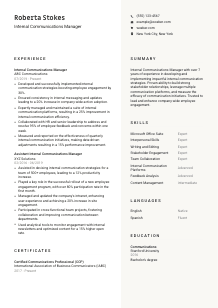
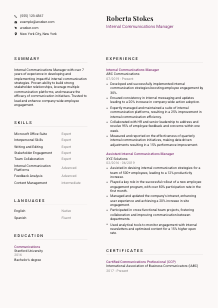
Bridging messages, but your CV feels like a missed memo? Sync up with this Internal Communications Manager CV example, created with Wozber free CV builder. Learn how to shape your corporate communications strengths to match job needs, making your career story a team favorite, not just filed away in the inbox!
Internal communications work is judged in everyday execution. Leaders rely on this role to translate strategy into messages employees actually understand, trust, and act on across channels like intranets, newsletters, executive updates, and town halls. Your CV needs to show that you can bring order to company messaging, keep communication consistent, and improve engagement in measurable ways.
A tailored CV helps hiring teams quickly separate broad communications experience from true internal communications leadership. When your wording reflects the employer's language around employee engagement, platform management, stakeholder collaboration, and reporting, an ATS-compliant CV becomes much easier to rank for the right reasons. Wozber's free CV builder helps structure that alignment cleanly, so your CV makes it clear you can manage the channels, messaging cadence, and communication outcomes this role depends on.
This section is simple, but it still carries hiring value. For an Internal Communications Manager, it should present you as organised, accessible, and already aligned with practical filters such as title, contact reliability, and location when the posting names one.
Use your full name in a clear, readable format with no distractions. Internal communications is a detail-sensitive field, and even the top line of your CV should reflect good presentation standards.
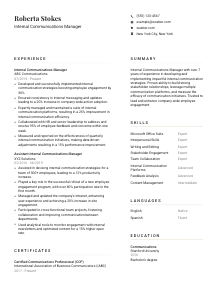
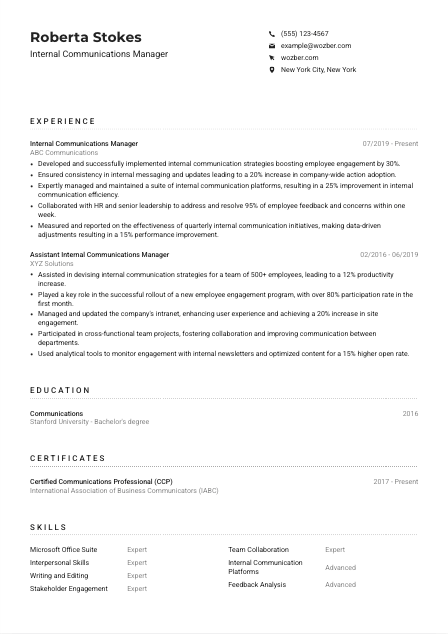
Place "Internal Communications Manager" directly under your name if that is the role you are targeting. Matching the posted title helps with ATS sorting and immediately frames your background around internal messaging, employee engagement, and communication strategy rather than broader marketing or PR work.
Include a working phone number and a professional email address. Since this role depends on credibility and polished written communication, avoid casual email handles and double-check for typos before sending.
If a posting specifies a city, list your city and state so that requirement is easy to confirm. In the example here, "New York City, New York" belongs in the header because the employer made location part of the screening criteria.
A LinkedIn profile or personal website can reinforce your experience, especially if it reflects communications leadership, internal campaigns, editorial work, or cross-functional initiatives. Make sure it matches the dates, titles, and tone used on your CV.
Your personal details should remove friction. A hiring team should be able to confirm who you are, how to reach you, what role you are targeting, and whether you meet any location requirement within seconds.




For this role, experience matters most when it shows communication strategy in action. Hiring teams want to see how you handled company updates, employee-facing channels, leadership messaging, feedback loops, and performance reporting, then what changed because of your work.
Start by pulling out the responsibilities that define the role, then match them to your own history. For an Internal Communications Manager, that usually includes strategy development, message consistency, intranet or newsletter ownership, town hall support, stakeholder collaboration, and measuring engagement or adoption. Your bullets should show where you have already done those things, not just that you worked in communications.
List positions in reverse chronological order with title, employer, and dates. If you have held roles such as Internal Communications Manager, Communications Manager, or Employee Communications Lead, those titles should be prominent. The example CV does this well by moving from assistant-level work into a manager role, which makes career progression visible without extra explanation.
Replace task-only bullets with results tied to employee engagement, message adoption, platform usage, response time, or campaign performance. "Managed internal newsletter" says very little. "Improved newsletter open rates by 15% after refining content and cadence" shows editorial judgment and measurement discipline. The same applies to town halls, intranet updates, leadership announcements, and employee programs.
Quantify impact where you can with numbers that make sense for the function. Useful measures include engagement increases, open rates, participation rates, action adoption, content turnaround, employee response resolution, and channel efficiency. In the sample, a 30% boost in employee engagement and a 95% feedback resolution rate within one week give hiring teams a concrete read on effectiveness.
Every bullet should strengthen your case for this specific function. Keep the emphasis on employee-facing communication, executive alignment, culture initiatives, collaboration with HR or leadership, and reporting on what worked. If a past role included unrelated marketing or general admin work, keep only the parts that show transferable communication planning, channel management, or stakeholder handling.
Your experience section should show that you can run communication channels, shape clear messaging, work across functions, and improve employee engagement with measurable results. Wozber's ATS CV scanner can help you align those bullets with the language used in the job description so the most relevant experience is easy to spot.
Education is usually not the deciding factor for an experienced Internal Communications Manager, but it still matters when the employer names a degree requirement. Present it clearly so the hiring team can confirm your academic background and move on to your communication work and results.
If the employer asks for a Bachelor's degree in Communications, Public Relations, or a related field, make that easy to find. A Bachelor's degree in Communications, like the one in the example CV, directly supports the requirement and should be listed without burying it under less relevant details.
Include degree, field of study, school name, and graduation year or date. That is usually enough for this level of role. Keep the layout clean so it reads easily in both human review and ATS parsing.
If your degree title closely matches the posting, use the formal wording from your diploma or transcript. That helps ATS alignment and avoids confusion. If your field is related rather than identical, keep the wording accurate and let your experience do the rest of the work.
Most experienced candidates can skip coursework. If you are earlier in your career or moving into internal communications from an adjacent field, a short mention of writing, organizational communication, media relations, or employee engagement projects can add context.
If you have completed relevant seminars, workshops, or communications training, they can reinforce your background, especially when they relate to employee communications, change communication, or executive messaging. Formal certifications such as CCP belong in the certificates section, but education can still show the foundation behind your communication practice.
Education should confirm that you meet the stated academic requirement and support your communications background without taking space away from stronger proof in your experience section. Wozber's ATS-friendly CV template helps keep that structure clean and easy to read.
Certifications are rarely mandatory for internal communications roles, but the right one can strengthen your profile. They are most useful when they show formal development in communication strategy, professional standards, or specialised areas such as employee engagement and organizational messaging.
Choose certifications that reinforce the kind of work the role requires. A credential such as "Certified Communications Professional (CCP)" fits naturally because it supports strategic communication knowledge and professional commitment without feeling generic.
Do not crowd this section with unrelated training. A short, relevant list is stronger than a long list of certificates with no connection to internal content strategy, stakeholder communication, or employee engagement work.
Show the year earned and, if relevant, whether the credential is current. This is especially useful when a certification reflects ongoing membership, renewal, or recent study in a field that evolves with workplace communication practices and channel management.
Internal communications changes with new platforms, employee expectations, and leadership communication needs. Recent certifications or training can support your case if they show development in areas like digital communication channels, change communication, measurement, or editorial planning.
Certificates work best when they sharpen your professional profile rather than carry it. For internal communications roles, they should reinforce your strategic communication background and your investment in doing the work at a high standard. Wozber's ATS optimisation features can help place these credentials where they support the rest of your CV naturally.
A strong skills section for an Internal Communications Manager should read like the operating toolkit of the job. That means a mix of communication craft, stakeholder ability, platform fluency, and measurement skills that support employee-facing messaging across the business.
Start with the skills the employer already named. Here, that includes writing and editing, internal communication platforms, Microsoft Office Suite, interpersonal skills, relationship-building, and collaboration across levels of the organisation. Those terms belong on the CV when they reflect your real strengths.
Prioritise capabilities that help you deliver better communication, not vague descriptors. Strong examples include stakeholder engagement, executive communications, newsletter production, intranet content management, feedback analysis, employee engagement, content planning, and communication measurement. The sample CV's mix of writing and editing, stakeholder engagement, and feedback analysis is a solid model.
Put the most job-critical skills near the top so a hiring team quickly sees your value. For this role, written communication, editing, internal platform management, and cross-functional collaboration usually deserve earlier placement than broader or less essential skills.
This section should sound like the toolkit of someone who runs internal communications programs, not a generic communications professional. Wozber's free CV builder can help you organise those skills in an ATS-friendly way while keeping the language close to the employer's terminology.
Language skills matter differently in internal communications than they do in many other roles. Clear English writing is often a baseline requirement because this job involves drafting updates, editing executive messages, and shaping content employees rely on to understand company direction.
If the posting specifically requires clear English writing, list English prominently with an honest proficiency level. In this example, marking English as "Native" directly supports the employer's stated expectation.
Order languages by usefulness to the role and your level of fluency. For most Internal Communications Manager applications in the US, English will come first because it supports the core writing and editing work of the job.
Extra languages can strengthen your profile if the company has multilingual teams, distributed offices, or a diverse employee base. A language like Spanish may be helpful in some organizations because it broadens reach for employee communications, even when it is not formally required.
Use clear labels such as Native, Fluent, Advanced, or Conversational, and keep them truthful. Internal communications often involves nuance, tone, and policy-sensitive wording, so overstating language ability can quickly become a problem.
If you have used another language in employee updates, training materials, or cross-office communication, that is worth noting elsewhere in your CV. Here, the language section simply establishes capability and can support roles with broader workforce communication needs.
For this profession, language details should confirm that you can handle clear employee communication and, where relevant, support a broader workforce. Wozber's ATS-friendly CV format keeps this section easy to scan without distracting from your communication results.
Your summary should quickly place you in the right lane. For an Internal Communications Manager, that means showing years of relevant experience, the kind of communication work you lead, and the business or employee outcomes your work improves.
Start with the main themes in the posting. Here, that means internal communication strategy, clear writing, platform management, stakeholder collaboration, and measuring effectiveness. Your summary should reflect those priorities in a compact form rather than offering a broad statement about being a communications professional.
Lead with your title and total relevant experience. A line such as "Internal Communications Manager with over 7 years of experience" works because it immediately establishes seniority and aligns with a posting that asks for 5+ years in the field.
Mention the parts of your background that matter most for internal communications hiring, such as improving employee engagement, managing communication channels, partnering with leadership, or reporting on campaign performance. The example summary does this well by pairing strategy with platform use and measurement.
Aim for three to five lines with no filler. Every phrase should help explain what kind of internal communications leader you are, whether that is someone who strengthens message consistency, improves channel performance, or builds trust across the organisation.
A well-written summary should make a hiring team expect strong internal communication strategy, polished writing, and measurable engagement results before they even reach your experience section. Wozber's free CV builder helps shape this section into an ATS-compliant introduction that supports the rest of your CV.
An Internal Communications Manager CV should make one thing easy to understand. You know how to turn company priorities into clear employee communication, manage the channels that carry those messages, and track whether people respond.
Once each section reflects that through relevant titles, clean structure, strong metrics, and language that matches the posting, your application reads with much more credibility. Wozber's ATS-friendly CV templates and ATS CV scanner can help you tailor those details into a CV that is easier to parse, easier to rank, and easier for a hiring team to trust.
That is the standard your CV should now meet.