



Use Wozber and land your dream job
Create CV
No registration required
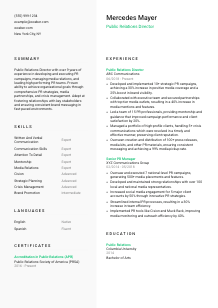
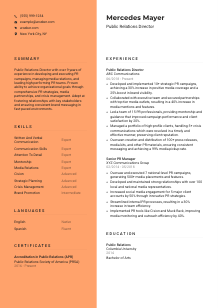
Spinning headlines, but your CV feels buried in the back pages? Step up with this Public Relations Director CV example, created with Wozber free CV builder. Learn how to position your strategic narratives in sync with job expectations, making your career trajectory newsworthy and always in the spotlight!
Public Relations Director hiring usually turns on one practical question: can you shape the public narrative when visibility is high, scrutiny is real, and the message has to hold across media, leadership, and crisis response. Your CV needs to show that range clearly. Hiring teams expect to see campaign strategy, press leadership, reputation management, and team oversight translated into outcomes such as stronger media coverage, higher brand visibility, or steady handling of sensitive issues.
A tailored CV changes how quickly that story comes through in both human review and ATS screening. When your wording reflects the posting's priorities, such as national campaign execution, media relationships, crisis communications, and PR platform experience, Wozber's free CV builder helps shape that experience into an ATS-compliant CV that surfaces your leadership scope early. That makes it easier for a hiring team to recognize whether you can lead the organisation's voice, not just contribute to it.
In PR leadership roles, the header does more than identify you. It establishes professionalism, seniority, and practical alignment before anyone reaches your campaign history. Keep it clean, direct, and consistent with the level of responsibility attached to a Public Relations Director role.
Use your full name as the most prominent text in the header so it reads like an executive identifier, not an afterthought. Public relations is a visibility-driven field, and senior candidates benefit from a polished presentation that feels as controlled as a well-prepared media statement.
Place "Public Relations Director" directly beneath your name when that is the role you are pursuing. This helps align your CV with the target opening and keeps your positioning clear in ATS parsing and recruiter review, especially when your recent title is close but not identical, such as Senior PR Manager.
List a reliable phone number and a professional email address with no distractions. PR leaders are often contacted quickly for interviews, portfolio requests, or follow-up conversations about campaign scope, stakeholder management, and media experience, so accuracy matters.
If the posting calls for New York City, NY, include that location when it applies or make your relocation status clear. For this opening, location is a stated requirement, so meeting it in the header removes an avoidable objection before the hiring team gets into your experience.
Include a LinkedIn profile or personal site if it strengthens your candidacy with speaking appearances, media coverage, thought leadership, or campaign work. Just make sure the titles, dates, and leadership scope match your CV, because inconsistencies are especially noticeable in communications roles.
This section should confirm that you are reachable, appropriately positioned, and practically available for the role. In PR leadership hiring, that clarity helps the reader move straight to your campaign results and media leadership.




For a Public Relations Director, the experience section carries most of the decision weight. Hiring teams look for evidence that you have run campaigns, managed reputation risk, worked credibly with executives and media, and led a team that can deliver consistent messaging under pressure.
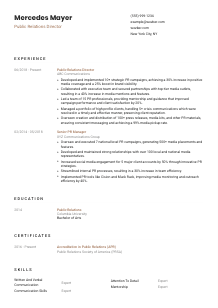
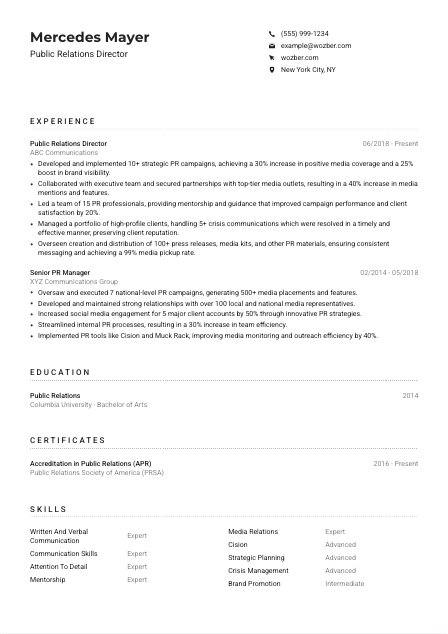
Prioritise achievements that map directly to the opening's demands, especially campaign strategy, media relations, crisis communications, and team leadership. The example CV does this well by opening with strategic PR campaigns, measurable media coverage gains, and executive collaboration, which immediately matches the leadership scope of the job description.
List roles in reverse chronological order and make each one easy to scan: company, title, dates, then accomplishment bullets. For senior PR roles, your bullets should show what you led, who you worked with, what channels or stakeholders were involved, and what changed as a result, whether that was media pickup, brand visibility, or team performance.
Numbers matter when they reflect how communications work is actually evaluated. Include campaign counts, media placements, pickup rates, audience reach, engagement lifts, response time in crisis situations, or improvements in brand visibility. Results like "30% increase in positive media coverage" or "500+ media placements" give your claims weight because they tie strategy to public outcomes.
At director level, broad communications experience only helps if it supports the target role. Emphasize national or local campaign execution, press materials, spokesperson coordination, media outreach, crisis handling, and reputation management. If you have unrelated work, trim it back so your CV reads as a progression toward PR leadership rather than a general communications background.
This role asks for managerial experience, so your bullets should show how you led people, not just projects. Include team size, mentoring responsibilities, workflow improvements, or performance outcomes. A line like leading 15 PR professionals and improving campaign performance gives a hiring manager a concrete view of your leadership range, not just a leadership label.
Your experience section should show increasing ownership over message strategy, media relationships, and team direction. By the end of it, a hiring manager should be able to picture you leading campaigns, guiding staff, and handling reputational pressure at director level.
Education is rarely the deciding factor for experienced PR leaders, but it still establishes that you meet the formal baseline and understand the discipline behind the work. Present it cleanly, with enough detail to confirm relevance without letting it crowd out your campaign track record.
Start with the credential that directly answers the posting. Here, a bachelor's degree in Public Relations, Communications, or a related field is required, so a degree such as a BA in Public Relations should be easy to spot. If you also hold a master's degree, include it prominently because this employer lists it as preferred.
Use a simple structure with school, degree, field of study, and graduation year or date. For senior candidates, that is usually enough. A clear format keeps attention where it belongs, on the leadership and campaign work that qualify you for a director seat.
When your field of study connects directly to public relations, corporate communications, journalism, or strategic communications, make that connection visible. In the example, "Bachelor of Arts" paired with "Public Relations" works well because it mirrors the role's academic expectation without overexplaining.
Courses, student media work, communications societies, or graduate research can be useful if they reinforce your PR specialization. For a seasoned applicant, these details are optional and should stay brief unless they clearly support media strategy, writing, or leadership development.
Honors, leadership roles, or notable academic projects can stay if they show early strength in communication, research, or public-facing work. Keep them concise. At director level, they should complement your professional record rather than compete with it.
This section should confirm that you satisfy the academic criteria and have relevant training in communications. Once that is clear, your CV should return quickly to the campaign outcomes and leadership experience that matter most for this level.
Certifications are not mandatory for every Public Relations Director role, but they can reinforce subject-matter credibility and commitment to the profession. In communications hiring, the most useful credentials are the ones that connect directly to reputation management, media practice, and strategic PR standards.
When a posting names a certification, give it space. This one lists APR as a plus, so including "Accreditation in Public Relations" helps show added professional standing. If a credential appears in the job description, do not bury it below less relevant certificates.
Choose certifications that support the work of a PR leader, such as media relations, crisis communication, brand reputation, or strategic communications. A short, focused list is stronger than a long catalogue that drifts into tools or topics with little connection to director-level responsibilities.
List the year earned and, where relevant, an active status. In a field shaped by changing media channels, audience behaviour, and reputation risk, current credentials suggest you stay engaged with professional standards rather than relying only on older experience.
Show the certification name, issuing body, and date in a format that is easy to scan. The example's APR entry works because the credential is instantly recognizable, the issuer is clear, and the timing supports the candidate's continuing professional development.
A certification section should strengthen your profile where it matters, especially when it supports strategic PR judgment or matches a stated preference. It works best as a credibility booster alongside a results-driven experience section.
A Public Relations Director skills section should read like the operating toolkit behind campaign performance and reputation management. Focus on capabilities that support planning, media execution, issue response, team leadership, and the platforms used to run modern PR workflows.
Start with the skills the employer explicitly values, then match them with wording that reflects your actual experience. For this role, that includes written and verbal communication, attention to detail, leadership, strategic campaign development, media relations, and PR tools such as Cision or Muck Rack. This approach strengthens ATS alignment without sounding forced.
Director-level PR work sits across several layers of responsibility. Include a mix of strategic planning, crisis management, media relations, messaging, stakeholder communication, mentorship, and platform proficiency. The example CV handles this well by combining communication strengths with Cision, strategic planning, and crisis management rather than listing only soft skills.
Avoid turning this section into a full inventory of everything you can do. Keep the list tight and relevant to senior PR leadership. If a skill does not help you run campaigns, manage media, guide a team, or protect brand reputation, it probably does not need to be here.
Your skills should reinforce what the rest of the CV already proves: that you can lead public relations strategy, manage high-stakes communication, and use the tools and judgment the role requires.
Language ability matters in PR because meaning, nuance, and tone carry real consequences across media statements, executive messaging, and stakeholder communication. Include languages when they support the role's requirements or widen the audiences you can serve.
If the posting specifies language capability, reflect it directly. Here, the employer requires the ability to read complex texts in English, so English should be listed with an honest proficiency level. For communications leadership roles, that detail matters because the work involves reviewing nuanced materials, press copy, and sensitive messaging.
Extra languages can strengthen your profile when they support multilingual audiences, international media, or culturally varied stakeholder groups. Spanish, for example, can be a real asset in outreach, spokesperson preparation, or campaign adaptation across broader markets, even when it is not required.
Stick to plain terms such as Native, Fluent, Professional, or Conversational. PR leaders are often expected to review copy, handle media interactions, or adapt messaging quickly, so vague labels do not help anyone understand your actual working level.
Include languages that reflect the scale of the environments you work in. If your background includes regional, national, or international communications programs, language skills can reinforce your ability to tailor messages across markets and audiences with fewer translation gaps.
Language skills should clarify how you operate in real communications settings, whether that means meeting a posting's English requirement or supporting broader media and stakeholder reach.
The summary is where you establish your level in a few lines. For a Public Relations Director, it should quickly frame your years of experience, leadership scope, and strongest areas of PR execution so the reader understands the scale of your work before scanning the rest of the CV.
Read the posting closely and identify the themes that define the role. Here, the big ones are strategic campaign execution, media relations, crisis communication, leadership, and strong written communication. Your summary should reflect those priorities in a concise form rather than trying to cover every detail of your background.
Start with who you are professionally and how long you have worked in PR. A line such as "Public Relations Director with over 9 years of experience" works because it establishes seniority immediately and fits the posting's requirement for 8+ years in the field.
Use the next sentence to name the areas where you create results, such as leading local and national campaigns, securing media coverage, managing crisis communications, and guiding PR teams. The example summary is effective because it links campaign execution, media partnerships, and crisis management into one coherent leadership profile.
Aim for a short paragraph with concrete language and no generic claims. Public relations leaders are expected to communicate with precision, so your summary should sound controlled and credible. Save the detailed metrics for the experience section, but make sure the summary points toward them.
When this section is working, the reader understands your level, your PR strengths, and the kind of organizational visibility you are ready to manage. It should frame you as someone prepared to lead the message, the media strategy, and the team behind it.
Your CV should now present a clear case for Public Relations Director work: campaign leadership, media judgment, crisis response, and team management backed by measurable outcomes. Keep the language close to the target role, especially where the posting emphasizes leadership years, PR tools, executive communication, and local or national campaign experience.
Use Wozber's free CV builder to organise that experience into an ATS-friendly CV format, then refine it with the ATS CV scanner and AI-driven tailoring features so the right terminology, tools, and responsibilities show up in the right places. The finished CV should make one conclusion easy to reach: you can lead public relations strategy with credibility and control.