



Use Wozber and land your dream job
Create CV
No registration required
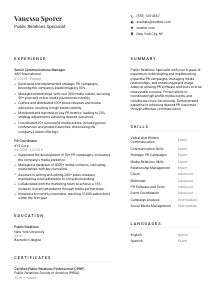
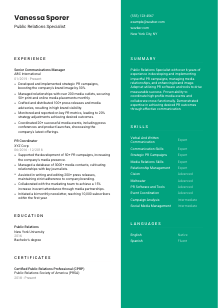
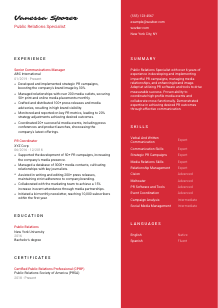
Crafting stories, but your CV feels PR-less? Check out this Public Relations Specialist CV example, created with Wozber free CV builder. It shows how to align your narrative chops with job narratives, making your PR career the talk of the town and the top of the talent pool!
Public relations work is measured in public outcomes. A hiring team wants to see whether you can shape a message, earn credible media attention, and manage the day-to-day relationships that keep campaigns moving across print, digital, broadcast, and live events. Your CV should make that visible quickly through placements, campaign outcomes, press materials, and media coordination.
When PR experience is tailored well, the difference shows up fast. Wozber's free CV builder helps you align your background with the posting in an ATS-friendly CV format, so keywords such as media relations, press releases, campaign strategy, and PR metrics appear in the right context. That makes it easier for reviewers to recognize whether you've handled the kind of outreach, reporting, and brand exposure this Public Relations Specialist role requires.
PR is a communication discipline, and that expectation starts before anyone reads your experience bullets. The personal details section should look clean, current, and professional, with no friction around contactability, title alignment, or location when the posting calls it out.
Your name should be the most visible line on the page. Use a clear format and slightly stronger visual weight so it stands out immediately, much like the header on a press release or media brief.
Place "Public Relations Specialist" under your name when that is the role you are pursuing. This gives immediate context and helps ATS matching, especially when your current title is adjacent, such as Communications Manager or PR Coordinator.
List a current phone number and a professional email address. PR hiring often moves through quick outreach for interviews or writing tests, so make sure the basics are accurate and easy to scan.
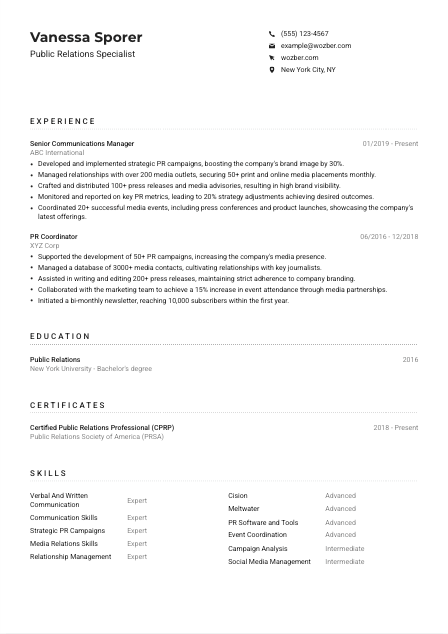
If the employer requires someone in New York City or open to relocation, say so clearly in this section. In the example CV, listing New York City, NY removes a practical question before it becomes a screening issue. Only do this when location is relevant to the job you are targeting.
A LinkedIn profile or personal website can strengthen a PR application, especially if it reflects your campaign work, media exposure, writing samples, or portfolio materials. Make sure the content matches your CV language and career level.
This section should answer three practical questions without delay: who you are, what PR role you are targeting, and how easily an employer can contact or place you. Clean details help the rest of your CV do its job.




Experience carries most of the decision in PR hiring. Employers are looking for someone who can plan campaigns, maintain journalist relationships, write usable materials, track coverage, and support launches or events without losing the brand message.
Start by marking the responsibilities and requirements that repeat or carry the most weight. For this role, that includes strategic PR campaigns, media relations, press releases, PR metrics, and event support. Use that language naturally in your bullets when it reflects real work you have done.
Use reverse chronological order and include your title, employer, and dates. In PR, titles often signal level of ownership, so a progression from PR Coordinator to Senior Communications Manager tells a useful story about increasing responsibility for campaigns, media outreach, and stakeholder management.
Do not stop at "responsible for media relations" or "wrote press releases." Show what happened because of that work. The sample CV does this well by tying campaign execution to a 30% brand image boost and media outreach to 50+ placements per month. That kind of detail tells a hiring manager you understand both output and outcome.
Numbers are especially persuasive in PR when they reflect media activity and campaign performance. Include metrics such as placements secured, journalist lists managed, releases distributed, event attendance growth, subscriber growth, share of voice improvement, or strategy adjustments based on reporting. These are measures PR teams use to judge effectiveness.
Prioritise experience that supports the job you want now. For a Public Relations Specialist CV, bullets about media contacts, brand messaging, launches, monitoring coverage, and stakeholder coordination deserve more space than unrelated communications tasks. Relevance is more convincing than volume.
Your experience section should show that you can do more than support communications in general. It should make clear that you have run or contributed to PR work that earned coverage, strengthened brand presence, and held up under measurement.
Education is usually a straightforward section in PR CVs, but it still matters. Many postings ask for a bachelor's degree in public relations, communications, journalism, or a related field, so this section should confirm that requirement without making the reader search for it.
If the employer asks for a bachelor's degree in Public Relations, Communications, Journalism, or a related field, list that degree clearly. The example CV does this directly with a bachelor's degree in Public Relations, which immediately answers the requirement.
Format the entry so the degree, field, school, and graduation year are easy to find. A simple structure works best here because the hiring team is usually checking qualification match, not looking for decorative detail.
If your degree is in a related discipline rather than PR itself, make the connection visible. Communications, journalism, marketing, English, or similar fields can still support a PR application when your coursework or early work shows writing, messaging, or media-facing preparation.
Relevant coursework, thesis work, student media, or communications projects can help if you are early in your career or shifting into PR. Keep it focused on skills that matter in the field, such as media writing, strategic communication, audience research, or event promotion.
Awards, leadership roles, debate, student publications, PRSSA involvement, or campaign competitions can add useful context when they show writing ability, public messaging, or stakeholder communication. Skip items that do not support your PR story.
This section does not need much space, but it should remove any doubt that you meet the educational baseline. If your degree also reinforces your training in media writing or communications strategy, that is a useful bonus.
Certifications are not always required in public relations, but the right ones can strengthen your profile, especially when they show continued development in media relations, communications strategy, or PR tools. Use this section to add signal, not clutter.
Start with the job description. This one does not require a certification, so certificates are supporting material rather than a gatekeeping item. That means you should only include credentials that reinforce your PR practice.
Prioritise credentials tied to public relations, communications, reputation management, media training, analytics, or relevant platforms. A certification such as CPRP can strengthen your profile because it points to recognized professional standards in the field.
If the certification has an issue date, renewal cycle, or active status, include it. In a field shaped by changing media channels, reporting tools, and digital communication practices, current credentials carry more weight than outdated ones.
PR teams increasingly value people who can work across media databases, monitoring platforms, analytics dashboards, and event communications. Adding newer learning in those areas can help, especially if the role mentions tools such as Cision or Meltwater.
A certificate section works best when it supports the kind of PR work you want to do next. Keep only the credentials that add professional relevance or show that your methods and tools are current.
The skills section should read like a concise map of how you operate as a PR professional. Hiring teams look for a mix of communication ability, campaign execution, media relationship management, writing strength, and familiarity with the tools used to track outreach and coverage.
Start with the exact abilities the role emphasizes. Here that includes compelling messaging, press release writing, media relations, stakeholder management, and proficiency with PR software such as Cision or Meltwater. These should appear in your skills section if they match your background.
Use skills labels that line up with the posting and with common PR terminology. "Strategic PR Campaigns," "Media Relations," "Press Release Writing," and "Event Coordination" are stronger than vague entries because they reflect recognizable work areas in the field.
Order matters. Lead with capabilities that are central to day-to-day success in the target role, then follow with platform knowledge and supporting skills. In the example CV, communication, campaign strategy, media relations, Cision, Meltwater, and event coordination create a clear picture of practical PR capability.
A useful PR skills section should help the reader picture how you contribute, from message development to media outreach to campaign reporting. Keep it specific enough that each skill points to real work you can discuss in an interview.
Language ability can matter in public relations when the audience, media landscape, or stakeholder mix extends beyond one market. Even when a role is primarily English-based, listing language skills correctly helps clarify communication range and client-facing readiness.
If the posting requires professional English, make that explicit. The example lists English as Native, which fully satisfies the requirement. Use the level that truthfully reflects how you write, speak, and handle professional communication.
Additional languages can be useful in PR for regional media outreach, multicultural campaigns, spokesperson support, or international coordination. Include them when they are real working strengths, not just classroom exposure.
Use standard levels such as Native, Fluent, Intermediate, or Basic. PR work often involves nuance in tone, writing, and live communication, so vague labels make it harder to judge how usable the language really is.
A second language can be an asset even if it is not listed in the posting. In some PR environments, Spanish, French, or Mandarin can support media lists, audience segmentation, community outreach, or event coordination. Include it when it is relevant and credible.
If the company works across international markets, multilingual communities, or global media, language skills may carry more weight. Keep the section aligned with the likely communication environment rather than listing every language you have studied.
Language entries should help an employer understand where you can communicate effectively and with what level of polish. For PR roles, that matters most when messaging, outreach, or stakeholder contact crosses markets or communities.
Your summary should sound like someone who understands media, messaging, and outcomes. In a few lines, it should establish your level, your main strengths, and the kind of PR results you have delivered, without drifting into buzzwords or generic communications language.
Start with your title or professional identity, then state your years of experience and main area of value. For example, a Public Relations Specialist with 6+ years in campaign development, media relations, and brand visibility gives the reader an immediate sense of scope.
Build the summary around the work this employer needs done. For this posting, that means strategic campaigns, press materials, journalist relationships, PR tools, and measurable reporting. The sample summary does this effectively by connecting campaign work and media management to brand impact and cross-functional execution.
Aim for three to five lines. That is enough room to mention seniority, core strengths, and one or two outcome themes such as earned media visibility, campaign performance, or event support. Save detailed metrics for the experience section.
End on the value you bring, not a slogan. A line about driving measurable PR outcomes, strengthening brand presence, or managing high-visibility media activity lands better than broad claims about passion or ambition.
A well-written summary should prepare the reader for the evidence that follows. After those first lines, they should already understand your level of PR experience, your media-facing strengths, and the kind of results you are used to delivering.
A Public Relations Specialist CV works best when it makes the operational side of PR easy to see: campaign strategy, media relationships, press materials, event support, and reporting on outcomes. When each section is tailored to the job description, the hiring team can quickly tell whether your experience matches the pace and visibility of the role.
Use Wozber to shape that tailoring into an ATS-compliant CV with focused language, role-specific keywords, and structure that supports ATS optimisation. The final result should make one thing clear at a glance: you know how to turn messaging and media work into measurable brand impact.