



Use Wozber and land your dream job
Create CV
No registration required
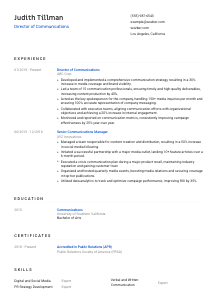
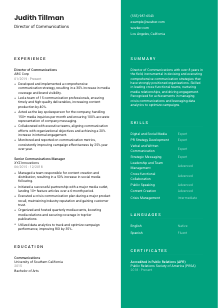
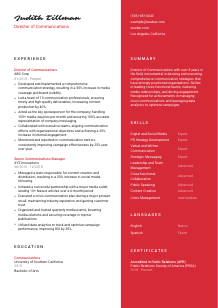
Shouting strategies but your CV isn't broadcasting? Check out this Director of Communications CV example, created with Wozber free CV builder. Learn how to present your communication prowess in line with job requirements, ensuring your career speaks as eloquently as your campaigns!
Communications leadership is judged in public. A Director of Communications is expected to shape the message, guide the response when pressure rises, and keep executives, employees, media, and external audiences hearing the same story. Your CV needs to make that operating range visible quickly through strategy ownership, spokesperson experience, team leadership, and measurable communication outcomes.
Hiring teams usually scan for whether you have led integrated communications work at the right level, not just produced content or managed channels. Wozber's free CV builder helps you align that story in an ATS-compliant CV, so strategy terms like media relations, internal communications, digital engagement, and team oversight are easy to parse and easy to connect to director-level results.
For a communications leader, the header should feel controlled, current, and deliberate. This section is simple, but it still sends a message about professionalism, location fit, and how easy it will be to reach you for media-facing, executive-facing, and leadership-level conversations.
Set your name at the top in a clean, readable style. For a Director of Communications, presentation matters from the first line. A cluttered header undercuts the polish expected from someone who may serve as a spokesperson or oversee high-visibility messaging.
Place "Director of Communications" directly under your name when that is the role you are pursuing. This keeps your positioning consistent with the job ad and helps both recruiters and ATS tools sort you into the right senior communications track.
List a reliable phone number and a straightforward email address based on your name. Communications leaders are often contacted on short timelines, so this information needs to be easy to scan and error-free. If you include a website or portfolio, make sure it supports your executive brand with press work, thought leadership, or major campaigns.
Some roles have a firm location requirement, as this Los Angeles-based opening does. If you already live in the required market, state it clearly in your header. That removes a practical objection immediately and keeps attention on your communications background rather than relocation logistics.
A current LinkedIn profile or professional site can strengthen your application, especially in a field where public positioning, media visibility, and leadership presence matter. Keep titles, dates, and achievements aligned with the CV so your message stays consistent across every channel.
This section should confirm that you are easy to contact, accurately positioned, and already aligned with any practical requirements in the posting. For a Director of Communications, even the basics should feel precise and well-managed.




This is where director-level candidates separate themselves from strong managers. Hiring teams want to see who built the communications strategy, who led the team, who handled the press, and what changed because of that work. Your bullets should read like operating results, not a task list.
Before writing or editing bullets, mark the responsibilities that define the role's level. Here, the central themes are integrated communications strategy, media relations, internal communications, team leadership, spokesperson duties, cross-functional alignment, and performance measurement. Those are the areas your experience section should answer directly.
List roles in reverse chronological order and make the growth in scope obvious. A move from Senior Communications Manager to Director of Communications tells a useful story when the bullets also show larger teams, broader channel ownership, crisis visibility, or closer work with executives and organizational priorities.
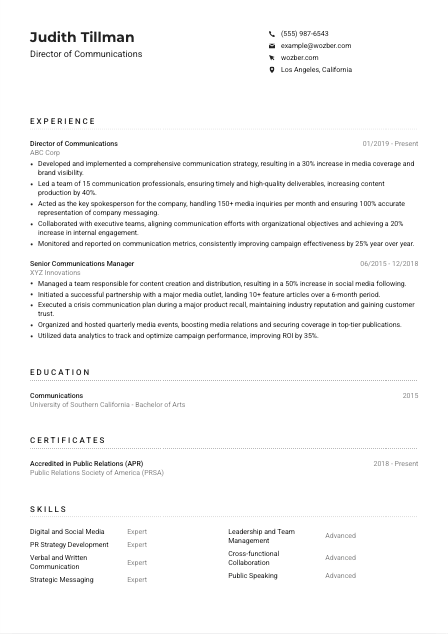
Director-level CVs need accomplishments with business or reputation impact. Instead of saying you "managed media relations," show what that produced. The sample does this well with results like a 30% increase in media coverage, 20% higher internal engagement, and year-over-year campaign improvement. Those numbers make strategy execution tangible.
Numbers carry real weight in communications hiring when they reflect the scope of your work. Include team size, media inquiries handled, campaign reach, content output, engagement lift, coverage volume, event cadence, or ROI improvements where they are accurate. A bullet such as leading 15 communications professionals or handling 150+ media inquiries per month immediately shows operational scale.
Trim accomplishments that belong to a coordinator or specialist profile unless they support a bigger leadership story. Prioritise examples that show message stewardship, executive partnership, crisis handling, integrated planning, and metrics-driven improvement. The section should leave no doubt that you can lead a communications function, not just contribute to one.
Your experience section should show that you can set the communications agenda, manage the people delivering it, and measure whether it worked. If those three points are clear, your CV is speaking the language of the role.
Education is rarely the deciding factor for a senior communications hire, but it still needs to answer the posting cleanly. Keep it concise, relevant, and easy to verify, especially when the employer asks for a degree in communications, public relations, or a related field.
When a posting specifies a bachelor's degree, make sure your education section states the degree, field, school, and graduation year clearly. For this role, a Communications or Public Relations degree lines up naturally, and a related field can work if the rest of the CV strongly supports your communications background.
Avoid crowding this section with unnecessary detail. A clean line for degree, field, institution, and year is usually enough for a Director of Communications CV. Hiring teams want to confirm the credential quickly and move back to the experience that shows strategy, media judgment, and leadership.
If your degree directly matches the field, that is already useful. The example's Bachelor of Arts in Communications from the University of Southern California works because it answers the requirement without forcing extra explanation. Use that same principle even if your school or degree path differs.
Most senior candidates do not need coursework, but it can help if your degree title is broader or if you want to reinforce expertise in areas such as crisis communication, digital media, corporate messaging, or public relations. Include it only when it clarifies your preparation for the work.
Advanced learning matters in communications because channels, audience behaviour, and reputation risks keep shifting. If you have additional training, executive education, or industry credentials, keep the education section focused and let the certifications section carry that continuing-development story.
This section should confirm that you meet the academic baseline and let the rest of the CV prove your senior communications range. Clear, relevant, and brief is the right standard here.
Certifications are not mandatory for most Director of Communications roles, but the right one can reinforce expertise in public relations, messaging, crisis response, or executive communication. At this level, certifications work best as credibility markers, not filler.
Start with certifications that support the kind of communications work you want to lead. Public relations, crisis communication, digital strategy, media training, or executive leadership programs can all add value when they connect to the responsibilities in the target role.
Choose certifications that make sense for a senior communications leader rather than listing every short course you have taken. The APR credential in the sample is a good example because it supports strategic PR credibility and professional standing in the field.
Dates help employers understand whether a certification is current, active, or recently earned. That matters in communications, where media practice, digital channels, and audience behaviour change quickly. A clean date range is enough.
Senior communicators are expected to keep up with evolving channels, crisis expectations, and stakeholder communication practices. A short, relevant certifications section can show that you continue to sharpen your judgment beyond formal degree work.
A certification will not replace executive-level experience, but it can sharpen your profile when it supports the work you are expected to lead. List the credentials that add real authority to your communications background.
The skills section should function like a fast executive snapshot. For a Director of Communications, that means a mix of strategic, managerial, and channel-specific capabilities that match how communications leadership is actually delivered across teams, media, and internal stakeholders.
Use the job description to identify the language the employer already uses. In this case, that includes written and verbal communication, digital and social media, team management, and communication strategy development. Mirroring those terms helps with ATS optimisation and keeps your CV aligned with the role.
Put strategic and leadership skills near the top, not just execution tools. For this role, skills like PR strategy development, strategic messaging, leadership and team management, media relations, and cross-functional collaboration should carry more weight than narrower production tasks.
A long skills list can dilute your positioning. Choose the capabilities that support director-level communications work across planning, spokesperson responsibilities, digital channels, and internal messaging. The example works because it stays close to what the employer asked for instead of drifting into unrelated software or generic soft skills.
This section should confirm that you can lead messaging, manage people, and work across the channels that matter to the organisation. If the skills list reads like a communications leader's toolkit, it is doing its job.
For communications leadership, language proficiency is more than a nice addition when it affects spokesperson work, media handling, internal messaging, or community reach. The section should stay accurate and concise, with the required working language stated clearly.
If the role requires an English-speaking work environment, list your English proficiency directly. That removes ambiguity for a position built around message quality, executive communication, and public-facing accuracy.
Additional languages can strengthen your profile when they are relevant to the market, stakeholder base, or media environment. In a diverse region, fluency in Spanish or another widely used language may support community engagement, bilingual messaging, or broader media outreach.
List languages that you can actually apply in meetings, interviews, stakeholder communication, or content review. For a communications leader, overstating proficiency is risky because language ability may be tested quickly in real interactions.
Use plain labels such as Native, Fluent, Advanced, or Conversational. Clear proficiency levels help employers understand whether a language is suitable for spokesperson duties, internal communication, or only limited support.
Some Director of Communications roles are heavily local, while others support national, multilingual, or international audiences. Let the likely audience mix guide whether additional languages deserve space on the page.
This section should clarify your ability to communicate in the environments the organisation actually serves. Keep it honest, relevant, and tied to audience reach.
The summary is your opening argument for why you belong in a director-level communications seat. It should quickly place you at the right level of seniority and point to the areas where you create value, such as strategy, media leadership, internal messaging, crisis response, or team oversight.
Start with a direct line that states your title or specialization and your years in communications. For this posting, something like "Director of Communications with 8+ years in strategic communications and public relations" immediately frames your background at the right level.
Use the next sentence or two to show the scope of your work. Focus on integrated communication strategy, media relations, spokesperson responsibilities, executive alignment, team leadership, and digital engagement if those reflect your experience. The sample summary works because it points to strategy execution, cross-functional leadership, and campaign optimisation rather than broad claims alone.
A summary gains credibility when it includes specific outcomes or recognizable strengths. You might reference increased media coverage, stronger internal engagement, successful crisis communication, or data-informed campaign improvement, depending on your background.
Stay within 3 to 5 sentences and remove anything that belongs elsewhere on the CV. The summary should align with the employer's priorities and set up the rest of the document, not repeat every skill or accomplishment in compressed form.
When the summary is tailored well, it tells the reader within seconds that you have already been operating at the level the role demands. That makes the rest of the CV easier to trust and easier to read in context.
A Director of Communications CV should show who you can lead, which messages you can steward, and what outcomes your communication strategy has driven. When your experience, skills, and summary all point to integrated planning, media judgment, team leadership, and measurable impact, the hiring team can picture you in the role with much less guesswork.
Use Wozber's AI CV builder to tighten that alignment, surface the right terminology from the job description, and strengthen ATS optimisation in an ATS-friendly CV format. The finished CV should make one conclusion easy to reach: you are ready to lead the organisation's voice.




