



Use Wozber and land your dream job
Create CV
No registration required
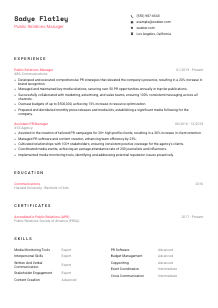
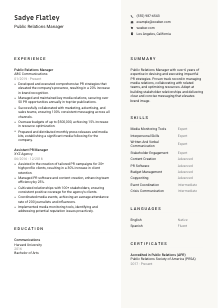
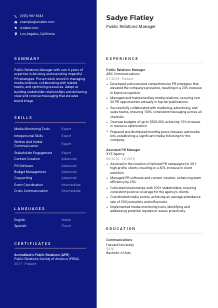
Spinning narratives but feeling your CV is lost in the newsprint? Communicate your story with this Public Relations Manager CV example, created with Wozber free CV builder. Learn how to present your reputation management expertise and media relations skills to match job specs, painting your professional profile as bright as the press conference flashlights!
Public relations managers are hired to shape how a company is seen when attention is high, messaging has to stay tight, and every media interaction can affect brand trust. A CV for this role needs to show more than general communications experience. It should make clear that you can develop campaigns, manage press relationships, and keep the story consistent across teams and channels.
Hiring teams often scan first for the kind of PR work you have actually led, from earned media placements to press materials and budget ownership. Using Wozber's free CV builder helps you tailor that experience into an ATS-compliant CV with the right terminology, so your background reads clearly as PR leadership rather than broad marketing or content support. That distinction matters early.
For public relations roles, the header does quiet but important work. It tells the employer whether you are easy to contact, professionally presented, and already aligned with key practical requirements before they even reach your experience section.
Place your full name at the top in a clean, readable format. PR work is tied to recognition and credibility, so avoid decorative styling. Keep it polished and straightforward, the same way you would present a spokesperson bio or media contact line.
Add "Public Relations Manager" directly beneath your name if that is the role you are pursuing. Matching the target title helps frame the rest of the CV around media strategy, stakeholder communication, and brand visibility instead of leaving room for your background to be read as general communications support.
Use a reliable phone number and a professional email address, ideally a simple variation of your name. In PR, where responsiveness and polished communication matter, even small details in your contact block contribute to the impression that you can represent a brand well.
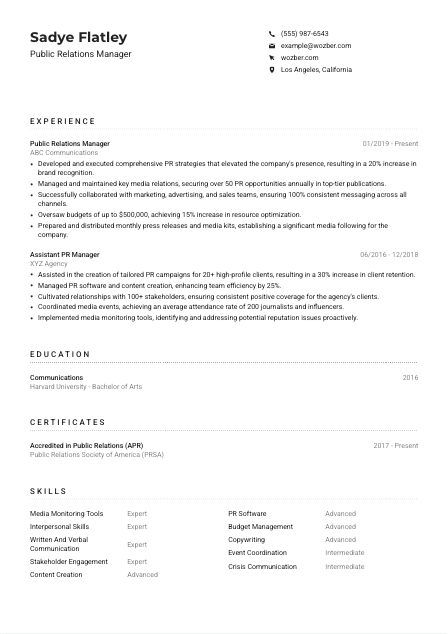
If a role includes a location requirement, state your city and state clearly. Here, Los Angeles, California is part of the stated criteria, so listing it removes a basic point of doubt. For other applications, only include location when it helps confirm availability or regional relevance.
Include a LinkedIn profile or personal site if it supports your candidacy with relevant material such as campaign highlights, press coverage, speaking appearances, or portfolio samples. For a public relations manager, an online presence should reinforce your media-facing credibility, not distract from it.
This top block should confirm that you are professionally presented and ready to be contacted for a media-facing leadership role. Keep it clean, accurate, and aligned with any practical requirement the posting calls out.




This is the section where public relations hiring decisions usually sharpen. Employers want to see whether you have actually driven coverage, shaped messaging, managed relationships with media and stakeholders, and delivered measurable visibility or reputation outcomes.
Start by identifying the work the employer needs most. In this posting, that includes building PR strategy, securing media opportunities, coordinating with marketing and sales, handling press materials, and managing budget use. Those priorities should guide which achievements you surface first and how you phrase them.
List your most recent role first, then work backward with company name, title, and dates. For PR managers, career progression matters. Moving from support or assistant-level communications work into campaign ownership, media management, or client leadership gives the reader a fast sense of scale and readiness.
Write bullets that show what changed because of your work. Strong PR bullets mention strategy development, earned media wins, message alignment, stakeholder handling, event execution, or crisis response, then tie those efforts to outcomes. The sample CV does this well with specifics like securing more than 50 PR opportunities annually and distributing monthly press materials that built a stronger media following.
Use metrics that fit the field, such as brand recognition lift, media placements, press event attendance, budget size, client retention, response time, share of coverage, or resource efficiency. Numbers are especially persuasive in PR because they turn relationship-driven work into visible business results. A bullet like "increased brand recognition by 20%" or "managed budgets up to $500,000" gives hiring teams concrete scope to judge.
Keep the focus on experience that supports this role: media relations, messaging, campaign execution, content development, stakeholder communication, agency or in-house collaboration, and reputation management. If an older role is less relevant, trim it to the most transferable parts rather than letting unrelated work crowd out stronger PR evidence.
By the end of this section, the reader should understand the level of PR work you have led, the media and cross-functional relationships you have managed, and the results your campaigns produced. That is what moves you from communications experience to Public Relations Manager territory.
Education is usually a supporting section for an experienced Public Relations Manager, but it still matters when the posting names a degree requirement. Present it clearly so the hiring team can confirm the foundation without having to search for it.
When a job asks for a bachelor's degree in Public Relations, Communications, Journalism, or a related field, make sure your degree and field are easy to spot. In the example, a Bachelor of Arts in Communications aligns directly with the requirement and supports the candidate's credibility from the start.
List degree, field of study, school, and graduation year in a clean order. This section does not need creative formatting. It should read quickly and confirm that you meet the academic baseline for a communications leadership role.
If your studies directly connect to media relations, journalism, strategic communication, or brand messaging, let that alignment stand on its own. Exact or near-exact relevance helps when employers are sorting candidates from agency, corporate, and adjacent marketing backgrounds.
Early-career candidates can include relevant coursework in areas like media writing, crisis communication, public affairs, or strategic communications if professional experience is still limited. For someone with several years in PR management, coursework usually matters less than campaign results and media outcomes.
Awards, student media leadership, communications society involvement, or editorial work can still be worth mentioning if they connect to PR skills like writing, audience messaging, or public-facing communication. Keep these additions brief and relevant, especially if you already have 5+ years of professional experience.
Your education section should confirm that your academic background supports a communications-driven role without taking attention away from your PR achievements. If the degree matches the posting, make that easy to verify.
Certifications are not required in every public relations manager search, but the right one can strengthen your positioning, especially when it reflects professional standards in strategy, ethics, media communication, or reputation management.
Start with the job posting. If a certification is requested or would clearly support the role, include it. Even when no certificate is required, a credential such as APR can reinforce that you bring structured PR knowledge and recognized professional development.
Choose credentials that connect directly to the work, such as public relations, communications strategy, crisis communication, media relations, or digital reputation management. A shorter list of relevant credentials carries more value than a long list of loosely related courses.
Include the year earned and, when relevant, whether the credential is active. That helps the reader understand whether your certification reflects current practice. In the example, listing APR with an active date range signals ongoing professional standing rather than one-off training.
PR changes with media channels, monitoring tools, newsroom behaviour, and stakeholder expectations. Updating your credentials in areas like analytics, social listening, crisis response, or executive communications shows that your knowledge has kept pace with how modern PR teams operate.
A relevant credential can strengthen your CV by adding recognized expertise to the campaign results already shown in your experience section. Keep the list selective and tied to the kind of PR work you want to lead.
A Public Relations Manager skills section should quickly show whether you can handle the tools, communication demands, and coordination required to run effective PR work. The best lists balance technical capabilities with the relationship and messaging skills the role depends on every day.
Read the job ad closely and note both explicit and implied skills. Here, the employer names media monitoring tools, content creation, PR software, stakeholder relationship building, strong communication, and attention to clear messaging. Those should have priority over generic soft skills that could belong to almost any office role.
Lead with the abilities most tied to day-to-day delivery: media relations, stakeholder engagement, written communication, media monitoring, press material development, PR software, campaign strategy, and budget management. The sample CV handles this well by surfacing media monitoring tools, stakeholder engagement, communication, content creation, and budget management near the top.
Avoid turning this section into a keyword dump. Group your strongest skills, use consistent wording, and make sure every item connects to actual work shown elsewhere on the CV. If you claim crisis communication, for example, your experience should support it with reputation management, issue response, or media handling under pressure.
A hiring manager should be able to scan your skills and immediately see that you can run PR programs, manage messaging, and work effectively with media, internal teams, and external stakeholders. Relevance matters more than volume.
Language ability carries real weight in PR because message control, audience nuance, and spokesperson support all depend on precise communication. If a posting names a required language, treat that as a core qualification rather than a minor add-on.
If the role specifies a language requirement, list it first with an honest proficiency level. In this case, English fluency is a stated criterion, so it should be clearly visible. That matters in a role built around press materials, stakeholder communication, and concise public messaging.
Choose standard terms such as Native, Fluent, Intermediate, or Basic so the employer can quickly understand your working level. PR teams need confidence that you can write clean copy, handle live conversations, and adapt messaging without overstatement.
Additional languages can strengthen your profile when the role involves community outreach, multicultural media, regional campaigns, or stakeholder groups across markets. Spanish, for example, may be especially useful in some U.S. media environments, but it is an added strength rather than a universal requirement unless the posting says so.
Only claim a level you can support in real PR work. If you list a language as fluent, expect to use it in interviews, media coordination, written materials, or stakeholder conversations. Precision matters here as much as it does in a press release.
Where relevant, think about the audience mix the role serves. Public relations often involves tailoring messages for different communities, executives, journalists, or partners, so language range can be a practical asset when campaigns cross cultural or geographic lines.
List languages in a way that helps the employer understand your communication range immediately. For PR roles, that means showing the level needed to write, speak, and represent a brand clearly.
The summary sits at the top of the CV, so it needs to establish your PR scope quickly. For this role, that means naming your level, your core strengths in media and messaging, and the kind of results you have delivered.
Start with the core of the job you are targeting. For a Public Relations Manager, that usually means strategic communications, media relations, brand visibility, press material development, and cross-functional coordination. Let those themes guide the language instead of writing a broad communications statement that could fit several adjacent roles.
State your title or specialty and your years of experience early. A line such as "Public Relations Manager with 6+ years of experience" immediately frames you as someone with enough tenure to own campaigns, media relationships, and reputation-sensitive messaging.
Pick the capabilities that matter most for the target role and anchor them with outcomes. The example summary works because it combines PR strategy, media relations, stakeholder management, and resource optimisation with a clear brand-image focus. You can go one step further by echoing measurable wins already proven in the experience section.
Aim for a short paragraph that reads like an executive introduction, not a career autobiography. Three to five lines are usually enough to show your PR leadership scope, your communication strengths, and the business or media outcomes you are known for.
Your summary should make the reader expect strong PR experience before they reach the first job entry. When it is tailored well, it frames you as someone who can protect and grow a brand's public presence from day one.
A Public Relations Manager CV works when each section reinforces the same story: you can build strategy, secure coverage, manage messaging, and represent a brand with sound judgment. Keep the details aligned so your media wins, communication skills, and operational scope point in one direction.
Use Wozber's free CV builder to shape that story into an ATS-friendly CV format, then refine it with Wozber's ATS CV scanner and AI CV builder features to match the language of the posting more closely. The final result should make it easy to see your PR leadership, your communication range, and the impact of the campaigns you have led.




