



Use Wozber and land your dream job
Create CV
No registration required
Navigating the skies, but your CV feels grounded? Elevate your profile with this Drone Pilot CV example, created with Wozber free CV builder. Learn how to match your high-flying skills to job essentials, propelling your career as smoothly as your flights!
Drone pilot hiring turns on trust. Employers need to know you can fly safely in changing weather, handle pre-flight and post-flight discipline, and deliver usable aerial imagery or data without creating compliance problems. Your CV should make that operational judgment easy by showing flight volume, mission type, equipment handling, and how you work with ground crews or clients.
A targeted CV also helps separate experienced operators from candidates who only list gear and enthusiasm. When your wording mirrors the posting's priorities, from FAA compliance to data analysis and team coordination, hiring teams can quickly connect your background to the work in front of them. Wozber's free CV builder supports that kind of ATS optimisation, so an ATS-compliant CV surfaces the flight experience, reporting work, and safety habits that matter first.
For a Drone Pilot, the top of the CV should establish professional identity and practical availability without clutter. This section is simple, but it still carries useful signals, especially when a posting includes location or communication requirements.
Use your full name in a clean, readable font larger than the body text. Recruiters often scan quickly before moving into flight experience and certifications, so keep your name prominent and professional rather than stylized.
Place "Drone Pilot" directly under your name if that is the role you are targeting. Matching the title used in the posting helps frame the rest of the CV immediately, especially when your background also includes adjacent work such as drone operator, aerial imaging specialist, or UAV technician.
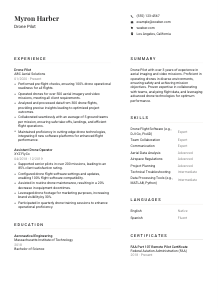
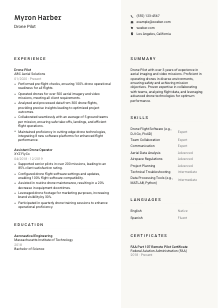
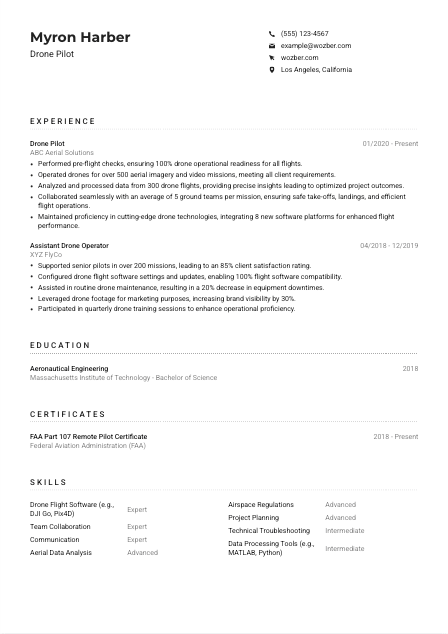
Include a current phone number, a professional email address, and your city and state. Here, Los Angeles, California matters because the job specifically asks for it. If a posting includes a location requirement, showing that detail up front can prevent unnecessary screening delays. Fluent English is also required here, so make sure your email address, voicemail, and any linked profile read as polished and business-ready.
A LinkedIn profile or portfolio site can strengthen your application when it shows aerial work samples, industries served, or project scope. If you include a link, make sure it aligns with the CV and highlights material a hiring manager would actually want to review, such as imagery projects, mapping work, inspection footage, or client-facing deliverables.
Skip age, marital status, headshots, and other non-essential details. Use the space for information that supports operational credibility, such as location, a portfolio link, or contact details that make it easy to schedule an interview or flight assessment.
This section should confirm who you are, where you are based if the role requires it, and how to reach you. For drone work, that clean start helps the hiring team move straight to the parts that prove safe, capable flight operations.




Experience is where a Drone Pilot CV earns credibility. Hiring teams look for more than time in role. They want to see mission volume, operating conditions, safety discipline, software use, data handling, and whether you can coordinate cleanly with crews and clients.
Read the responsibilities and requirements closely, then map your experience to them. In this case, the posting emphasizes pre-flight checks, aerial capture, data analysis, team coordination, troubleshooting, and regulatory awareness. Those themes should shape your bullets more than generic claims about being hardworking or detail-oriented.
List your most recent drone-related work first, then move backward. Include job title, company, and dates. If you progressed from an assistant drone operator role into a lead pilot position, that progression matters because it shows growing responsibility for flight execution, maintenance checks, software setup, and client deliverables.
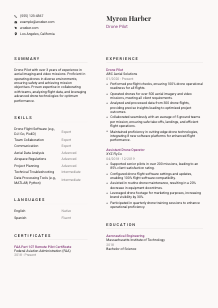
Each bullet should show what you did, how you did it, and what resulted. Good Drone Pilot bullets mention flight operations, imagery capture, mapping or inspection outputs, compliance, or operational safety. The sample CV does this well with lines such as completing pre-flight checks for 100% operational readiness and processing data from hundreds of flights to improve project outcomes.
Quantify mission count, readiness rates, downtime reduction, client satisfaction, footage volume, turnaround time, or the number of flight teams supported. "Operated drones for over 500 aerial imagery and video missions" says much more than "responsible for many flights." Metrics make your level of field exposure and reliability easier to judge.
Trim experience that does not strengthen your case for this kind of work. If a past role included footage editing, maintenance support, GIS-related analysis, or software configuration, keep the parts that connect to flight operations and deliverables. Remove unrelated tasks that distract from your ability to fly safely, troubleshoot equipment, and produce useful aerial data.
A strong experience section should read like a record of safe operations, repeatable execution, and useful results. When your bullets reflect the same kinds of missions, software, reporting, and team coordination the employer needs, your background becomes much easier to place.
Drone Pilot roles are often won on operational experience and certification, but education still adds context. It can show technical grounding in aviation, engineering, imaging, data analysis, or other disciplines that support better flight planning and post-flight work.
If you have a degree in aeronautics, engineering, geography, media production, robotics, or a related field, include it clearly. A degree is not always mandatory for drone roles, but relevant coursework can reinforce your understanding of aircraft systems, imaging workflows, environmental conditions, or technical analysis.
List degree, school, and graduation year in a straightforward format. The sample CV's Bachelor of Science in Aeronautical Engineering works because it immediately supports the technical side of drone operations without needing extra explanation.
Education and licensing should work together, not compete for attention. If your academic background is broad, the FAA Part 107 certificate becomes the more direct operational qualifier. If your degree is highly relevant, it can strengthen your credibility around flight systems, safety procedures, and data interpretation.
You do not need to turn this into a coursework list, but one strong academic project can help if it connects to UAV systems, aerial imaging, mapping, remote sensing, or flight data analysis. Include it only when it adds practical relevance to the target role.
Honors, technical clubs, or aviation-related organizations can be worth noting if they support your professional direction. Keep these additions brief and relevant. At this career stage, most hiring teams will prioritise logged experience and current certification over general campus involvement.
This section should reinforce your understanding of the work, not compete with your mission history. For Drone Pilot applications, concise education details paired with relevant certification usually do the job well.
Certifications carry real weight in drone hiring because they speak directly to legal operation and current knowledge. If a posting names a required credential, make it easy to find and easy to verify.
For this role, the FAA Part 107 Remote Pilot Certificate is essential, so it should appear prominently in its own section. When a required certificate is buried lower on the page, it can slow down screening or create doubt about eligibility.
Include additional credentials when they support the kind of drone work you want, such as safety training, inspection-related coursework, mapping software training, or manufacturer-specific flight systems. Avoid padding this section with certificates that have no clear connection to UAV operations.
Licensing in regulated work needs time context. Include the year earned and, when relevant, indicate that it is current. The sample CV handles this clearly with "2018 - Present," which helps confirm active standing at a glance.
Drone platforms, sensors, software, and airspace rules evolve quickly. If you have recent training in updated regulations, new flight software, thermal imaging, photogrammetry, or maintenance procedures, those additions can show that your skills have stayed current with the market.
For a Drone Pilot, certificates are not a minor extra. They establish legal readiness and professional upkeep. Put the required license in plain view, then support it with training that matches the kind of missions you want to fly.
The skills section should read like a working toolkit, not a generic list. For Drone Pilot roles, employers usually want a blend of flight software knowledge, airspace awareness, troubleshooting ability, data handling, and calm coordination with people on the ground.
Start with the terms the employer already uses. Here, that includes drone flight software, airspace regulations, troubleshooting, collaboration, and communication. If those are part of your real background, use the same wording so both ATS filters and human reviewers can connect your CV to the role quickly.
A Drone Pilot rarely works in isolation. Your skills should show both operational control and coordination. Pair software, maintenance, and aerial data analysis with communication, client interaction, and teamwork, especially if your work involves ground crews, production teams, inspectors, or survey stakeholders.
Choose skills that support actual drone workflows. The sample CV does this well by naming tools such as DJI Go and Pix4D alongside airspace regulations, aerial data analysis, and technical troubleshooting. A shorter, targeted list is stronger than a long inventory of vague strengths.
Anyone can claim communication or technical ability. What stands out is a combination of software, compliance knowledge, data work, and crew coordination that reflects how drone missions are actually run.
Language ability matters in drone work when you are briefing clients, coordinating with field teams, or explaining findings from a flight. Keep this section concise, but make sure it supports the communication demands of the role.
This posting asks for fluent and articulate English, so English should be listed first with an accurate proficiency level such as "Native" or "Fluent." That matters because drone work often involves verbal coordination during takeoff and landing, client communication, and written reporting after a mission.
If you speak another language well enough to support field coordination or client service, include it. In markets with diverse crews or customer bases, an additional language can help with smoother on-site communication and broader project coverage.
Choose clear levels such as Native, Fluent, Intermediate, or Basic. Overstating language ability can become obvious quickly in roles that involve live team communication, safety instructions, and client-facing updates.
If your drone work includes inspections, production shoots, surveying, or public-facing projects, language skills can have practical value beyond conversation alone. They can help with briefings, stakeholder updates, and clearer coordination in mixed-language environments.
Languages can strengthen a Drone Pilot application, but they should support your operational profile rather than replace it. Keep the section lean and let it complement your mission experience, certification, and technical skill set.
For Drone Pilot roles, language proficiency matters most when it improves safe coordination and clear client communication. Present it plainly so employers can understand where it adds value.
The summary should give a hiring manager a quick, credible read on your operating level. In a few lines, show how much drone experience you have, the kinds of missions you handle, and the technical or collaborative strengths that matter most for the opening.
Before writing, identify the two or three themes the posting emphasizes most. Here, those include varied flight conditions, FAA compliance, aerial capture, data analysis, troubleshooting, and teamwork. Your summary should echo the priorities that best match your background rather than trying to cover every skill at once.
Start with a direct line such as your role, years of experience, and mission type. The sample summary works because it quickly establishes more than 3 years of experience in aerial imaging and video missions, then moves into safety and operational follow-through.
Use the next sentence or two to mention capabilities tied to actual drone operations, such as flying in diverse environments, coordinating with ground teams, analysing flight data, or maintaining equipment readiness. Keep the language specific enough to sound field-tested, not generic.
Aim for 3 to 5 sentences. That is enough space to establish your profile without repeating the experience section. A hiring manager should finish the summary with a clear sense of your mission background, technical range, and whether you can step into active operations quickly.
Your summary should quickly position you as a pilot who can fly safely, deliver the required output, and work well with others around the mission. When those points are clear, the rest of the CV has a much easier job.
A Drone Pilot CV works best when it reads like an operator's record, not a list of interests. Show flight volume, safety discipline, software familiarity, data or imagery output, and the kind of coordination your missions require.
Use Wozber's free CV builder to shape that experience into a clean ATS-friendly CV template, then refine the language with Wozber's ATS CV scanner so the final version reflects the posting's terminology and priorities. The finished CV should make one thing clear fast: you are ready to handle the mission, the equipment, and the compliance standards that come with the job.