



Use Wozber and land your dream job
Create CV
No registration required
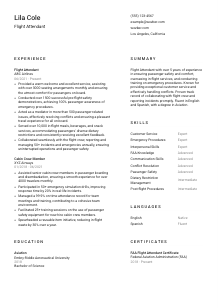
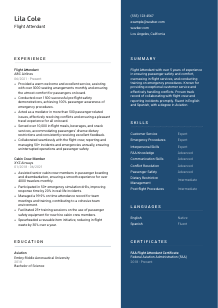
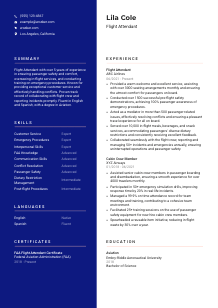
Elevating service, but your CV is grounded? Soar through this Flight Attendant CV example, created with Wozber free CV builder. Learn how to fasten your onboard strengths to meet job altitude, ensuring your career remains as high-flying as the destinations you serve!
Flight attendant hiring moves quickly past generic hospitality claims. Airlines need people who can keep a cabin calm, deliver safety briefings with authority, handle service across hundreds of passengers, and stay composed when delays, medical issues, or onboard conflicts change the pace of the flight. Your CV needs to make that operating standard visible from the start.
When a CV is tailored well, the hiring team can quickly separate broad customer service experience from real cabin-readiness. Using Wozber's free CV builder to align your wording with the posting and keep an ATS-compliant CV easy to scan helps surface the details that matter here, such as safety training, onboard service volume, incident handling, and clear communication in English.
The top of a flight attendant CV should read like dependable crew information: clear, accurate, and easy to confirm. This section is short, but it can immediately show that you meet practical requirements such as role alignment, contact accessibility, and, when relevant, location.
Use your full name as the most visible line on the page. Keep it clean and professional so the recruiter can immediately connect it to your application, interview scheduling, and training records without distraction.
Place "Flight Attendant" directly beneath your name when that is the role you are applying for. This helps airline recruiters and ATS filters place you in the right candidate pool, especially when your previous title may have been "Cabin Crew Member" or another variation.
List a current phone number and a professional email address that you check regularly. Airlines often move quickly between screening, interview coordination, and training follow-up, so this information needs to be accurate and easy to use.
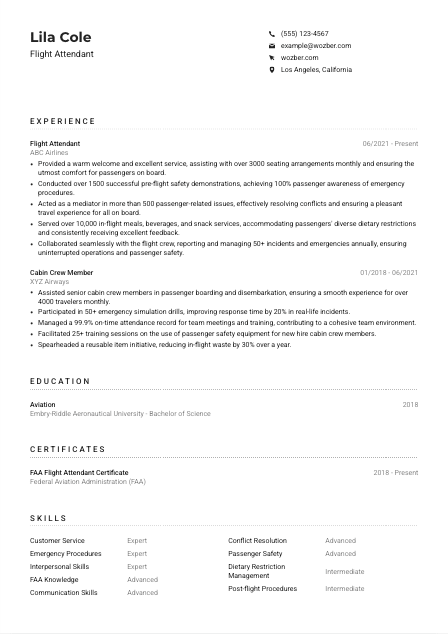
If the airline asks candidates to be based in a specific city, reflect that clearly in your personal details. In the example, listing "Los Angeles, California" directly addresses the permanent base requirement and removes doubt about relocation timing.
Do not include age, marital status, photo, or other details unrelated to cabin operations, customer care, or compliance. Keep the focus on what matters for hiring: your availability, professionalism, and alignment with the posting.
This section should quickly answer the practical questions an airline recruiter has first: who you are, how to reach you, what role you want, and whether you meet any stated location requirement. Keep it clean and operational.




For flight attendants, experience is where airlines look for real proof of judgment under pressure. Hiring teams want to see how you've handled passenger volume, safety procedures, onboard service, coordination with crew, and difficult situations in a confined, highly regulated environment.
Before rewriting your bullets, isolate the duties and requirements that define the role. In this posting, that means passenger welcome, seating assistance, safety demonstrations, conflict management, in-flight food and beverage service, crew coordination, and incident reporting. Those themes should appear throughout your experience section in language that reflects what you have actually done.
Start with your most recent position and work backward so recruiters see your current level of responsibility first. For cabin crew candidates, recent experience carries extra weight because safety procedures, service standards, and emergency response expectations must stay current.
Each role should show what you handled and how well you handled it. Instead of vague lines about customer service, use bullets tied to flight operations, such as conducting pre-flight safety demonstrations, resolving passenger disputes, accommodating dietary requests, or reporting onboard incidents to the captain. The sample CV does this well by pairing core duties with numbers, such as 1500+ safety demonstrations and 10,000+ meals served.
Metrics help airlines judge pace, consistency, and scale. Useful numbers for this profession include passengers assisted per month, flights covered, training drills completed, incident volume handled, service counts, response improvements, attendance reliability, or safety compliance outcomes. Choose figures that reflect real cabin performance, not inflated claims.
If part of your background is in hospitality, retail, or general customer service, rewrite it around skills airlines actually value: de-escalation, service under time pressure, teamwork, clear communication, and handling special requests. Aviation experience should lead when you have it, but related customer-facing work can still support your case when presented through a flight attendant lens.
A useful experience section makes it easy to picture you working a live flight. It should show safety discipline, service range, passenger handling, and coordination with crew, backed by the scale of work you handled.
Education is rarely the deciding factor in flight attendant hiring, but it can strengthen your profile when it points to aviation knowledge, service training, communication, or disciplined learning. Present it clearly, then let it support the operational story told in your experience and certification sections.
Start with your highest or most relevant completed education. A degree is not always required for flight attendant roles, but study in aviation, hospitality, communications, tourism, or a related area can reinforce your understanding of passenger service and regulated environments. In the example, a Bachelor's degree in Aviation adds useful context.
List the degree, school, field of study, and graduation year or date range. Recruiters do not need a dense academic profile here. They need a clear record that is easy to scan alongside your cabin experience and FAA credential.
If your studies included aviation safety, emergency management, human factors, communication, or customer service training, mention that only when it strengthens your case. Keep it brief and relevant to onboard work rather than turning the section into a full course catalogue.
Include honors, clubs, or volunteer work only if they connect to aviation, service, leadership, or high-accountability teamwork. For example, airport volunteering or aviation society involvement can reinforce genuine industry interest, but only if the detail adds something your experience section does not already cover.
If you have recent training in safety, service, conflict resolution, or language development, make sure your education history does not feel frozen in time. For flight attendants, current learning matters because airline procedures and passenger expectations keep evolving.
This section should quietly reinforce your preparation for the role. Clear academic details, relevant field of study, and any useful training context are enough to support your broader cabin crew profile.
Certifications carry real weight in flight attendant hiring because they point to regulated training and operational readiness. If the posting asks for a specific credential, make it easy to find and impossible to miss.
Lead with any certificate named in the job description. Here, the FAA Flight Attendant Certificate is a direct requirement, so it should appear prominently and exactly as recognized by the issuing body.
List certificates that strengthen your ability to work safely and effectively in the cabin. Beyond required credentials, this can include emergency response training, first aid, CPR, or airline-specific service and safety programs when relevant to the role you are targeting.
Include the certifying organisation and the date earned, plus an active range if the credential remains valid. The sample CV handles this clearly with the FAA listed as issuer and the certificate shown as active from 2018 to present.
Aviation is procedural work. If you have completed refresher training, compliance updates, emergency drills, or recertification, include them when they help demonstrate current readiness. This is especially useful if your formal certificate was earned several years ago.
For this profession, certifications are not extra polish. They help confirm that you can step into a safety-sensitive passenger role with the required training already in place.
A flight attendant skills section should reflect the real mix of cabin work: safety awareness, passenger communication, service delivery, crew coordination, and calm decision-making under pressure. Keep it focused on abilities you can support elsewhere in the CV.
Start with the exact capabilities the posting emphasizes. In this case, that includes interpersonal communication, written and verbal English, staying calm in stressful situations, passenger safety, conflict handling, and customer service. These terms help your CV align with both recruiter expectations and ATS parsing.
Do not build this section around hospitality alone. Flight attendant hiring sits at the intersection of safety compliance and passenger care, so include a mix such as emergency procedures, FAA knowledge, conflict resolution, passenger safety, food and beverage service, and communication skills. The example CV uses that balance effectively.
Choose skills that matter on board and remove broad filler. A concise list is easier to scan and carries more credibility, especially when the same capabilities show up in your experience bullets through actions like conducting demonstrations, resolving disputes, or managing special meal requests.
Your skills section should read like the capabilities needed on a real flight, not a generic service profile. Prioritise the mix of safety knowledge, communication, service execution, and composure that airlines rely on.
Language ability matters in flight attendant work because communication affects both service and safety. Clear English is essential for announcements, emergency instructions, crew coordination, and passenger support. Additional languages can widen your usefulness on certain routes or with diverse passenger groups.
If the posting calls for high proficiency in English, list English first and state your level clearly. Airlines need confidence that you can deliver safety briefings, answer passenger questions, and document incidents without ambiguity.
Additional languages are a genuine advantage when they help with passenger service, de-escalation, or cultural ease on board. In the example, Spanish is a strong addition because it supports communication with a broad passenger base, though extra languages should be presented as added value rather than assumed requirements.
Use straightforward levels such as native, fluent, intermediate, or basic. Avoid overstating ability. In a safety-sensitive environment, recruiters need an accurate sense of whether you can manage real passenger interactions in that language.
Highlight a language more prominently when it clearly supports the airline's route network or the posting's passenger context. For flight attendants, the strongest language claims are the ones tied to practical onboard use, not just classroom exposure.
If you are actively improving a language that could support your route flexibility or passenger communication, note that only when it is meaningful. It shows initiative, especially for airlines serving multilingual markets, but should not distract from your proven operational strengths.
List the languages you can actually use in service or safety communication, and be precise about your level. For airlines, clarity matters more than a long list.
The summary should quickly establish your level, your flight attendant strengths, and the kind of onboard work you handle well. This is where you frame your experience before the recruiter gets into the bullet points.
Start with your title and years of relevant experience, especially if you meet or exceed the posting's minimum. For example, "Flight Attendant with over 5 years of experience" immediately places you above a two-year requirement and gives recruiters a clear benchmark.
Add two or three role-specific strengths pulled from your actual background, such as passenger safety, in-flight service, conflict resolution, emergency procedures, or crew collaboration. The sample summary works because it combines safety, service, and incident handling rather than relying on generic customer care language.
Aim for a tight paragraph that covers scope, strengths, and one or two differentiators like FAA certification, bilingual ability, or aviation education. This section should give a clear hiring read in a few lines, then hand off to the experience section for proof.
A sharp summary helps recruiters place you quickly: experienced or entry-level, service-focused or safety-heavy, domestic or multilingual. Keep it concise, grounded, and aligned with the work you are ready to perform.
A tailored flight attendant CV should now show the parts airlines care about most: current contact details, the right base location when required, FAA credentials, passenger-facing experience, safety procedures, incident handling, and clear English communication.
Wozber's ATS-friendly CV template and ATS CV scanner can help you align each section with the posting, surface missing requirements, and strengthen wording without losing the practical detail that makes cabin crew experience credible.
When your CV makes it easy to see how you handle safety, service, and crew coordination in real flight conditions, you give the hiring team a much clearer reason to move you forward.




