



Use Wozber and land your dream job
Create CV
No registration required
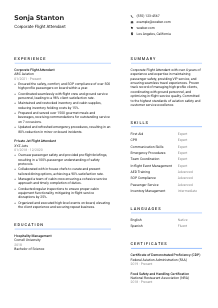
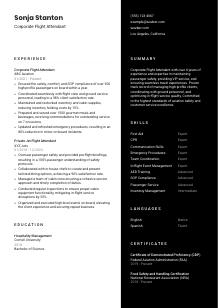
Escorting high-fliers, but your CV feels grounded? Soar with this Corporate Flight Attendant CV example, created with Wozber free CV builder. Learn how to match your inflight finesse to job requirements, ensuring your career trajectory always flies at optimal altitude!
Corporate flight attendants work in a setting where safety procedure and white-glove service happen at the same time. Hiring teams look quickly for proof that you can manage emergency readiness, protect passenger privacy, and deliver polished cabin service for travelers who expect precision, discretion, and calm judgment on every leg.
A tailored CV makes that combination easier to read at a glance. Using Wozber's free CV builder to mirror the employer's language and keep an ATS-compliant CV cleanly structured helps surface the experience that matters most here, from cabin safety certifications to VIP service standards and coordination with flight crew.
Corporate aviation is detail-sensitive from the first line. Your personal details should present you as polished, reachable, and ready for the operating realities of the job, especially when the posting includes a location requirement or extensive travel expectations.
Place your full name at the top in a clean, easy-to-read format. Keep it slightly more prominent than the rest of the header so the CV feels orderly and professional, much like the service standard expected in a private cabin environment.
Add "Corporate Flight Attendant" directly under your name if that is the role you are pursuing. Matching the posted title helps frame your background immediately and supports ATS parsing, especially when you also have experience under related titles such as private jet flight attendant or cabin attendant.
Include a phone number and professional email address that you check regularly. In a role where timing, responsiveness, and accuracy matter, small errors in contact details create the wrong impression before anyone reaches your experience section.
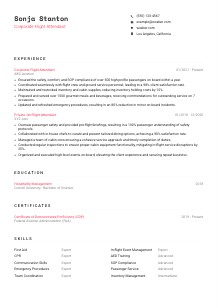
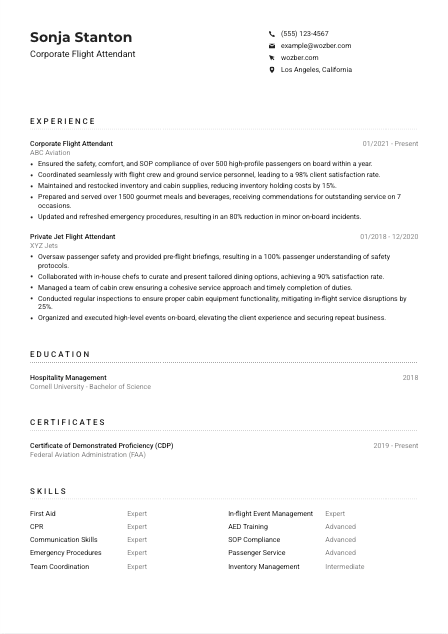
If the employer wants someone based in a specific city, mention your current location or your willingness to relocate. In this example, listing Los Angeles, California immediately answers a stated requirement and removes a common screening question for a schedule-heavy aviation role.
If you have a polished LinkedIn profile or professional website, add it only if it supports your candidacy. Keep the information consistent with your CV, especially around titles, dates, certifications, and aviation or hospitality experience.
This section should confirm that you are easy to contact, professionally presented, and logistically aligned with the posting. That lets the reader move straight to your flight experience and service record.




Experience carries the most weight for a corporate flight attendant because the job depends on execution, not theory. Your bullets should show how you handled safety procedures, client service, cabin preparation, crew coordination, and the pace of private aviation without losing composure or standards.
Before writing bullets, identify the work patterns the employer is hiring for. Here, the priorities are corporate or private aviation experience, SOP compliance, gourmet meal service, inventory control, discretion with high-profile passengers, and close coordination with crew and ground personnel. Those themes should shape what you emphasize under each role.
List jobs in reverse chronological order and include your title, company name, and dates. For this profession, titles matter because "Corporate Flight Attendant" and "Private Jet Flight Attendant" instantly tell the reader that you understand a more personalized service model than commercial cabin service alone.
Each bullet should connect a core cabin responsibility to a result. Safety briefings, cabin inspections, meal service, equipment checks, supply management, and crew coordination all belong here when they reflect real work. The example CV does this well with points such as serving over 1,500 gourmet meals and maintaining SOP compliance for more than 500 high-profile passengers.
Numbers help hiring teams gauge scale and consistency. Client satisfaction scores, repeat business, reduction in service disruptions, inventory cost savings, onboard incident reduction, or passenger volume are all credible measures in this field. A line like "led to a 98% client satisfaction rate" works because it ties polished service to a concrete result.
Prioritise experience that reflects private aviation service, passenger care, emergency readiness, and operational reliability. If you include broader hospitality or customer service work, connect it clearly to VIP care, food and beverage standards, or discreet client handling so it strengthens rather than distracts from your aviation background.
The best experience sections make it easy to picture you in the role. By the end of this section, the reader should understand the level of passengers you served, how you supported safe operations, and how smoothly you worked with crew and ground teams.
Education is rarely the deciding factor for experienced corporate flight attendants, but it can still strengthen your profile. Relevant study in hospitality, service management, nutrition, communications, or a related field adds context to the way you manage premium passenger expectations and onboard presentation.
If the posting does not require a degree, keep the section straightforward and relevant. A degree such as Hospitality Management can reinforce your background in service delivery, guest experience, and presentation standards, which all translate well to private aviation.
List your degree, field of study, school, and graduation year. Clear formatting helps the CV stay easy to scan, and that matters when aviation hiring teams are moving quickly through applications with similar years of flight experience.
When your studies support the role, make that connection visible through the field of study rather than extra explanation. In the example, a Bachelor of Science in Hospitality Management quietly supports the candidate's strength in premium service and guest care without overstating the point.
If you completed coursework or academic programs tied to food service, safety, event coordination, or luxury hospitality, include them when they help explain your readiness for cabin duties. Keep nonessential coursework out unless you are early in your career and need additional supporting detail.
Honors, leadership roles, or relevant extracurriculars can help if you have limited flight experience. For seasoned candidates, those details are secondary to flight operations, service execution, and certification status, so include them only if they add real value.
This section should reinforce your professional profile, not compete with your aviation experience. A concise, relevant education entry is enough to round out the picture.
Certifications matter in this profession because they connect directly to passenger safety, regulatory compliance, and day-to-day cabin operations. This section should make your current training status easy to verify without forcing the reader to hunt for essentials.
Start with credentials the posting explicitly asks for. In this case, the FAA-issued Certificate of Demonstrated Proficiency, or an equivalent cabin safety and service certification, should appear prominently because it is a baseline qualification rather than a bonus item.
After the primary aviation credential, list certifications that support real cabin responsibilities. First Aid, CPR, AED, food safety, emergency procedures, and service-related training all strengthen a corporate flight attendant profile because they connect to both passenger care and operational preparedness.
Show the issue date and, when relevant, whether the certification is active or renewed. Aviation employers need to know your training is current, especially for safety-related credentials that may require periodic refreshers.
Corporate flight attendants are expected to refresh emergency procedures, equipment knowledge, and service techniques regularly. If your certifications are up to date, this section quietly supports that expectation and helps demonstrate that you stay current with cabin standards.
When this section is arranged well, the employer can immediately see that you meet the safety and service training baseline for the role. That clarity matters in aviation hiring.
A corporate flight attendant skills section should read like the operating toolkit behind excellent cabin performance. Focus on the abilities that support safe flights, polished service, smooth coordination, and the discretion required around executives, families, and other high-profile travelers.
Pull both direct and implied skills from the posting. Here that includes First Aid, CPR, AED, interpersonal communication, SOP compliance, passenger service, inventory management, and coordination with crew and ground staff. Using the employer's wording where it matches your experience improves ATS optimisation without making the list feel forced.
Lead with skills that speak to passenger safety and cabin execution before broader personality traits. For this role, emergency procedures, communication, VIP service, discretion, and service coordination usually carry more weight than generic descriptors because they tie directly to how the work is performed.
The most useful skills sections mix operational skills with service-facing abilities. The example profile does this well by combining items such as emergency procedures, team coordination, SOP compliance, passenger service, and inventory management, which together reflect the full rhythm of cabin work rather than only hospitality or only safety.
A focused skills list should make the employer think, "This person understands the cabin, the passengers, and the procedures." Keep it specific enough to support that conclusion.
Language ability matters in corporate aviation because service depends on clear communication under both routine and urgent conditions. This section should confirm that you can brief passengers, coordinate with crew, and maintain polished communication throughout the trip.
If the posting specifies English proficiency, list English clearly with an accurate fluency level. That answers a stated requirement and supports the core communication demands of safety briefings, service interactions, and crew coordination.
Additional languages can strengthen your profile, particularly for international routes or globally mobile clients. They are not mandatory unless the employer says so, but they can be a useful differentiator when they help you serve passengers more smoothly.
Use clear levels such as Native, Fluent, Advanced, or Conversational. Overstating language ability is risky in a client-facing role where misunderstanding a request, briefing, or special instruction can affect both service quality and safety.
Many corporate flight departments serve passengers across borders, often on irregular schedules. Even when another language is not required, multilingual ability can support smoother service, better cultural awareness, and a more comfortable passenger experience.
If you regularly fly routes where another language comes up, continued practice is worth mentioning only if it has real professional relevance. The value here is practical communication, not collecting language lines for decoration.
This section works best when it is simple and credible. Clear language levels help the employer understand how you will communicate with passengers and crew in real flight conditions.
The summary is where you set the tone for the rest of the CV. For a corporate flight attendant, it should quickly establish your flight experience, service standard, safety training, and comfort working with high-profile passengers without repeating every bullet that appears later.
Build your summary around the actual mix of responsibilities the role requires. Corporate flight attendant work combines cabin safety, premium service, discretion, and logistical coordination, so your opening lines should reflect that blend rather than sounding like a generic hospitality profile.
Start with your current professional identity and a credible experience range. A line such as "Corporate Flight Attendant with over 4 years of experience" works because it gives immediate context before moving into your safety, service, or VIP strengths.
Choose strengths that align tightly with the posting, such as managing high-profile clients, coordinating with flight and ground personnel, maintaining cabin safety standards, or delivering high-end meal and beverage service. The example summary succeeds by combining passenger safety, VIP service, and seamless travel support in a compact way.
Aim for 3 to 5 sentences that read cleanly in a quick screen. Avoid vague claims about passion or excellence unless they are backed by concrete strengths, certifications, or operational experience that matter in corporate aviation.
A well-written summary should make the rest of the CV easier to understand. It should leave no doubt that you can protect safety standards, deliver refined service, and handle the pace and discretion corporate aviation demands.
A strong Corporate Flight Attendant CV presents the full picture clearly: current safety credentials, polished cabin service, experience with high-profile passengers, and the discipline to support smooth operations before, during, and after each flight.
Use Wozber to refine the wording, strengthen ATS optimisation, and format everything in an ATS-friendly CV template that keeps those qualifications easy to spot. The finished CV should make one thing clear fast: you can step into the cabin and perform to corporate aviation standards.