



Use Wozber and land your dream job
Create CV
No registration required
Taking flight, but your CV feels grounded? Soar high with this Pilot CV example, created with Wozber free CV builder. Learn how to present your aviation expertise to match job checkpoints smoothly, propelling your career to new horizons!
Pilot hiring starts with trust. Before anyone looks at aircraft type, route structure, or total time, they need to see a professional who operates safely under pressure, follows procedure without drift, and communicates clearly when conditions change. Your CV should make that operational discipline visible, from flight hours and inspections to crew coordination and recordkeeping.
A tailored pilot CV also helps separate general aviation experience from the exact flying background a carrier or operator needs. Using Wozber's free CV builder to shape an ATS-compliant CV makes it easier to surface the right license, flight-time profile, and FAR-related experience in language that both screening systems and chief pilots can scan quickly. That clarity matters when a hiring team needs to confirm, fast, that you can step into the cockpit with the expected level of proficiency.
In aviation, small details carry weight. The contact section should present you as organised, reachable, and already aligned with practical requirements such as title, location, and professional contact information.
Use your full name in a larger, clean font so it stands out immediately. For a pilot, that top line should read like a professional header, not a design element. Keep it straightforward and consistent with the name used on your licenses and other aviation records.
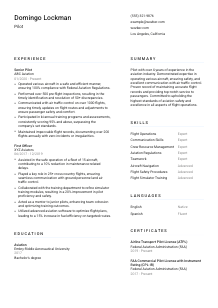
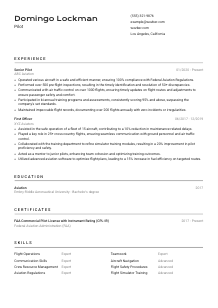
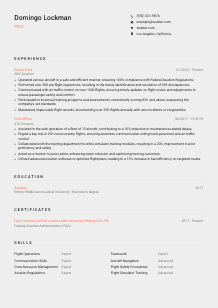
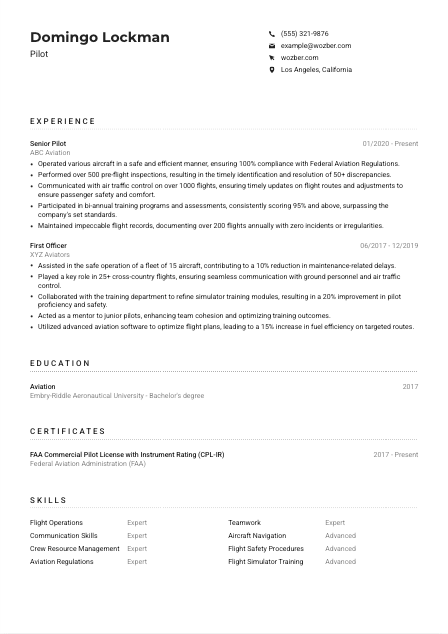
Place your target title directly under your name. If the posting is for a Pilot, use "Pilot." If a more specific title matches both your background and the opening, such as "Commercial Pilot" or "First Officer," use that only when it is accurate. The sample CV keeps this simple with "Pilot," which works well because it mirrors the employer's wording and stays broad enough for ATS matching.
List a phone number and email address that you actually monitor. Hiring conversations for pilots can move quickly around interview windows, simulator evaluations, or document requests, so accuracy matters. Use a professional email format and verify that every digit and character is correct before sending your CV.
If the employer requires a local base or relocation willingness, include your city and state. That is useful here because the role specifies Los Angeles, California. If you are relocating, make that clear in a way that removes doubt about your availability for training, check rides, or reporting timelines.
Include a LinkedIn profile or personal website only if it adds real value, such as aviation credentials, additional flight background, safety recognition, or professional affiliations. Skip links that are empty or outdated. Any extra profile should support the same picture your CV presents: current, compliant, and professional.
Your personal details should answer the practical basics without friction: who you are, how to reach you, what role you are targeting, and whether location is already workable. That keeps the focus on your flight qualifications instead of avoidable logistics.




For pilots, experience is reviewed like a performance record. Employers look for operating responsibility, safety discipline, communication quality, and the kind of flying environment you have handled. Your bullets should read like professional logbook highlights, not generic duty statements.
Read the posting closely and pull out the responsibilities that define the job. Here, those include safe aircraft operation, compliance with FARs, pre-flight inspections, route communication with ATC and ground personnel, recurrent training, and accurate flight records. Use those priorities to decide which parts of your history belong near the top of each role.
Show your most recent flying position first, then work backward. Include employer name, title, and dates for each role. That sequence helps a chief pilot or recruiter see your progression from supporting flight operations to higher-responsibility positions such as the sample CV's move from First Officer to Senior Pilot.
Do not stop at "operated aircraft" or "performed inspections." Show scope, standards, and outcomes. The sample CV does this well by tying pre-flight inspections to the identification of more than 50 discrepancies and by linking flight recordkeeping to zero incidents or irregularities. Those details tell a hiring team how you work, not just what your title was.
Pilot hiring is one of the clearest cases where numbers matter. Include flight counts, inspection volume, training scores, fleet size, delay reduction, fuel-efficiency gains, or other metrics that naturally reflect your work. If the employer asks for 1500 hours and certain aircraft exposure, make sure your experience section supports that requirement with concrete evidence from your background.
Prioritise aviation experience over unrelated jobs unless an older role adds something unusually relevant, such as formal safety training or regulated operations. Space on a pilot CV should go to cockpit responsibility, crew resource management, compliance, and operational judgment. Keep the section centered on flying, training, and measurable contributions to safe and efficient operations.
By the end of this section, the reader should understand what you have flown, how you have operated, and how consistently you have met safety and procedural standards. That is the foundation of a credible pilot application.
Education matters in pilot hiring when it confirms that you meet stated requirements and supports the technical foundation behind your flight training. Present it clearly so the degree is easy to verify and easy to match to the posting.
If the role calls for a bachelor's degree in Aviation, Aeronautical Engineering, or a related field, make sure that information is visible at a glance. This posting does, so an entry like the sample CV's Bachelor's degree in Aviation from Embry-Riddle Aeronautical University directly supports eligibility.
List your degree, field of study, school, and graduation year or date. A simple structure works best because it is easy for both ATS parsing and human review. Recruiters should not have to hunt for whether your education meets a baseline requirement.
Write your major or concentration in the clearest relevant terms. If your degree aligns with the posting, say so plainly. Matching the employer's language where it is truthful, such as "Aviation" or "Aeronautical Engineering," improves alignment and avoids ambiguity.
Most experienced pilots do not need a long course list. Add selected coursework only if it strengthens your case, especially early in your career or when your degree title is broad. Subjects tied to instrument procedures, aerodynamics, aviation safety, or flight systems can help when they connect to the target role.
Flight team participation, aviation research, leadership in aeronautics groups, or academic projects on safety and operations can add value, especially for newer pilots. Keep these details brief and include them only when they support your aviation profile more than another CV section would.
This section should confirm that you meet the academic requirement and that your training background fits the level of technical and regulatory understanding expected in professional flight operations.
This section carries unusual weight for pilots because it directly confirms legal and operational qualification. Present licenses and ratings clearly, with accurate naming and current status, so there is no confusion about what you are authorized to fly.
Start with the exact licenses or ratings named in the posting when you hold them. Here, that means the FAA Commercial Pilot License with Instrument Rating. The sample CV places that credential prominently, which is exactly what you want when a requirement is non-negotiable.
Include certifications that strengthen your candidacy for the target operation. For a pilot role, that may include commercial, instrument, multi-engine, ATP, type ratings, or other current qualifications tied to your flying profile. Leave out anything that does not affect cockpit eligibility or professional standing.
Add issue dates and, when applicable, indicate that the credential is current. That matters in aviation because currency and recency affect how your background is interpreted. A license listed as "2017 - Present," as shown in the sample, quickly tells the reader it remains active.
Pilot credentials are part of a continuing proficiency standard, not a one-time milestone. If you have advanced from CPL-IR to ATP or added ratings that expand your operational range, show that progression. It signals continued training and greater responsibility, which are both highly relevant in flight hiring.
A hiring team should not have to guess whether you meet the licensing threshold. After reading this section, they should know you hold the required credentials and maintain them at a professional standard.
Pilot skills should reflect how you actually operate in the aircraft and with the crew. Generic soft-skill lists are less useful than a focused mix of technical, procedural, and communication strengths tied to safe flight execution.
Start with the capabilities the posting emphasizes. In this case, that includes communication, teamwork, composure under stress, regulatory compliance, and safe, efficient aircraft operation. Build your skills list from real cockpit demands rather than broad corporate language.
A pilot CV should show both aircraft-handling competence and operational communication. Include skills such as flight operations, aircraft navigation, flight safety procedures, crew resource management, and aviation regulations alongside interpersonal communication where it is central to the role. The sample CV strikes this balance well.
Keep the list tight and relevant. Put the skills closest to the job requirements near the top, especially those linked to compliance, coordination, and safe execution. A shorter list of highly relevant skills is more convincing than a long catalogue that mixes critical cockpit abilities with generic traits.
This section should reinforce that you can operate within procedures, communicate effectively with crew and ATC, and maintain control in routine and high-pressure conditions. Those are the skills that carry weight in pilot selection.
Clear communication is a safety matter in aviation, not a decorative CV detail. If language ability affects ATC communication, crew coordination, passenger interaction, or international operations, include it in a way that is precise and easy to read.
When professional English communication is listed as a requirement, state your English proficiency clearly. This posting does, so English should appear first with an accurate level such as Native or Fluent. That immediately addresses a core operational expectation.
Additional languages can strengthen your profile when they help with crew communication, passenger service, or international flying. In the sample CV, Spanish adds useful range without distracting from the required English proficiency.
Choose standard levels such as Native, Fluent, Advanced, or Conversational. Avoid vague phrases that leave too much room for interpretation. Aviation communication depends on precision, and your CV should reflect that standard.
Not every pilot role values additional languages equally. If the operator serves multilingual passenger routes or international destinations, extra language skills may carry more weight. If not, keep the section brief and focused on what is genuinely useful.
Extra languages are helpful when they add operational value, but they should not crowd out more important qualifications such as hours, licenses, and aircraft experience. Include them as a supporting advantage, not as a substitute for core flight credentials.
After this section, the employer should know that you can meet required communication standards and, where relevant, support a broader operating environment with additional language capability.
The summary should give a quick read on your flying background, operating strengths, and the kind of responsibility you have already handled. For pilots, the best summaries sound grounded, current, and specific enough to support the rest of the CV.
Before writing, identify the few requirements that define success in the position. Here, those are safe aircraft operation, FAR compliance, communication, ongoing proficiency, and accurate records. Build your opening lines around those realities, not around generic ambition.
Lead with a direct statement that tells the reader who you are professionally. The sample summary opens with "Pilot with over 4 years of experience in the aviation industry," which works because it establishes role and experience level immediately. If you also meet a major threshold such as 1500+ flight hours, this is often a strong place to mention it.
Choose strengths that matter in day-to-day operations, such as safe aircraft handling, clear communication with ATC, strong documentation habits, or proven training performance. Keep the claims tied to real experience shown elsewhere on the CV so the summary feels credible rather than inflated.
Aim for three to five lines. That is enough space to present your flying background, core qualifications, and professional standard without repeating your whole CV. Concise writing suits this section well because pilot hiring often starts with a quick scan for license level, experience depth, and safety-minded execution.
A well-built summary gives the reader an immediate sense of your flight background and professional standard. It should make them expect a CV filled with safe operations, clean documentation, and experience that matches the role.
A pilot CV works when it shows the same qualities expected in the cockpit: accuracy, discipline, and calm control of important details. Every section should help confirm that you meet the role's requirements, from degree and licenses to flight experience, communication, and current operational judgment.
Use Wozber's free CV builder to organise that experience in an ATS-friendly CV format, then refine the language with its ATS CV scanner so your hours, ratings, and safety-related achievements align closely with the posting. The finished CV should make one conclusion easy to reach: you are prepared to operate at the standard the role demands.




