



Use Wozber and land your dream job
Create CV
No registration required
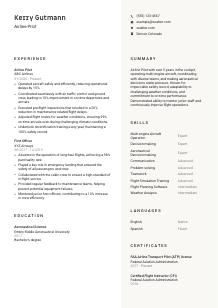
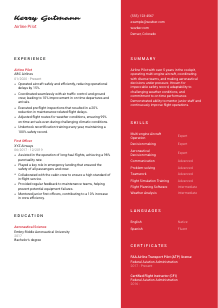
Guiding jets, but your CV feels grounded? Ascend to new heights with this Airline Pilot CV example, created with Wozber free CV builder. Learn how to align your aviation skills with company requirements, making sure your career soars just as high as your favorite routes!
Airline pilot CVs are reviewed through an operational lens. Hiring teams need to see command judgment, regulatory discipline, multi-engine flight experience, and the ability to work smoothly with dispatch, air traffic control, cabin crew, and maintenance. Generic aviation language falls flat here. Your CV has to show how you fly, how you manage risk, and what kind of reliability you bring to day-to-day operations.
A tailored CV changes the first read by making your flight qualifications easy to connect to the route structure, aircraft environment, and compliance standards the airline is hiring for. Wozber's free CV builder helps organise that information into an ATS-friendly CV format, so details like ATP licensure, flight-hour depth, weather-based decision-making, and crew coordination are visible early. That gives the hiring team a faster read on whether you can step into line operations with confidence.
For an airline pilot, the header needs to do one simple job well: identify you clearly and remove friction from the application. Contact details, title, and location should support the employer's screening process without taking attention away from flight time, licensure, and operational experience.
Use your full name in a clean, easy-to-read format at the top of the page. Keep it slightly larger than the body text so it is immediately visible when the CV is scanned by a recruiter or viewed beside flight qualifications and license information.
Place "Airline Pilot" directly under your name when that is the role you are pursuing. This keeps your positioning clear from the first line and helps align your CV with the job title used in the posting and ATS search filters.
List a phone number you answer and a professional email address, ideally based on your name. Accuracy matters here. If a chief pilot's office or recruiter cannot reach you quickly to discuss interviews, documentation, or training windows, a strong application can stall for avoidable reasons.
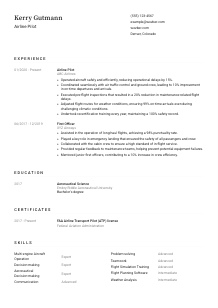
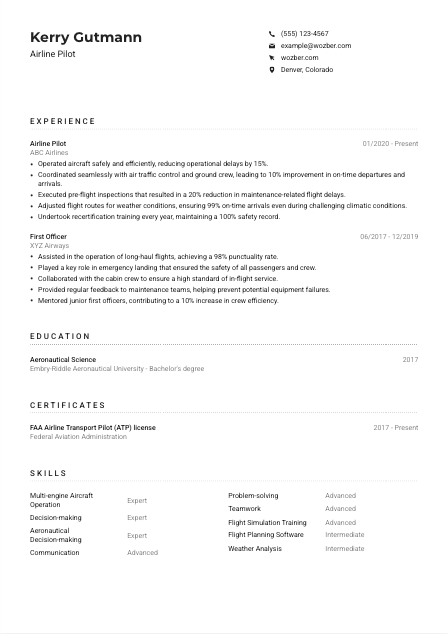
If the posting names a base or relocation expectation, include your city and state. In the example, listing Denver, Colorado directly supports a stated requirement. If you are relocating, make that clear in a simple way. This is useful when airlines are screening for base availability or training logistics.
A LinkedIn profile or professional website can be worthwhile if it reinforces your aviation background with consistent job history, certifications, or training milestones. Only include it if it is current and aligned with your CV. A stale profile creates extra questions instead of strengthening your application.
Keep the header clean, accurate, and easy to scan. It should confirm who you are, what cockpit role you are targeting, and whether there are any location barriers before the reader moves into flight experience.




This is the section where airline employers look for proof of safe operations, crew coordination, and measurable performance. Titles alone do not carry much weight. What matters is the type of flying you have done, the operational environment, the standards you worked under, and the results you delivered in the cockpit.
Before editing your bullets, mark the work that appears repeatedly in the job description. For airline pilot roles, that usually includes safe aircraft operation, FAA compliance, pre-flight inspection discipline, weather assessment, communication with ATC and ground teams, and ongoing recurrency training. Those are the responsibilities your experience section should bring forward first.
List positions in reverse chronological order with airline name, job title, and employment dates. Keep the structure consistent so the reader can move quickly from your current seat to prior progression, such as a path from First Officer to Airline Pilot. Clear chronology helps employers understand readiness for their operation and training pipeline.
Each bullet should connect a pilot responsibility to a real operational result. Prioritise safety, punctuality, coordination, and aircraft readiness over vague statements about being responsible or hardworking. The sample does this well with bullets tied to pre-flight inspections, route adjustments, and crew coordination, including a 20% reduction in maintenance-related delays and a 10% improvement in on-time departures and arrivals.
Quantify outcomes where they reflect actual performance. Good metrics for this field include on-time performance, delay reduction, safety record, training completion, route efficiency, or team outcomes. In the example, a 99% on-time arrival rate during difficult weather and a 100% safety record quickly tell the reader what kind of operational consistency the candidate delivered.
Include supporting experience only if it strengthens your case for commercial line operations. Flight instruction, charter flying, military aviation, or regional work can all matter, but frame them through relevant outcomes such as multi-engine time, CRM, emergency decision-making, or mentoring junior crew. The closer your bullets are to the demands of scheduled air transport, the more useful they will be in screening.
Your experience section should make it easy to picture you in active operations. Focus on aircraft handling, safety discipline, crew communication, weather judgment, and the measurable reliability you brought to each flight assignment.
Education matters in airline hiring because it confirms technical grounding and helps you meet stated requirements quickly. This section does not need long explanations, but it should make your aviation degree or related academic background easy to identify at a glance.
If the role asks for a bachelor's degree in aviation, aeronautical science, or a related field, make sure that information is easy to spot. Lead with the degree and field rather than burying them in a dense line of text.
List your degree, field of study, school name, and graduation year. Airline recruiters do not need a paragraph here. They need to confirm that your academic background supports the hiring requirements and fits the professional standards of the operation.
When your degree lines up closely with the posting, use the real wording of your credential. A degree listed as "Bachelor's degree, Aeronautical Science" aligns cleanly with a requirement for aviation or aeronautical science and removes guesswork during screening.
If you are early in your aviation career or your degree title is broad, a short mention of relevant coursework can help. Topics such as meteorology, aircraft systems, crew resource management, flight operations, or aviation law can reinforce technical preparation. Skip this if your flight experience already carries the weight.
Honors, aviation scholarships, or membership in recognized aviation organizations can add context, especially for newer pilots. Keep these additions brief and secondary to the degree itself. They should support your professional track, not overshadow operational qualifications.
Education should confirm that you meet the academic bar and have formal grounding in aviation concepts. Keep it straightforward so the reader can move quickly from credentials to flight experience and licensure.
In airline hiring, certificates are not decorative. They are core qualification checks. This section should make required licensure unmistakable and show that your training status is current enough for a serious hiring conversation.
Put the FAA Airline Transport Pilot license first when it is required, as it is here. That is one of the fastest qualification screens in the process, and it should never be buried beneath secondary credentials.
After the essential license, include certificates that strengthen your range or instructional background, such as CFI or type-related training if relevant to your experience. The sample's Certified Flight Instructor credential adds useful depth because it points to procedural discipline and structured flying knowledge.
Use issue dates or active date ranges where appropriate so recruiters can see whether your credentials are current. In aviation, recency matters. Clear dates help avoid follow-up questions around renewal status, eligibility, or training continuity.
Airline employers value pilots who stay current with recurrent training, regulatory changes, and standard operating procedures. If recertification or recurrent programs are a visible part of your recent experience, support that in this section or in your experience bullets. It reinforces professionalism and operational readiness.
Your certificates section should answer a practical question immediately: are you licensed, current, and professionally maintained for airline operations. Put the ATP first, keep the dates clear, and let every listed credential strengthen that answer.
An airline pilot skills section works best when it mixes technical capability with crew-facing judgment. Generic soft skills on their own are not enough. Hiring teams want a concise snapshot of aircraft-related competence, operational decision-making, and the communication habits that support safe flights.
Start with the requirements in the posting, then add closely related skills you can support elsewhere in the CV. For airline pilots, that often includes multi-engine aircraft operation, weather analysis, aeronautical decision-making, CRM, communication, and problem-solving under pressure.
Move the most relevant skills toward the top, especially if they are named in the posting. In this case, communication, teamwork, decision-making, and multi-engine experience deserve prominent placement because they connect directly to line operations and safety-critical work.
A shorter list of role-specific skills is more effective than a long inventory of generic strengths. The sample strikes a useful balance by combining technical capabilities such as multi-engine aircraft operation and weather analysis with operational behaviors like teamwork and decision-making. Only include skills you can back up through flight history, training, or accomplishments.
If a skill would matter during a flight briefing, in the cockpit, or during abnormal operations, it probably belongs here. Keep the list focused enough that every item reinforces your ability to operate safely and work well within an airline crew environment.
Clear communication is a safety issue in aviation, not a bonus feature. This section should confirm the language proficiency needed for standard phraseology, crew coordination, and operational clarity, while also noting any additional languages that may support broader route networks or passenger-facing environments.
If the posting requires proficient English speaking and listening skills, lead with English and show your level clearly. That is a core operational requirement for radio communication, briefings, SOP execution, and coordination across flight and ground teams.
Additional languages can strengthen your profile, particularly for airlines with international routes, multilingual crews, or diverse passenger operations. In the example, Spanish adds value because it signals broader communication range without distracting from the required English proficiency.
Choose clear levels such as Native, Fluent, Advanced, or Intermediate and be accurate about them. Overstating language ability can create problems quickly in an environment where instructions, timing, and clarity matter.
General fluency is helpful, but aviation also relies on precise operational communication. If your background includes strong radio discipline, standardised phraseology, or international operating exposure, let that be reflected through the rest of your CV, especially in experience and training details.
Not every airline role needs a long language section. Include extra languages when they add practical value to the kind of operation you are targeting. If the route network or crew environment is more domestic, keep the section concise and let English proficiency do the main work.
Make English proficiency unmistakable, then add other languages only when they strengthen your operational profile. In aviation, clarity and accuracy matter more than variety for its own sake.
The summary is your opening operational profile. In a few lines, it should tell the reader what kind of pilot you are, how much experience you bring, and which strengths are most relevant to the airline's requirements. Keep it grounded in cockpit work, safety, and measurable performance.
Start with your title and years of experience, then anchor that experience in the type of flying you have done. Mentioning airline operations, multi-engine aircraft, commercial routes, or similar scope gives the reader immediate context for your background.
Choose two or three strengths that map directly to the posting. For this role, safety record, FAA compliance, weather-based decision-making, and crew coordination all make sense. The sample summary handles this well by referencing multi-engine aircraft, pressure-based decision-making, and on-time performance without turning into a list of keywords.
Use a specific strength that gives texture to your candidacy, such as mentoring junior first officers, handling challenging weather, long-haul experience, or consistent operational punctuality. This is where you show professional range beyond baseline qualifications.
Aim for three to five sentences and avoid broad claims that could fit any job. Every line should relate to flying, safety, crew effectiveness, training discipline, or operational outcomes. A concise summary reads better in both human review and ATS processing, and it sets up the rest of the CV with the right priorities.
When your summary is done, a recruiter or chief pilot should quickly understand your seat readiness, operating strengths, and the kind of performance you bring to flight operations. That is the right opening frame for the rest of the CV.
An effective airline pilot CV makes the hiring decision easier in practical terms. It should show licensure, flight relevance, crew coordination, weather judgment, and operational results without forcing the reader to hunt for them.
Use Wozber's free CV builder to sharpen section structure, tailor language to the posting, and improve ATS optimisation with an ATS CV scanner that highlights missing requirements and phrasing gaps. The finished CV should make one thing clear right away: you are prepared for safe, dependable airline operations.