



Use Wozber and land your dream job
Create CV
No registration required
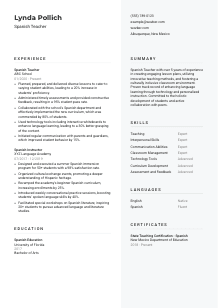
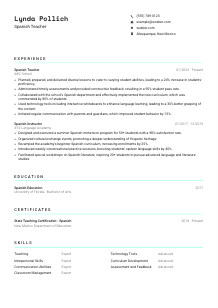
Conjugating verbs in the classroom, but your CV isn't speaking volumes? Check out this Spanish Teacher CV example, created with Wozber free CV builder. It shows how easily you can blend your language expertise with job requirements, allowing your career story to resonate on both sides of "the subjunctive divide!"
Spanish teaching CVs are reviewed through the lens of classroom practice. Schools want to see whether you can plan lessons for mixed ability groups, track language growth through assessments, and create a classroom where students engage with both language and culture. Your CV should make that teaching range visible, not bury it under generic education language.
When the wording lines up with the posting, reviewers can quickly separate a language teacher with real instructional depth from someone with broader teaching experience but less subject alignment. Wozber's free CV builder helps shape that into an ATS-compliant CV by matching your phrasing to the role's requirements, so your lesson delivery, student progress data, and curriculum work come through clearly.
This section is brief, but it still carries hiring value. For a Spanish Teacher, it should confirm professional identity, make contact easy, and remove avoidable questions about location or basic eligibility before the reader gets to your classroom experience.
Use your full name in a larger, clean font so it is easy to find at a glance. School leaders often review many CVs in one sitting, and a clear header keeps your application easy to track through screening, interview scheduling, and reference checks.
Place "Spanish Teacher" directly under your name if that is the role you are pursuing. Matching the posted title helps frame the rest of the CV around subject-specific instruction, which matters when schools are sorting between general education candidates and teachers with direct language teaching experience.
List a reliable phone number and a professional email address. A straightforward format like firstname.lastname@email.com works well. If a department chair wants to move quickly after seeing strong results in student proficiency, parent communication, or curriculum work, your contact details should not slow that down.
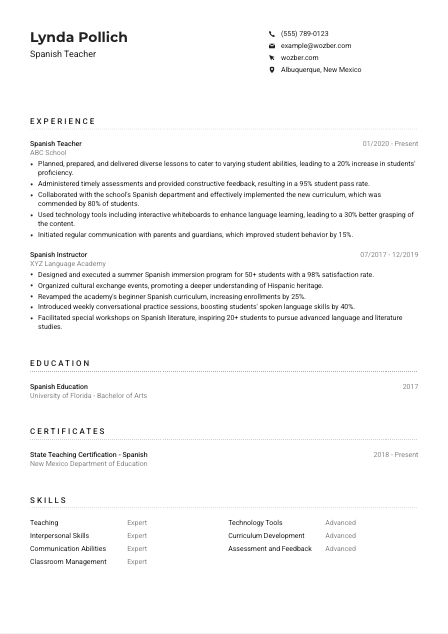
If the job requires local availability, include your city and state. In this example, Albuquerque, New Mexico, belongs in the header because the posting explicitly asks for candidates located there. That small detail can prevent your CV from being screened out before your teaching credentials are reviewed.
Include LinkedIn or a professional teaching portfolio if it strengthens your application. For a Spanish Teacher, that might mean curriculum samples, language program work, student project highlights, or professional development activity. Leave it off if it is outdated or does not add useful teaching context.
Personal details should confirm who you are, how to reach you, and whether you meet any practical filters tied to the opening. Once that is clear, the reader can focus on your classroom record.




This section carries the most weight because schools hire Spanish teachers for what happens in the classroom. Hiring teams look for lesson planning, language assessment, classroom management, cultural inclusion, and collaboration with other educators. Your bullets should show how you taught, what students achieved, and how your work supported the wider program.
Start by pulling the key themes from the posting and mapping your past work against them. For a Spanish Teacher, that usually includes differentiated instruction, assessment, technology use, curriculum collaboration, and family communication. When your bullets reflect those same teaching functions, the CV reads as a direct match instead of a general education profile.
Prioritise positions where you taught Spanish in a formal school or structured academic setting. Include the school name, job title, and dates, then focus your bullets on work that shows subject expertise. The example does this well by leading with a Spanish Teacher role and describing lesson delivery for varied student abilities, which directly reflects the posted responsibilities.
Whenever possible, connect your teaching to student progress, course performance, participation, or program growth. Numbers help when they reflect how teaching is actually evaluated. In the sample CV, a 20% increase in student proficiency and a 95% pass rate are strong because they tie instructional work to clear academic outcomes.
Use bullets that explain the effect of your methods. That might include stronger speaking confidence, better assessment scores, higher enrollment in upper-level Spanish, or stronger engagement through technology such as interactive whiteboards or conversational practice. Concrete outcomes carry more weight than task-only lines like "responsible for lessons and grading."
Trim experience that does not support your case as a Spanish Teacher, and give more space to work tied to language instruction, inclusive classroom practice, and curriculum development. If you mention extracurricular work or events, connect them to Hispanic culture, student engagement, or language immersion so each line strengthens your teaching profile.
By the end of your experience section, a school should be able to see how you teach Spanish, how you measure progress, and how your work improves student learning. That is the standard this section needs to meet.
For teaching roles, education is not filler. It confirms subject preparation and often serves as a first check against the posting. A Spanish Teacher CV should make the degree easy to find, especially when the school asks for Spanish, Spanish Education, or a related field.
List the degree that most directly matches the role, especially if it is in Spanish, Spanish Education, or a closely related field. In this example, a Bachelor of Arts in Spanish Education aligns exactly with what the school requested, so it should be easy to spot without extra searching.
Keep the entry simple: degree, field of study, school, and graduation year. Education sections work best when they are easy to scan, especially for school administrators reviewing certification, experience, and subject alignment side by side.
Do not hide relevant subject preparation behind vague wording. "Bachelor of Arts in Spanish Education" carries more value than listing only "Bachelor of Arts" because it confirms direct preparation for language instruction, pedagogy, and curriculum design.
Relevant courses can strengthen this section if you are early in your career, changing fields, or want to show depth in language instruction. Classes in second-language acquisition, Hispanic literature, linguistics, assessment, or classroom methodology can add useful context without taking over the section.
Honors, language society membership, study abroad, or education-related distinctions can support your candidacy if they add real value. Keep them if they reinforce subject knowledge, cultural fluency, or commitment to teaching. Leave them out if they distract from stronger classroom experience.
Your education section should quickly confirm that your training supports the subject and teaching level you are targeting. If the degree aligns cleanly, the reader can move on to your classroom record with confidence.
Certification matters in education because it speaks directly to eligibility. For Spanish teaching roles, schools usually need to know whether you already hold the required state credential or are on a clear path to obtaining it. Present that information plainly and early.
If the posting asks for state teaching certification in Spanish, list that credential clearly in its own section. In the example, "State Teaching Certification - Spanish" from the New Mexico Department of Education answers a core requirement immediately, which helps the CV move faster through review.
If you hold several certifications, lead with the ones most relevant to Spanish instruction, state licensure, bilingual education, ESL support, or secondary education. The reader should not have to sort through unrelated credentials to find the one that establishes your eligibility to teach.
Add the year earned, validity period, or current status when it helps clarify that the credential is active. This is especially useful in education, where schools need confidence that licensure requirements are current and will hold up through hiring and onboarding.
Professional learning can support this section if it reflects current teaching practice. Workshops in differentiated instruction, instructional technology, language acquisition, or culturally responsive teaching can reinforce that you stay current with methods that matter in a Spanish classroom.
A well-structured certification section removes uncertainty about whether you can step into the classroom and teach the subject legally and effectively. That clarity matters.
A Spanish Teacher's skills section should look like it belongs to someone who runs an active classroom, not a generic list pulled from an education template. Focus on skills that support instruction, student progress, classroom culture, and collaboration with families and colleagues.
Use the posting to identify the capabilities the school is emphasizing. Here, that includes interpersonal skills, English communication, technology tools, and culturally inclusive teaching. Then match those priorities to skills you can support elsewhere in the CV through classroom examples, results, or curriculum work.
List skills that reflect how Spanish is actually taught. Good examples include lesson planning, curriculum development, classroom management, assessment and feedback, educational technology, and differentiated instruction. The sample CV also includes technology tools and curriculum development, which helps reinforce the experience section rather than repeat vague traits.
Choose the skills that matter most for the target role instead of trying to cover everything. A shorter list of well-chosen teaching skills is more convincing than a long inventory of broad strengths. If a skill cannot be backed up by experience, student outcomes, or certification, it probably does not belong here.
This section should confirm the methods, tools, and teaching habits already visible in your experience. When the skills line up with your classroom results, the CV feels consistent and credible.
For a Spanish Teacher, the languages section is part of your professional qualification, not an extra detail. Schools want to understand how well you can teach in Spanish, communicate in English, and support a culturally inclusive classroom with confidence.
If the role calls for strong English communication and Spanish proficiency, list both clearly. Do not assume your job title covers it. This section should confirm, in seconds, that you can teach the subject and communicate with students, parents, and colleagues in the school environment.
Start with the languages most relevant to the role and state your proficiency honestly. The example uses "English - Native" and "Spanish - Fluent," which works well because it aligns directly with the posting's classroom and communication requirements.
Additional languages can be useful if they support multilingual school communities, family communication, or broader cultural competence. Keep them if they strengthen your profile. Do not add them simply to make the section longer.
Choose labels you can defend in an interview or demonstration lesson, such as native, fluent, advanced, or conversational. For a teaching role, inflated language claims can create problems quickly, especially if instruction quality or parent communication depends on that ability.
Some schools value broader multilingual ability because of community demographics, immersion programming, or cross-cultural events. If that applies, tailor the section accordingly. If not, a clear English and Spanish pairing is often enough for a focused application.
Your language section should leave no doubt about your ability to teach Spanish and communicate effectively in the school setting. Precision matters here.
Your summary sits at the top of the CV, so it should establish your teaching profile fast. For this role, that means years of experience, subject focus, classroom strengths, and one or two outcomes or methods that match the school's priorities.
Start from the actual demands of the job. For a Spanish Teacher, that often means lesson planning, differentiated instruction, student assessment, culturally inclusive teaching, and collaboration with staff and families. Use the summary to pull those strengths together in a few direct lines.
Lead with a clear statement such as your role and years of experience. The example summary starts with "Spanish Teacher with over 5 years of experience," which works because it immediately establishes subject area and classroom tenure before moving into instructional strengths.
Choose details that reflect the target school's priorities, such as technology-enhanced instruction, student proficiency gains, curriculum collaboration, or inclusive classroom practice. This is a good place to mention strengths like interactive whiteboard use or personalized instruction if those points also appear in your experience section.
Aim for three to five lines. Avoid broad claims about passion or dedication unless they are backed by specifics. A concise summary that mentions lesson planning, language growth, technology use, and collaboration will land better than a paragraph filled with generic educator language.
A good summary should make the reader expect exactly what the rest of the document delivers: a Spanish teacher who can run an effective classroom, support student progress, and contribute to the school's language program.
A Spanish Teacher CV should leave a school with a clear picture of how you teach, how students respond, and how you contribute beyond your own classroom through curriculum work, parent communication, and inclusive practice.
Use Wozber's free CV builder to organise that experience into an ATS-friendly CV template, then refine it with targeted wording and ATS optimisation so the strongest parts of your teaching record are easy to find.
When your CV is tailored this way, a hiring team can quickly recognize that you are ready to step into the classroom and teach Spanish with confidence.