



Use Wozber and land your dream job
Create CV
No registration required
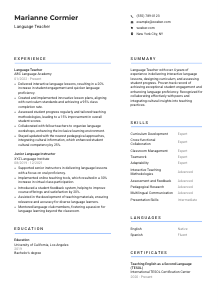
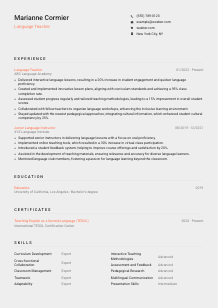
Unraveling grammar mysteries, but your CV seems lost in translation? Explore this Language Teacher CV example, created with Wozber free CV builder. Learn how to fluently showcase your linguistic expertise to align with job requisites, positioning your career on the top of the language podium!
Language teaching work becomes visible through what happens in the classroom. Hiring teams look for teachers who can plan lessons for a defined proficiency level, keep students engaged, track progress over time, and adjust instruction when learners struggle with grammar, speaking, comprehension, or confidence. Your CV should make that classroom practice easy to picture, not just state that you taught languages.
A tailored CV helps separate broad teaching experience from language-specific instruction. When your wording reflects lesson planning, assessment, proficiency growth, and relevant credentials, an ATS can place you in the right applicant pool and a school can quickly see whether you match its curriculum needs. Wozber's free CV builder helps shape that into an ATS-compliant CV that clearly shows how you teach, measure student progress, and contribute to a supportive learning environment.
This section should confirm the basics fast and remove friction before anyone gets to your lesson outcomes or teaching methods. For a Language Teacher, that means clear contact details, a role title that matches the opening, and location information when the posting specifies it.
Use your full name as the most prominent line on the page so the CV is easy to identify in a stack of applications or an ATS export. Keep the styling clean and professional. Schools and language institutes do not need decorative formatting here, just a clear header they can connect to your application records.
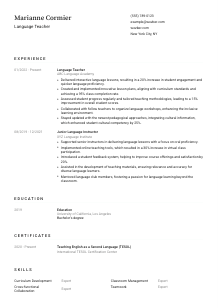
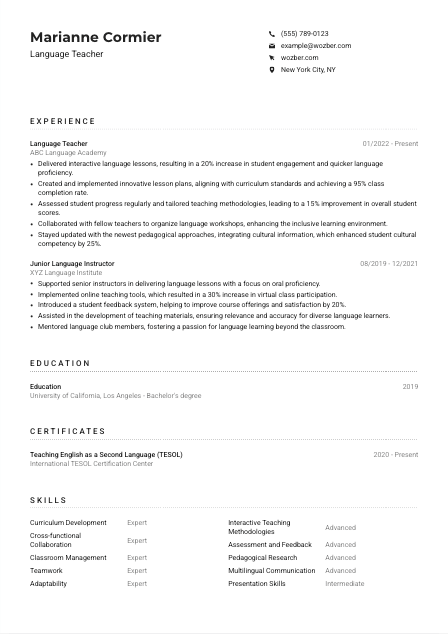
Place "Language Teacher" under your name if that is the role you are pursuing. If the opening is more specific, such as ESL Teacher or Spanish Language Instructor, use the posted title when it accurately reflects your background. In the sample CV, the direct title immediately aligns the candidate with the vacancy and avoids any ambiguity about instructional focus.
Include a current phone number and a professional email address. Double-check both. Hiring for teaching roles often moves through quick coordination for interviews, demo lessons, or reference checks, so your contact details should be simple, accurate, and visible at a glance.
If a school or academy asks for candidates in a specific city, include your city and state in this section. Here, listing New York City, NY addresses a stated requirement and helps avoid questions about relocation or availability. Keep this practical. You do not need a full street address unless an employer specifically asks for it.
A LinkedIn profile or professional website can help if it supports your CV with consistent information, teaching credentials, workshop participation, or education-related accomplishments. If it is outdated or sparse, leave it off. Any link you include should reinforce your classroom credibility, not send the reader to unfinished content.
Your personal details should answer three questions immediately: who you are, what role you are targeting, and whether you meet any basic logistical requirement such as location. Once that is clear, the rest of the CV can stay focused on your teaching practice.




For Language Teacher roles, experience is where hiring teams look for proof that you can run a class, adapt instruction, and move learners forward. Generic teaching bullets blend together quickly. What stands out is specific classroom work, measurable student outcomes, and evidence that you can teach with intention rather than just cover material.
Before editing your bullets, mark the responsibilities that define the role. In this description, the priorities include delivering lessons through varied methodologies, building lesson plans to curriculum standards, assessing student progress, collaborating with staff, and staying current with pedagogy and cultural content. Those points should shape the language of your experience section so your CV mirrors the real work of the role.
Start with your most recent teaching position and work backward. For each role, include your job title, institution, and dates. That format lets a hiring manager quickly track your experience level, whether you have taught at the relevant proficiency range, and how your responsibilities developed over time. The sample does this well by showing progression from Junior Language Instructor to Language Teacher.
Each bullet should show what you taught, how you taught it, and what changed because of your work. Strong examples include designing interactive lessons, adapting materials for learner needs, using online teaching tools, improving oral proficiency practice, or organising language workshops. In the sample CV, bullets connect teaching activity to outcomes like higher engagement, better scores, and improved course satisfaction, which makes the experience feel grounded in classroom performance.
Quantify outcomes where you can do so honestly. In language teaching, useful measures include engagement rates, class completion, student score improvement, participation in virtual classes, retention, or gains tied to proficiency assessments. A bullet such as "improved student scores by 15% through tailored assessment and feedback" carries much more weight than a general claim about helping students succeed.
Prioritise experience that supports your candidacy as a language educator. That includes lesson planning, curriculum alignment, assessment, cultural instruction, classroom management, and collaboration with other teachers. Activities outside the classroom belong only if they strengthen that story, such as mentoring a language club or supporting online instruction. If a detail does not help explain your teaching range or student impact, cut it.
Your experience section should show that you can teach a language course from planning through assessment, not just that you have worked in education. Clear bullets, relevant metrics, and role-specific language make that easy to understand.
Language teaching roles usually start with an academic baseline, especially when schools want a degree in Education, Linguistics, or a related field. This section should confirm that foundation quickly and show any study that supports your ability to teach language structure, pedagogy, literacy, or second-language acquisition.
Check the exact educational expectation before you format this section. For the role here, a bachelor's degree in Education, Linguistics, or a related field is part of the minimum criteria. If you meet that requirement directly, make sure it is easy to spot. The sample candidate does this by listing a Bachelor's degree in Education, which aligns cleanly with the posting.
List your degree, field of study, school, and graduation year. Keep the order consistent and easy to scan. A hiring manager reviewing multiple teaching applications usually wants to confirm qualification level quickly before moving on to your classroom experience and certifications.
If you have more than one credential, lead with the one most relevant to the role. Degrees in Education, TESOL, Applied Linguistics, Modern Languages, or related teaching fields should sit above less relevant study. This helps frame you as a language educator rather than a general applicant with unrelated academic history.
This is most useful early in your career or when the coursework speaks directly to the role. Modules in second-language acquisition, curriculum design, phonetics, literacy instruction, or classroom assessment can add context. Academic honors, teaching practicums, or education research projects also help when they show preparation for real classroom work.
If you completed graduate coursework, specialised teacher training, or notable academic distinctions, include them when they support the target role. Keep the focus on what matters for language instruction and learner development. A concise section is usually stronger than a long academic list that does not change how your candidacy is evaluated.
This section should quickly confirm that you meet the role's educational threshold and, where relevant, show training connected to language pedagogy. Once that is established, your experience and certifications can carry the deeper teaching story.
Certifications matter in language teaching because they show formal preparation in methodology, learner support, and instructional standards. For some openings, a TESOL or equivalent credential is a stated requirement. Even when it is not mandatory, relevant certificates strengthen your credibility in second-language instruction.
If the employer asks for TESOL, TEFL, CELTA, state certification, or another language-teaching credential, place that certificate first. In this job description, TESOL or an equivalent credential is explicitly requested, so it should be impossible to miss. The sample CV handles this well by featuring TESOL at the top of the section.
Prioritise certifications tied to language instruction, assessment, pedagogy, literacy development, or curriculum delivery. A smaller, focused list is stronger than a long collection of unrelated courses. For this profession, certificates should help explain how you teach and what standards or methods you are trained to use.
Add the year earned and, if relevant, the active date range. This matters when certifications are current, renewable, or part of ongoing professional development. Recent dates can also show that you are keeping pace with changes in instructional practice, online teaching, or assessment frameworks.
Language teaching changes with new classroom technology, inclusion practices, and research on acquisition and engagement. If you are actively maintaining a credential or adding training in areas like online instruction or differentiated learning, include that selectively. It tells employers you are not teaching from outdated methods.
A well-chosen certification section shows formal preparation for language instruction and continued professional growth. For postings that name TESOL or equivalent credentials, this section should remove any doubt that you meet that expectation.
Schools expect more than subject knowledge from a Language Teacher. They want someone who can manage a classroom, build lessons that meet students where they are, assess progress, and communicate well with learners, families, and colleagues. Your skills section should reflect that day-to-day teaching reality.
The job description gives you a useful shortlist. Here, that includes diverse teaching methodologies, lesson planning, assessment, communication, collaboration, and cultural awareness. You can also infer related teaching skills such as classroom management, curriculum development, differentiation, and learner feedback. Use the posting to decide which skills deserve space on the page.
Balance technical teaching abilities with the interpersonal skills that matter in language classrooms. Strong entries might include curriculum development, proficiency assessment, interactive teaching methodologies, classroom management, multilingual communication, and cross-functional collaboration. The sample CV does this effectively by combining pedagogy-focused skills with teamwork and adaptability, which reflects how language teaching actually works in schools and institutes.
Group or order skills so the most relevant teaching capabilities appear first. Lead with instructional and assessment skills before broader workplace traits. Avoid filling this section with vague terms that could belong to any job. If a skill does not connect to language learning, student progress, curriculum delivery, or collaboration in an education setting, it probably does not belong here.
Your skills list should help a hiring team picture how you run a class, support learners, and work within a teaching team. Prioritised well, it reinforces the methods and strengths already shown in your experience.
For a Language Teacher, this section is more than a nice addition. It can be central to the hiring decision. Schools need to know which languages you can teach or support, how strong your English is when it is a core competency, and whether your proficiency matches the classroom level you would handle.
Read the posting carefully and place required languages first. In this case, English fluency is a core competency, so English should appear prominently with an accurate proficiency level. Do not assume it is understood. If the employer names a required teaching language, that language belongs at the top of the section.
Begin with the language or languages most connected to the role, then add others that broaden your teaching value. For example, the sample CV lists English first and Spanish second, which works well because it covers the required fluency and shows additional language capability. That order makes practical sense to both ATS screening and human review.
Extra languages can strengthen your candidacy when they reflect multilingual competence, cross-cultural awareness, or flexibility with diverse learners. They are especially useful in schools serving multilingual communities or programs that value broader language exposure. Include them when they add real instructional or communication value.
Use honest labels such as Native, Fluent, Advanced, Intermediate, or Basic. If you teach a language professionally, your stated level should be consistent with the experience and credentials elsewhere on the CV. Inflated language claims are easy to challenge in interviews, demo lessons, or classroom observations.
Where relevant, think beyond listing languages as personal attributes. For language educators, proficiency often supports lesson delivery, pronunciation modeling, grammar explanation, bilingual support, or cultural instruction. The section stays concise, but the language mix you choose should support the teaching story told in the rest of the CV.
This section should tell an employer, in seconds, whether you can meet the linguistic demands of the classroom. Clear ordering and accurate proficiency levels matter here more than volume.
The summary should quickly establish what kind of Language Teacher you are, how much experience you bring, and what results your teaching has produced. In a few lines, it should connect your instructional style, classroom strengths, and credentials to the type of program you want to join.
Use the posting to decide what belongs in your opening lines. For this role, interactive lessons, curriculum-aligned planning, regular assessment, and strong communication are central themes. If those reflect your background, echo them naturally in your summary so the employer sees alignment before reading the rest of the CV.
State your years of experience and the kind of language instruction you provide. The sample summary begins with "Language Teacher with over 4 years of experience," which works because it gives immediate context. You can strengthen this further by naming your teaching setting, learner level, or instructional specialty if it is relevant to the job.
A useful summary does more than list traits. Mention the teaching approaches you use and the results they have produced, such as stronger engagement, improved proficiency, better assessment outcomes, or effective curriculum delivery. The sample does this well by referencing interactive lessons, curriculum design, and student progress rather than relying on generic enthusiasm.
Aim for three to five lines that a hiring manager can absorb quickly. Focus on experience, subject fit, and classroom impact. Avoid broad statements that could describe any teacher. A short, targeted summary is especially helpful for ATS optimisation because it places role-specific terms near the top of the CV in natural language.
Your summary should make it clear, within a few seconds, what you teach, how you teach, and what outcomes follow from your work. That gives the rest of the CV a clear direction and helps the employer read your experience in the right frame.
A well-tailored Language Teacher CV shows more than enthusiasm for education. It shows classroom ownership, lesson planning tied to standards, thoughtful assessment, and measurable progress in student language development.
Use the job description to shape your wording section by section, then refine it in Wozber with ATS-friendly CV templates, an ATS CV scanner, and AI-assisted tailoring that helps align your experience with the language schools and programs actually search for. The finished CV should make one thing easy to judge: you can step into the classroom and teach effectively from day one.