



Use Wozber and land your dream job
Create CV
No registration required
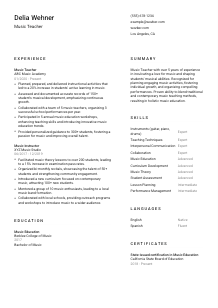
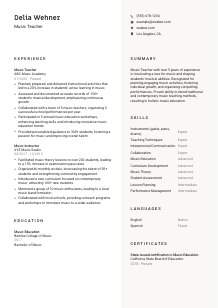
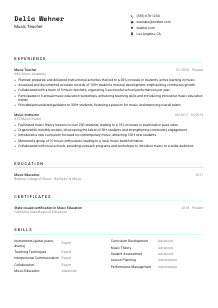
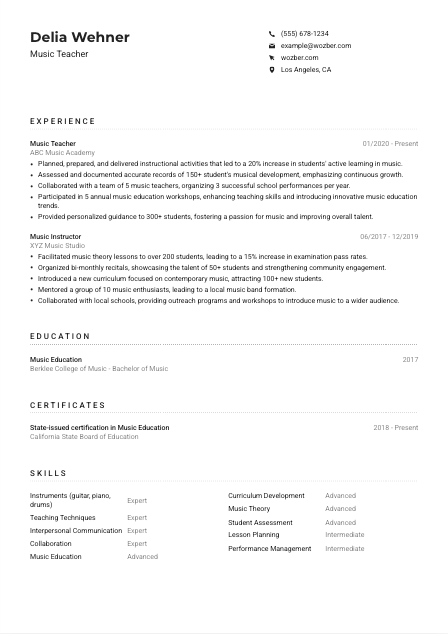
Hitting the right notes, but your CV seems out of tune? Tune into this Music Teacher CV example, created with Wozber free CV builder. It shows how to align your musical expertise with job requirements, composing a career that's always in perfect harmony!
Music teaching jobs are won on far more than performance ability. Schools want to see that you can turn musical knowledge into structured instruction, keep students engaged across different skill levels, track progress over time, and contribute to performances that reflect well on the program. Your CV should make that teaching practice visible, not just list instruments or a general love of music.
When a CV is tailored well, the hiring team can quickly separate a capable performer from someone who can actually run lessons, document student growth, and work within a school setting. Wozber's free CV builder helps you shape that story in an ATS-friendly CV format, so requirements like music education credentials, instructional experience, and classroom results are easy to find and easy to trust.
For a Music Teacher, the header needs to do one practical job well. It should confirm who you are, what role you do, and whether basic hiring requirements like location and contact access are already covered before anyone reaches your teaching experience.
Use your full name in a larger, clean font so it reads as the clear heading of the CV. This is simple, but important. School administrators and program directors often review many applications quickly, and a readable header keeps the document easy to scan and easy to revisit after interviews or audition-style teaching reviews.
Place "Music Teacher" right under your name if that is the role you are targeting. This immediately aligns your CV with the posting and helps both ATS screening and human reviewers place your background correctly. If your recent title was "Music Instructor," you can still position yourself for a school-based role by using the target title in the header and showing the overlap in your experience section.
Include a working phone number and a professional email address, ideally in a straightforward format such as first name plus last name. Double-check both. For teaching roles, missed calls or emails can mean missing interview scheduling, demo lesson requests, or follow-up questions about certification and availability.
If the school specifies a location requirement, show your city and state in the header. Here, listing "Los Angeles, CA" directly answers a stated requirement and removes uncertainty about relocation or local eligibility. Only include this when it is relevant to the job you are targeting.
A portfolio, school-safe personal website, or polished LinkedIn profile can add useful context if it shows recital programs, teaching philosophy, student ensemble work, or community music involvement. Only include it if the content is current and supports your classroom credibility as clearly as the CV does.
This section should answer the first basic questions without slowing the reader down. A clear name, matching title, reliable contact information, and any required location detail give the hiring team a clean starting point for evaluating your teaching background.




This is the section most likely to decide whether you move forward. Schools want to see evidence of instruction, student development, assessment, performance preparation, and collaboration with other educators, not just a list of music-related jobs.
Read the posting closely and underline the teaching actions it emphasizes. For a Music Teacher, that often includes planning lessons, delivering instruction, assessing student progress, maintaining records, guiding students, and helping organise performances. Those themes should shape the examples you choose from each role, especially if you have both school and private-instruction experience.
Start with your most recent position and list the school, academy, studio, or program, followed by your title and dates. This format helps hiring teams understand where you taught, how long you stayed, and whether your experience comes from formal education settings, private instruction, or both. In the sample CV, the progression from music studio work into a Music Teacher role makes that growth easy to follow.
Each bullet should show what you taught, how you taught it, and what changed because of your work. Focus on classroom or studio outcomes such as stronger participation, improved pass rates, successful recitals, curriculum updates, or student growth across a semester or school year. The sample does this well with points like increasing active learning by 20% and maintaining records for more than 150 students, which directly connects teaching effort to measurable results.
Numbers help schools understand your range as an educator. Include student counts, performance frequency, exam outcomes, workshop participation, ensemble size, or curriculum results where you can support them honestly. Metrics like "organised 3 school performances per year," "taught 200+ students," or "improved examination pass rates by 15%" tell a much fuller story than generic claims about being passionate or effective.
Prioritise roles and achievements that show classroom instruction, private lesson delivery, music theory teaching, ensemble support, performance planning, mentoring, or collaboration with staff. If you have unrelated work, trim it back unless it adds something that matters in school environments, such as youth leadership, event coordination, or parent communication. The closer every bullet stays to teaching practice, the stronger this section reads.
Your experience section should make it easy to picture you teaching students, tracking progress, and contributing to performances and school life. When the bullets show clear instructional scope and results, hiring teams can judge your classroom value quickly.
For Music Teacher positions, education is usually a qualification checkpoint, not a filler section. The degree listed here often determines whether you meet a baseline requirement for licensure, subject knowledge, and eligibility to teach in a formal school setting.
If the posting asks for a Bachelor's degree in Music Education or a related field, make sure that wording is easy to spot. List your degree, field of study, school, and graduation year clearly. In the sample, "Bachelor of Music" in "Music Education" lines up neatly with the employer's requirement and helps both ATS screening and manual review.
Keep this section straightforward. Degree, institution, field, and graduation date are usually enough. Hiring teams are checking for educational relevance first, not looking for decorative detail. A simple format also reduces the chance of key information being missed in ATS parsing.
If your degree is directly tied to music education, place that field front and centre. If your background is in performance, composition, or another music discipline, make the teaching connection clearer elsewhere through certification, coursework, student teaching, or experience bullets that show instructional depth.
Extra detail belongs here only if it adds something useful for the role. Coursework in music theory, pedagogy, child development, conducting, curriculum design, or instrumental methods can help newer teachers show range. For experienced candidates, this section can stay lean unless a specific training area supports the target school's program.
Academic distinctions, ensemble leadership, peer tutoring, or education-focused projects can strengthen this section when they relate to instruction or musicianship. Keep them relevant. A dean's list line matters less than a practicum, conducting role, or teaching assistantship that shows you have already worked with learners and repertoire in a structured setting.
This section should quickly establish that your academic background supports music instruction in a school or formal teaching environment. Clear degree information helps remove doubt early and lets the reader move on to your actual teaching results.
Certification matters in music education because it often decides whether a school can move forward with your application at all. If the posting mentions state licensure or eligibility, that credential should be visible and easy to understand.
Lead with any state-issued Music Education certificate, license, or eligibility status that matches the posting. For this job, a state-issued certification in Music Education is a stated requirement, so it should appear prominently. If you are still in progress, say that clearly and use the exact wording that reflects your current status.
This section works best when it stays focused. Include certifications that support your ability to teach music in schools, deliver instruction safely, or work with students effectively. A short, relevant list carries more weight than unrelated short courses that do not affect your eligibility or classroom practice.
Add issue dates and, when relevant, expiration dates or current validity. Schools need to know whether a credential is active, recent, or renewable. The sample CV handles this clearly by showing the certification as active from 2018 to present, which helps the reader quickly understand status.
If you have additional credentials in areas like Kodaly, Orff, classroom technology, choral direction, instrumental pedagogy, or student safeguarding, include them when they strengthen your fit for the type of program you are applying to. Professional development matters most when it connects to how you teach, manage ensembles, or update instruction.
A clearly listed credential tells the school that you meet a formal requirement and are prepared to teach within their standards. That clarity matters, especially in roles tied to state rules, student supervision, and academic recordkeeping.
The best Music Teacher skills sections balance musicianship with classroom practice. Schools need to see instrumental ability, but they also need confidence in lesson planning, student assessment, communication, and collaboration around performances and school events.
Pull out both the direct requirements and the obvious day-to-day abilities behind them. Here, that includes teaching multiple instruments, instructional delivery, student engagement, assessment, communication with parents and staff, and collaboration with other music teachers. These should shape the section more than broad terms like "creative" or "hardworking."
Choose skills that reflect the actual work of the role. Instrument proficiency, music theory, curriculum development, teaching techniques, lesson planning, student assessment, classroom management, and performance coordination are all stronger than vague descriptors. The sample CV handles this well by combining instrument range with teaching and collaboration skills, which gives a fuller picture of classroom readiness.
Do not overload this section with every musical or personal trait you can name. A focused list is easier to scan and easier to support with evidence elsewhere in the CV. If a skill cannot be backed up through experience, education, or certification, it probably does not belong here. Choose the abilities you would be comfortable discussing in an interview or demonstrating in a lesson.
A well-chosen skills section reinforces the methods, tools, and strengths already shown in your experience. Keep it tied to instruction, student progress, and musical versatility so the section adds substance instead of repetition.
Language ability can matter more in teaching than many candidates realize. In music education, it can affect how well you communicate instructions, write progress notes, speak with families, and build trust with a diverse student community.
If the job calls for strong English proficiency, include English first and mark your level accurately. For this posting, that is a fundamental requirement, so it should be unmistakable. This is especially important in roles that involve classroom instruction, written feedback, parent communication, and coordination with school staff.
Additional languages can be valuable in schools, community programs, and private instruction settings with multilingual families. In a diverse market like Los Angeles, another language such as Spanish may strengthen communication with students and parents, but it should be presented as an added asset rather than a substitute for the required teaching qualifications.
Stick to clear terms such as "Native," "Fluent," "Intermediate," or "Basic." Inflated language claims can create problems quickly in interviews or school interactions. Accurate labels help hiring teams understand whether you can handle classroom communication, informal family conversations, or only limited exchanges.
Only highlight languages that you can use meaningfully in the role. For a Music Teacher, that may include explaining technique, clarifying rehearsal instructions, discussing student progress with parents, or supporting community outreach events. When language skills improve communication around learning, they become much more than a side note on the CV.
If your language skills help you teach more clearly or connect with more families, they belong on the CV. Keep the section accurate and relevant to the school environment you want to work in.
Your summary should quickly answer the question a school is already asking: what kind of Music Teacher will this person be for our students? In a few lines, connect your experience, teaching range, and measurable outcomes so the reader understands your value before reaching the full work history.
Start with your title and years of relevant experience in music instruction. If you have taught in schools, academies, or private settings, summarise that scope in one line. The sample summary does this effectively by establishing more than 5 years of experience and a clear focus on developing students' musical abilities.
Choose two or three strengths that match the posting closely, such as lesson planning, active learning, student mentorship, assessment, instrument instruction, or performance preparation. This is the place to reflect the employer's priorities in your own words, especially if the job emphasizes engagement, documentation, and collaboration with staff.
Finish with a specific outcome, teaching method, or program contribution that helps you stand apart. That could be improved student participation, stronger exam performance, successful recitals, or a blend of traditional and contemporary instruction. Keep the full summary tight, usually three to five lines, and make every sentence point toward the classroom results you can deliver.
A sharp summary gives the hiring team an immediate sense of your instructional style, experience level, and contribution to student growth. When it is tailored well, the rest of the CV reads with much more context and confidence.
A Music Teacher CV should show that you can do the daily work of teaching, not just perform or describe your passion for music. When your experience, education, certification, and skills all point to student growth, lesson quality, assessment, and performance preparation, the application becomes much more persuasive.
Use Wozber's free CV builder to organise that information into an ATS-compliant CV, strengthen wording with role-specific language, and refine each section with clearer ATS optimisation. The final result should make it easy for a school to see your instructional range, your credibility in music education, and your readiness to lead students well.




