



Use Wozber and land your dream job
Create CV
No registration required
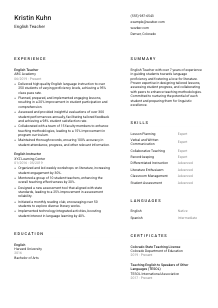
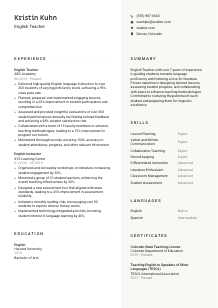
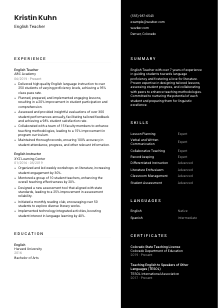
Molding minds, but your CV feels lost in translation? Check out this English Teacher CV example, created with Wozber free CV builder. Learn how to present your literary strengths to match a school's needs, penning a career story as captivating as the classics!
English teaching is reviewed through the work itself. Schools want to see whether you can turn reading, writing, speaking, and language instruction into lessons that meet mixed proficiency levels, hold student attention, and produce measurable progress. A CV for this field should make your classroom practice visible, from lesson design and assessment methods to the way you support different learners.
When that detail is tailored to the posting, the hiring team can quickly separate general teaching experience from English-specific instruction. Wozber's free CV builder helps you align your wording with the role and create an ATS-compliant CV that clearly surfaces teaching certification, differentiated instruction, assessment work, and student outcomes. That makes it easier to see whether you can step into the classroom and deliver strong English instruction from day one.
This section is brief, but it still does real work. For an English Teacher, it should immediately confirm professional identity, clear contact information, and any practical requirement the school may screen for early, such as location.
Use your full name in a clean, readable format at the top of the CV. Keep it more prominent than the rest of the text so the page looks organised from the first glance, much like a well-structured lesson plan.
Place "English Teacher" under your name if that is the role you are targeting. This removes ambiguity for both the hiring team and the ATS. If your current title is "English Instructor" or a similar variation, you can still target the posted title as long as your experience supports classroom teaching in English language arts or language instruction.
Include a phone number you answer, a professional email address, and any relevant professional link, such as a teaching portfolio or LinkedIn profile. If you share lesson samples, curriculum work, or student-facing materials online, make sure the content reflects your classroom standards and communication style.
Some schools filter early for local candidates or those ready to relocate. Here, Denver, Colorado is named in the posting, so listing Denver if you already live there helps remove a practical question. If you plan to relocate, make that clear in a way that does not distract from your teaching qualifications.
A portfolio is useful when it shows something concrete: unit plans, writing rubrics, literacy projects, or classroom technology use. Skip personal links that do not strengthen your case as an educator. For this profession, relevance matters more than having an extra line on the page.
Your header should confirm who you are, how to reach you, and whether any basic screening issue is already covered. Keep it polished, direct, and aligned with the teaching role you want.




For English Teachers, experience is not just a list of schools and dates. It should show what you taught, how you taught it, how students responded, and what improved under your instruction. Hiring teams look for classroom range, assessment practice, and evidence that your teaching moved students forward.
Read the posting closely and mark the instructional tasks that appear repeatedly. In this role, that includes delivering English instruction to varying proficiency levels, creating engaging lesson plans, assessing performance, collaborating with faculty, and maintaining student records. Those points should shape the bullets you choose and the language you use.
List positions in reverse chronological order with school name, title, and employment dates. Keep the structure easy to scan. If you have taught in both formal school settings and learning centers, present them in a way that makes your progression clear, especially if it shows movement from instructional support into full classroom responsibility.
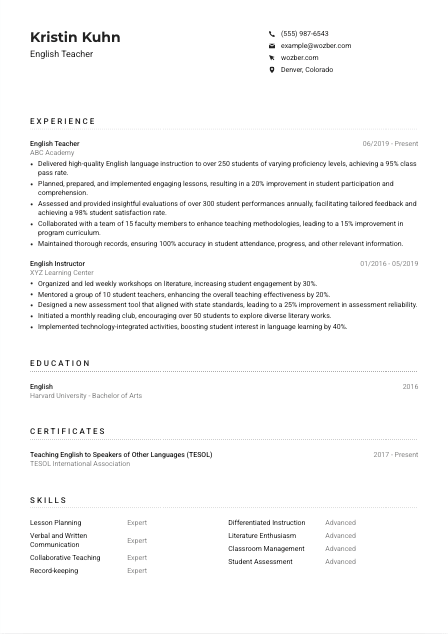
Your strongest bullets describe the teaching work and the result. Include lesson planning, differentiated instruction, student feedback, literacy activities, curriculum support, or classroom management when they are central to the role. The example CV does this well by connecting classroom actions to outcomes such as higher participation, improved comprehension, and stronger curriculum results.
Metrics help when they reflect real teaching performance. Student load, pass rates, participation gains, annual evaluation volume, workshop attendance, or curriculum improvements all make your impact more concrete. In the sample, figures like 250 students taught, a 95% pass rate, and a 20% participation increase give the reader a much clearer picture of scope and effectiveness than vague claims ever could.
Prioritise experience that strengthens your value as an English Teacher. Literature workshops, assessment design, reading initiatives, mentoring, and technology-integrated instruction all belong when they support language learning. Older or unrelated jobs can be shortened or removed unless they explain a key transferable strength such as communication, tutoring, or youth development.
This section should show that you can plan instruction, manage a classroom, measure learning, and contribute to the wider teaching team. If those points are easy to find in your bullets, your experience is doing its job.
Schools expect an English Teacher's education section to confirm subject grounding and basic eligibility. That usually starts with a bachelor's degree in English, Education, or a related field, then adds any details that strengthen your teaching profile.
If the posting asks for a bachelor's degree in English, Education, or a related area, place that qualification first and write it clearly. A degree such as "Bachelor of Arts in English" immediately lines up with the subject matter of the role and should not be buried under less relevant study.
List degree, field, school, and graduation year. Schools are usually scanning for qualification match first, not decorative detail. The sample CV handles this well with a concise entry that confirms the candidate meets the degree requirement without overexplaining it.
If your degree title is broader, use the field or concentration line to connect it to English teaching. For example, coursework or concentration in literature, writing, linguistics, or secondary education can clarify why your academic background supports the classroom demands of the role.
Newer teachers can use relevant coursework to show preparation in curriculum design, literacy instruction, adolescent literature, composition, ESL methods, or assessment. This is especially useful when your full-time teaching record is still developing and your academic training carries more weight.
Honors, scholarships, or academic societies can help if they point to subject mastery or consistent performance. Keep them concise. For experienced teachers, these details should stay secondary to classroom results and certification.
This section should confirm that you have the academic foundation to teach English and support literacy development. For most candidates, clean presentation and subject relevance matter more than extra detail.
Certification matters in education because it often determines whether you are eligible before anyone reads the rest of the CV. For English Teacher roles, licenses and language-teaching credentials should be easy to find and current.
Start with the certifications that satisfy the posting. Here, that means a state-issued teaching license or credentials such as TESOL or TEFL. If you hold both, list the one most directly tied to the school setting first, then the specialised language credential after it.
This section should stay selective. State licenses, TESOL or TEFL certification, reading intervention training, ESL endorsements, or curriculum-related credentials are usually more valuable here than general online course completions. The sample CV uses a Colorado teaching license and TESOL certification, which directly support the role's stated requirements.
Write the certificate name, issuer, and date or active period. That helps schools confirm whether the credential is valid and relevant to current hiring standards. If a license is pending renewal, make sure the wording is accurate and transparent.
If you have recent workshops or certificates in differentiated instruction, literacy intervention, assessment design, or classroom technology, they can reinforce your teaching range. Include them when they sharpen your fit for the role, especially if the posting emphasizes adapting instruction or improving program curriculum.
A school should be able to confirm your teaching credentials in seconds. Put the most relevant licenses and certifications first, keep the details current, and let this section reinforce your readiness to teach.
An English Teacher's skills section works best when it reflects actual classroom work. Schools are looking for teaching capabilities they can connect to lesson delivery, student support, assessment, and collaboration, not a generic list of soft skills.
Pull the skill terms that matter most from the job description. In this case, verbal and written communication, adapting to different learning styles, lesson planning, assessment, and record maintenance all point to skills worth naming directly. This improves both ATS optimisation and human readability.
Include skills tied to real classroom execution such as differentiated instruction, literature instruction, writing feedback, student assessment, classroom management, collaborative teaching, and curriculum development. The example CV also includes record-keeping, which fits the responsibility for maintaining attendance and progress data.
Do not overload this section with every trait you could claim. A tighter list is stronger if each skill can be backed up elsewhere in the CV. If you label yourself advanced in differentiated instruction or expert in lesson planning, your experience bullets should show where that work happened and what results followed.
The right skills section helps a school picture how you teach, communicate, and track learning. Keep it specific enough that every item could be proven by your experience, certification, or daily practice.
Language matters differently for teachers than it does in many other professions. For an English Teacher, English proficiency is essential, and additional languages can become a practical asset in classrooms with multilingual students or families.
If the role specifically requires the ability to understand and speak English, list English clearly and use an accurate proficiency level such as Native or Fluent. That should be immediate and unambiguous because it sits at the core of the teaching work.
Additional languages are worth listing when they can help with classroom rapport, family communication, or instruction in multilingual settings. In the example, Spanish adds useful context without distracting from the core requirement of English fluency.
Choose clear levels such as Native, Fluent, Intermediate, or Basic. Schools may rely on these labels when assigning responsibilities, speaking with families, or considering support for English learners, so precision matters.
If the school serves English learners or a multilingual student population, language skills can be more than a side note. In those cases, a second language may support differentiated instruction, vocabulary reinforcement, or parent communication, and deserves a place on the CV.
Only include languages you can genuinely use. The point is not to look worldly. It is to show communication range that could matter in a real educational setting.
For this role, English proficiency should be unmistakable. Any additional language should strengthen your ability to teach, support students, or communicate with the school community.
The summary is where you quickly establish your teaching profile before the reader reaches the details. For English Teachers, that means years of experience, instructional strengths, student group or proficiency range, and a clear sense of the outcomes you help produce.
Start with a direct line that states who you are and how long you have taught. "English Teacher with 7 years of experience" works because it places you immediately in the profession and gives the reader a frame for the rest of the CV.
Pull in two or three areas that match the posting closely, such as lesson planning, differentiated instruction, student assessment, literature engagement, or English language instruction across proficiency levels. The sample summary succeeds because it connects tailored lessons, student progress, and collaboration instead of staying vague.
Aim for a short paragraph that can be read in seconds. Replace broad claims with concrete teaching language. "Designed engaging lessons and assessed student progress across mixed-ability classrooms" says much more than a general statement about being passionate and hardworking.
End with a forward-looking line that fits the profession, such as supporting language proficiency, building confidence in reading and writing, or contributing to curriculum quality. Keep it grounded in student learning rather than personal aspiration alone.
After reading these lines, a school should already understand your level, your instructional strengths, and the kind of classroom impact you bring. That is enough to make the rest of the CV worth close attention.
Your CV should now show the essentials schools need to confirm quickly: subject knowledge, certification, classroom experience, student outcomes, and the ability to teach across different learning needs. Keep every section tied to real teaching work, whether that means lesson planning, assessment, literacy engagement, or accurate record-keeping.
Use Wozber's AI CV builder to tailor your wording to each posting, strengthen ATS optimisation, and present your experience in an ATS-friendly CV format. With the right details in the right places, your CV makes it much easier for a school to see you leading an English classroom with confidence and structure.