



Use Wozber and land your dream job
Create CV
No registration required
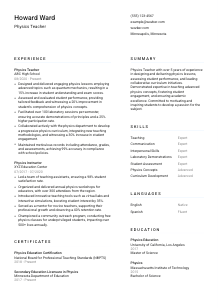
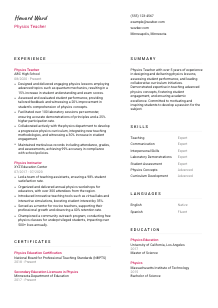
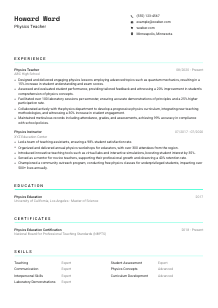
Unraveling laws of motion, but your CV seems at rest? Check out this Physics Teacher CV example, created with Wozber free CV builder. Learn how to put your physics know-how to work in line with school expectations, propelling your teaching career to the highest trajectory!
Physics teaching asks for more than subject knowledge. Schools look for someone who can turn abstract ideas into clear instruction, run safe and useful lab work, and help students progress from confusion to confidence across topics that can range from mechanics to electromagnetism. Your CV should make that classroom impact visible, not just list courses taught.
Screening gets easier when your CV shows the same language a school uses for instruction, assessment, lab facilitation, and curriculum work. Wozber's free CV builder helps shape that content into an ATS-compliant CV, so a hiring team can quickly see whether your background matches the teaching load, student level, and academic expectations of the role.
School leaders should be able to identify you, contact you, and confirm basic application logistics within seconds. Keep this section clean and direct so attention stays on your teaching background, licensure, and classroom results.
Use your full name as the most visible line on the page. A clear header helps administrators and department heads find your file quickly when they are reviewing multiple candidates for the same teaching assignment.
Place "Physics Teacher" under your name if that is the role you are pursuing. This helps align your CV with the posting and immediately frames your experience around secondary physics instruction rather than broader science teaching.
Add a current phone number and a professional email address. If you include a website or profile, make sure it supports your application with teaching credentials, classroom projects, curriculum work, or academic achievements rather than unrelated content.
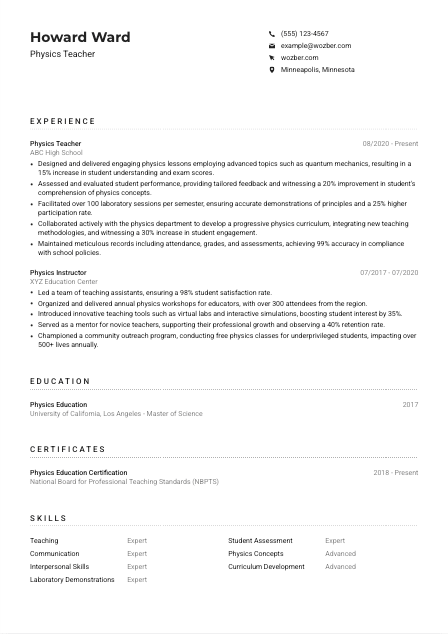
If a school specifies location or relocation expectations, respond directly in this section. In the example, listing Minneapolis, Minnesota removes doubt about local availability. If you are relocating, make that clear here instead of leaving the school to guess.
A LinkedIn profile, teaching portfolio, or school-facing website can add value when it includes lesson design, lab activities, certifications, or student-facing academic work. Keep titles, dates, and credentials consistent with the CV so there are no mismatches during review.
This section should answer practical questions fast: who you are, what role you teach, how to reach you, and whether you meet any location requirement. Once that is settled, the rest of the CV can stay focused on instruction, labs, and student outcomes.




For a Physics Teacher, experience is where schools look for proof of classroom range and instructional results. They want to see the subjects you taught, how you handled assessment and labs, and whether students benefited from your methods.
Read the posting for the actions the school repeats or emphasizes. Here, the priorities are lesson planning, advanced physics instruction, student assessment, lab facilitation, curriculum collaboration, and recordkeeping. Build your bullets around those same functions so your experience reads as directly relevant.
Start with your most recent teaching position and work backward. Include the school or institution, your title, and dates so reviewers can quickly track your experience level in secondary education and see whether you meet the requested 3+ years.
Focus on what you taught, how you taught it, and what changed for students or the program. The sample CV does this well by pairing work such as delivering advanced physics lessons and providing tailored feedback with outcomes like higher exam scores and stronger comprehension. That approach is much stronger than vague bullets about "supporting students" or "handling instruction."
Metrics make teaching impact easier to understand when they are tied to real school outcomes. Useful examples include exam score gains, participation rates in labs, number of lab sessions run, student satisfaction, curriculum adoption, or record accuracy. The example's 15 percent lift in understanding and 99 percent compliance in records are the kind of specifics that help a hiring team picture your effectiveness.
Choose accomplishments that support your candidacy for physics instruction in a school setting. Outreach, mentoring, or workshops can be valuable if they reinforce your teaching range, but classroom instruction, assessment, lab supervision, and curriculum work should take priority because those are closest to the daily demands of the role.
Your experience section should leave no doubt that you can teach physics, manage a classroom, run labs responsibly, and contribute to department goals. When the bullets mirror the school's teaching priorities, your background becomes much easier to place in their timetable and curriculum.
Physics teaching roles usually have a firm academic baseline. Your education section should show that you meet the degree requirement quickly, while also reinforcing your depth in physics or physics education.
If the role calls for a bachelor's degree in Physics or a related field, make sure that credential is easy to find. In this case, a Bachelor of Science in Physics directly satisfies the requirement, while an advanced degree such as a master's in Physics Education can further strengthen your profile.
List each entry with degree, field of study, school name, and graduation year. This straightforward structure works well for both hiring staff and ATS parsing, especially when your degree title and subject area match the posting language closely.
Write "Physics," "Physics Education," or your exact related field instead of relying on abbreviations alone. Clear subject naming matters when a school is screening for content expertise in advanced topics, especially if the role includes upper-level coursework.
Relevant coursework, thesis work, or research can be useful if you are early in your teaching career or if the role emphasizes advanced content such as quantum mechanics or electromagnetism. Keep those details brief and include them only when they strengthen your case for teaching the level of physics the school offers.
Academic honors, teaching fellowships, or participation in subject-matter organizations can add useful context, particularly if they show sustained engagement with physics education. Keep the emphasis on what supports your readiness to teach rather than listing every campus activity.
Schools should be able to confirm your degree background in seconds. A concise education section does that job well and adds subject credibility without pulling focus away from your classroom record.
In teaching, certifications often carry practical weight. They can determine whether you are eligible to teach a subject, whether you are already licensed for the grade band, and how quickly a school could move forward with your application.
This posting specifically asks for valid teaching certification or licensure in Physics. Put the credential that meets that requirement first. Unlike many industries where certificates are optional, teaching applications often hinge on whether the right license is already in place.
Lead with certifications that confirm subject-area and teaching eligibility, such as a state secondary physics license or a recognized physics education certification. The example includes both a Minnesota licensure entry and a physics education certification, which gives the school a clear view of both compliance and professional specialization.
Licenses and certifications should show when they were issued and whether they are current. That matters in education because administrators may need to confirm validity before scheduling interviews, extending offers, or assigning classes.
Additional credentials in lab safety, AP instruction, curriculum design, or subject-specific pedagogy can strengthen your profile over time. Add them when they support the kind of teaching the school offers, especially if you work with advanced physics courses or specialised lab programs.
For a Physics Teacher, this section is not filler. It tells the school whether you can step into the classroom with the right approval and whether you have kept developing your practice beyond the minimum requirement. Wozber's ATS CV scanner can help ensure these credentials are easy to spot and properly aligned with the posting.
A skills section works best when it reflects how physics is actually taught. Schools are looking for subject command, classroom communication, assessment judgment, and the practical ability to run labs and support learning at different levels.
Start with the capabilities the school names outright. Here that includes teaching physics concepts, communication, interpersonal effectiveness, lab facilitation, assessment, and collaboration. Those terms should appear naturally in your skills section if they reflect your real experience.
Include both hard and soft skills, but keep them grounded in the job. "Physics Concepts," "Laboratory Demonstrations," "Student Assessment," and "Curriculum Development" are all stronger than broad terms that could belong to any educator. The sample CV also pairs instructional and interpersonal skills well, which is useful for a role that depends on both content depth and student engagement.
Put the most decision-shaping skills first. Subject instruction, lab work, assessment, and communication usually matter more here than generic software familiarity unless a specific school names a learning platform. A well-ordered list also improves ATS optimisation by making the strongest matches easy to find.
This section should quickly confirm that you can teach the subject, manage classroom interaction, and support learning through labs and assessment. Wozber's ATS CV scanner can help you check whether your skill wording lines up with the terms schools use in their postings.
Language requirements in teaching are usually straightforward, but they still matter. Schools need confidence that you can explain difficult material clearly, communicate with students and families when needed, and operate effectively in the language of instruction.
If the posting requires English fluency, list English at the top with an accurate proficiency level such as "Native" or "Fluent." That immediately addresses a stated requirement and supports your ability to teach, assess, and communicate clearly in class.
Additional languages can be useful in diverse school communities, especially for family communication, tutoring, or broader student support. In the example, Spanish adds an extra layer of usefulness, though it is a bonus rather than a universal expectation for every Physics Teacher role.
Use clear labels such as "Native," "Fluent," "Intermediate," or "Basic." Schools may rely on this information when considering parent communication, student support, or extracurricular involvement, so accuracy matters.
If another language is not central to the teaching assignment, include it briefly without overselling it. The main purpose here is to confirm you meet the language of instruction and note any added communication value.
Extra language ability can strengthen your profile, especially in multilingual communities, but it should stay secondary to your physics teaching qualifications. Let it complement your instructional record rather than compete with it.
For this kind of role, the key point is simple: the school should see that you can teach physics clearly in English and, where relevant, bring additional communication value to the classroom community.
The summary is where you establish your teaching profile in a few lines. For a Physics Teacher, that means combining subject depth with classroom results, student engagement, and the kind of instructional responsibilities the school is hiring for.
Read the posting closely before writing the summary. If the role emphasizes advanced physics topics, lab instruction, and student assessment, those priorities should shape your opening lines rather than a generic statement about loving education.
Lead with your years of experience and your core role, such as secondary Physics Teacher or Physics Instructor. That gives immediate context. The sample summary does this effectively by stating more than 5 years of experience and tying it directly to lesson delivery and assessment.
Choose the strengths that matter most for the target school. Good options include teaching advanced physics concepts, improving student outcomes, facilitating labs, or contributing to curriculum development. Keep the focus on work you have actually done and can support elsewhere in the CV.
Aim for a short paragraph with concrete phrasing. Replace broad claims with details tied to the role, such as student engagement, exam improvement, lab-based learning, or departmental collaboration. A concise summary with the right terminology gives the reader a fast, credible picture of your teaching profile.
A focused summary helps a school understand your level, subject expertise, and classroom strengths before they reach the rest of the CV. In Wozber's free CV builder, this section is also a strong place to align your language with the posting and present a sharper first read of your qualifications.
A Physics Teacher CV should show more than enthusiasm for the subject. It should connect your degree, licensure, classroom experience, lab instruction, assessment work, and student results in a way that matches the school's needs.
Use Wozber to build an ATS-friendly CV template, refine wording with role-specific language, and check alignment through ATS optimisation features such as the ATS CV scanner. When your CV makes it easy to see how you teach physics and support student progress, you give a school a clear reason to move you to the next stage.