




Use Wozber and land your dream job
Create CV
No registration required
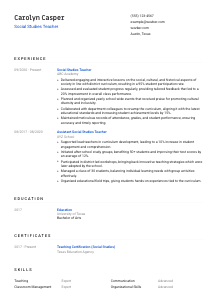
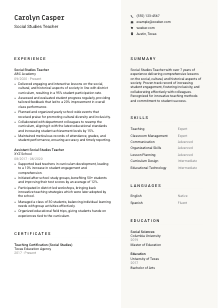
Weaving historical tales, but your CV feels like ancient history? Unearth this Social Studies Teacher CV example, created with Wozber free CV builder. Learn how to map your instructional expertise to match educational standards, ensuring your career narrative remains as dynamic as the societies you teach about!
Social Studies teaching is reviewed through the lens of classroom practice. Schools want to see how you turn history, civics, culture, and current events into lessons students actually engage with, how you track progress, and how you contribute beyond your own classroom through curriculum work, events, or field trips. Your CV should make that teaching impact visible quickly, not bury it under generic education language.
A tailored CV changes how clearly your classroom record comes through in both human review and ATS screening. Wozber's free CV builder helps you align your wording with the posting, keep an ATS-friendly CV format, and surface terms tied to the job such as curriculum standards, student assessment, and recordkeeping. That makes it easier for a school to recognize that your experience matches the demands of day-to-day instruction.
School administrators expect the top of your CV to be straightforward and accurate. For a teaching role, this section should confirm who you are, how to reach you, and whether you meet any immediate logistical requirement before they move on to your classroom experience.
Use your full name in a clear, readable style at the top of the page. It should be slightly more prominent than the rest of the text so the hiring team can identify your application quickly when reviewing multiple teaching CVs in a row.
Add the title "Social Studies Teacher" directly beneath your name if that is the role you are pursuing. This keeps the positioning clear for both ATS parsing and human review, especially when your background includes adjacent titles such as assistant teacher, humanities teacher, or history instructor.
List a reliable phone number and a professional email address. Double-check both. In school hiring, interview scheduling often moves quickly around academic calendars, and one typo can delay or cost you a conversation.
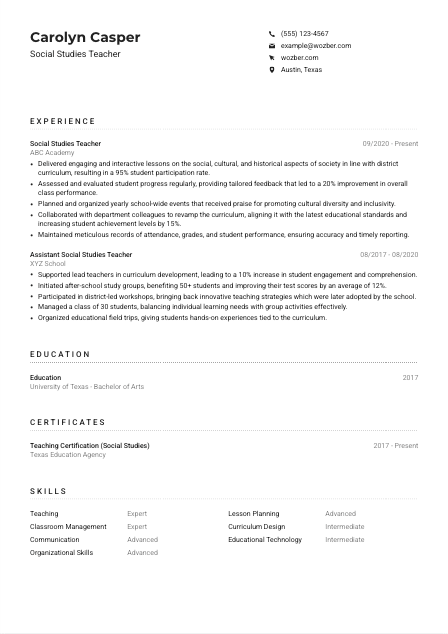
If a posting asks for local availability, include your city and state exactly. In this example, listing Austin, Texas directly addresses the stated location requirement and removes uncertainty about relocation or start-date logistics. Treat that as a tailoring move for this application, not a rule for every teaching CV.
If you have a LinkedIn profile or professional page, include it only if it supports your teaching record with consistent dates, school roles, or education credentials. For educators, that profile can reinforce your career progression, district work, or extracurricular involvement when it matches the CV closely.
This section does not need personality flourishes. It needs accuracy, role alignment, and any key logistical detail a school would want to confirm before reviewing your lesson delivery, student outcomes, and credentials.




The experience section carries most of the weight for a Social Studies Teacher CV. Hiring teams look for proof that you can teach to standards, manage a classroom, assess learning, and contribute to the broader life of the school. Your bullets should show those outcomes in action.
Read the job description closely and identify the few responsibilities that define the role. Here, the priorities include delivering engaging lessons, assessing student progress, collaborating on curriculum, participating in school activities, and maintaining accurate records. Those should shape which teaching achievements you feature first.
List your most recent teaching position first, then work backward. Include school name, job title, and dates for each role. That structure helps a principal or department chair quickly understand your classroom level, years of experience, and progression from support roles to full instructional responsibility.
Write bullet points that show what you taught, how you taught it, and what changed for students or the school. The sample CV does this well with lines such as delivering interactive lessons aligned to district curriculum and collaborating with colleagues to revamp curriculum materials. That is much stronger than simply saying "responsible for lesson planning."
Quantify impact where you can do so honestly. Useful metrics in teaching include student participation, assessment gains, class size, number of students supported, event attendance, or curriculum adoption results. The example's 95% participation rate and 20% class performance improvement give hiring teams a concrete read on classroom effectiveness.
Prioritise experience that supports your readiness for social studies instruction in a middle or high school setting. Classroom teaching, curriculum work, field trips, student support, and school event participation deserve space. Unrelated duties or older accomplishments that do not connect to instruction, student growth, or school collaboration can be shortened or removed.
Your experience section should show how you run a classroom, support learning, and work as part of a department. When those points are tied to standards, student progress, and measurable outcomes, your teaching record becomes much easier to trust.
For teaching roles, education is not background filler. It confirms that you meet the degree requirement and helps schools place your academic preparation in context, especially when your major, graduate work, or coursework aligns with the subject area you teach.
This posting asks for a bachelor's degree in Education, Social Sciences, or a related field, so that credential should be easy to spot. If you hold exactly that kind of degree, present it clearly and avoid abbreviations that make the field harder to read at a glance.
For each entry, include school name, degree, field of study, and graduation year. That is usually enough for an experienced teacher. Clean formatting matters here because administrators often scan this section quickly while confirming eligibility.
If your degree connects directly to education, history, government, social sciences, or a related teaching field, name that connection explicitly. The example combines a bachelor's degree in Education with a master's in Social Sciences, which supports both teaching preparation and subject-matter depth.
Coursework is most useful for early-career teachers, career changers, or candidates whose degree title is broad. If you need it, include only classes that strengthen your fit for social studies instruction, such as U.S. history, political science, world civilizations, curriculum design, or adolescent learning.
Honors, graduate research, student teaching placements, or education-related leadership can add value when they support your teaching profile. Keep them relevant. For an experienced classroom teacher, these details should complement your experience section rather than compete with it.
Schools should be able to confirm your degree background in seconds. If your education also shows subject expertise or advanced preparation, that is worth highlighting because it strengthens your case for teaching Social Studies with depth and confidence.
Certification carries real hiring weight in K-12 education. A school may admire your teaching background, but if your state credential is missing, unclear, or outdated, your application can stall early. This section should remove any doubt about your eligibility to teach the subject.
Place your valid state teaching certification where it is easy to find, especially when the posting specifically asks for Social Studies or a related subject-area certification. In this case, a Social Studies certification from the Texas Education Agency directly addresses the requirement.
Prioritise licenses and certificates that matter for classroom instruction, subject authorization, or student support. For a Social Studies Teacher, that usually means state certification first, followed by endorsements or relevant professional training if they add something meaningful.
Add the issue date, expiration date, or "present" status when that helps show the credential is active. Schools often need to confirm that certification is current before moving a candidate forward, so make that information easy to read.
If you have recent training in curriculum standards, instructional technology, differentiated instruction, or culturally responsive teaching, include it if it supports the role. Ongoing learning matters in teaching because standards, classroom tools, and district expectations change over time.
This section should answer one practical question immediately: are you authorized and prepared to teach this subject? When the answer is clear, hiring teams can focus on your teaching results and classroom strengths.
The skills section should reinforce what your experience already proves. For Social Studies teaching, that means a mix of instructional skills, classroom management strengths, and practical abilities tied to planning, assessment, and collaboration.
Look for both stated and implied requirements. This posting points to communication, organisation, subject knowledge, lesson delivery, student assessment, and collaboration. Build your skills section from those themes rather than from a generic master list.
Include subject-relevant and role-relevant skills together. A useful mix might include lesson planning, classroom management, curriculum design, student assessment, communication, and educational technology. The sample CV handles this well by pairing teaching and classroom management with communication and organizational skills.
A shorter, targeted list is easier to trust than a long inventory of vague strengths. Choose skills you can support through your work history, such as standards-based instruction, progress monitoring, or curriculum development. If you use proficiency ratings, keep them realistic and consistent.
Every skill listed should connect back to something a school expects from a Social Studies Teacher, whether that is leading discussion, tracking student growth, organising coursework, or working with colleagues on curriculum.
Language ability matters differently in education than in many other fields. At minimum, schools need to know you can communicate clearly with students, families, and colleagues in the language of instruction. Additional languages can also strengthen your value in diverse school communities.
If the posting specifies strong English communication, list English clearly and assign an honest proficiency level such as Native or Fluent. For teachers, this is not just a preference. It affects instruction, feedback, classroom discussion, and parent communication.
Place English at the top when it is required for the role, then list any additional languages you can use with confidence. This keeps the section aligned with the school's immediate needs while still showing your broader communication range.
Additional language ability can be especially useful in schools serving multilingual communities. In the example, fluent Spanish strengthens the candidate's profile because it may help with family outreach, student support, and culturally responsive communication, though it is not a universal requirement for every opening.
Choose simple labels such as Native, Fluent, Advanced, or Intermediate and use them consistently. Avoid overstating your ability. In a school environment, language claims can quickly come into play during instruction, meetings, or parent conferences.
For a Social Studies Teacher, language ability can support discussion-based teaching, cross-cultural learning, and stronger communication with a diverse school community. Include it when it adds real value, not as decoration.
This section works best when it shows how well you can communicate in the school's instructional setting and whether you bring additional language ability that could support students, families, or community engagement.
The summary should give a school a fast, accurate read on your teaching background. For Social Studies roles, that usually means years of experience, grade-level context, subject expertise, and one or two outcomes that show student engagement or curriculum impact.
Before writing the summary, identify what matters most in the posting. Here, the school wants subject knowledge, classroom teaching experience, strong communication, and the ability to assess students and work with colleagues. Your summary should reflect that mix in a few lines.
Lead with a direct statement of who you are professionally. A line such as "Social Studies Teacher with 7+ years of experience in middle and high school settings" gives immediate context and helps frame everything that follows.
Choose strengths that matter for this subject and that you can support elsewhere in the CV. The sample summary highlights student engagement, inclusivity, and collaboration, which works because the experience section backs those claims with curriculum work, participation rates, and class performance gains.
Aim for a short paragraph, usually 3 to 5 lines. Skip broad traits and focus on what you teach, how you contribute, and what results follow. A hiring team should come away understanding your instructional profile before they reach your first job entry.
A well-written summary gives immediate context for the rest of the CV. For a Social Studies Teacher, that means showing subject expertise, classroom experience, and the kind of student or curriculum impact a school would expect you to bring from day one.
A Social Studies Teacher CV should show more than subject knowledge. It should connect your classroom instruction, student progress, curriculum work, and school involvement in a way that feels specific to the opening you want.
Use Wozber's free CV builder to tighten that alignment, keep your document ATS-compliant, and apply ATS optimisation with tools such as the ATS CV scanner and ATS-friendly CV templates. The finished CV should make one thing easy to judge: you are ready to teach the subject well, manage the classroom, and contribute to the school community.




