



Use Wozber and land your dream job
Create CV
No registration required
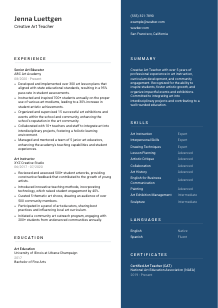
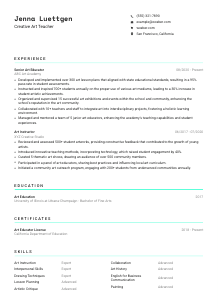
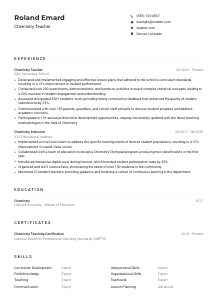
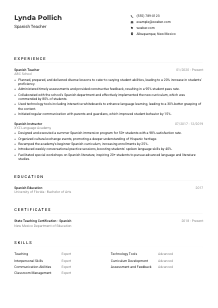
Unleashing inspiration, but your CV is a blank canvas? Check out this Creative Art Teacher CV example, created with Wozber free CV builder. Learn how to blend your artistic ingenuity with job needs, ensuring your career doesn't fade into the background, but takes the spotlight!
Art teaching CVs are reviewed through a classroom lens first. Schools want to see whether you can turn artistic skill into structured instruction, manage materials safely, guide critique in a productive way, and keep students engaged across different ages and ability levels. Your CV should make that teaching practice visible, not just your love of art.
When the CV is tailored well, the school can quickly connect your background to the parts of the job that matter most, such as standards-based lesson planning, K-12 instruction, exhibitions, and interdisciplinary collaboration. Wozber's free CV builder helps organise that experience into an ATS-compliant CV that uses the right education language and art-teaching terminology, so hiring teams can immediately see where you have already done the work.
School hiring teams move past the header quickly, but they still expect it to answer a few practical questions at once. For a Creative Art Teacher, that means clear identification, accurate contact information, and any location detail that removes uncertainty around availability.
Use your full name in a slightly larger font than the rest of the page. Keep it clean and readable. In school hiring workflows, CVs are often reviewed alongside lesson plans, portfolios, and certification records, so your name should be instantly visible.
Place "Creative Art Teacher" under your name if that is the role you are targeting. Matching the posted title helps frame the rest of the CV correctly, especially when your background includes adjacent titles such as Art Instructor, Senior Art Educator, or Visual Arts Teacher.
Include a phone number and a professional email address that uses your name. Check both carefully. If a principal or hiring coordinator wants to schedule a demo lesson or interview, you do not want a typo to slow that down.
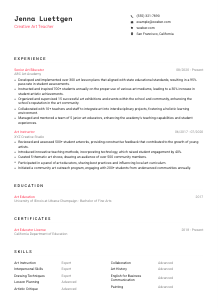
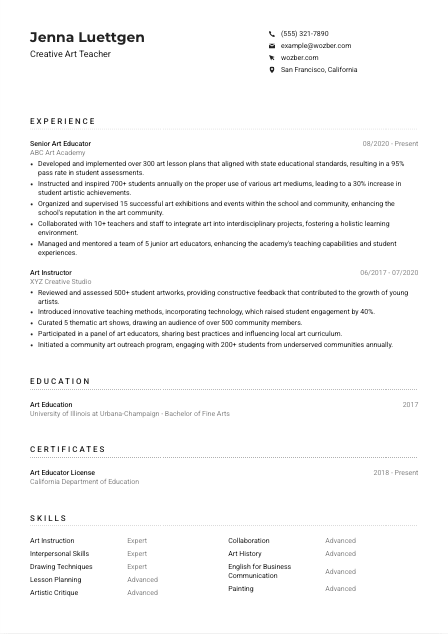
If the employer specifies a location requirement, reflect it clearly in your header. In the example, listing "San Francisco, California" directly addresses the stated local requirement and saves the employer from guessing about relocation or commute logistics.
A portfolio site, professional profile, or school-safe teaching showcase can strengthen your application when it includes student exhibitions, personal work, curriculum samples, or interdisciplinary projects. Only include it if the content is polished and supports your classroom credibility.
Your header should remove basic friction. When your name, title, contact details, and any required location are clear, the reader can move straight to your teaching background and art instruction experience.




This section carries the most weight because schools are hiring for classroom performance, not artistic identity alone. Your bullets should show how you planned instruction, taught techniques, gave critique, managed exhibitions, and contributed to student growth in real learning environments.
Start by marking the responsibilities and qualifications that define the role. Here, that includes K-12 art teaching, lesson plans aligned to state standards, use of different art mediums, student feedback, exhibitions, and collaboration with staff. Those themes should shape the examples you choose from each position.
Lead with your most recent teaching role and include job title, employer, and dates. This helps the reader quickly understand your level of responsibility, whether you taught in a school, academy, studio, or community arts setting.
Focus each bullet on work that matters in an art classroom. Strong examples include developing curriculum, teaching drawing or painting techniques, assessing portfolios, leading critique sessions, and coordinating student exhibitions. In the sample CV, "Developed and implemented over 300 art lesson plans" works because it connects instruction directly to standards and measurable student results.
Metrics make your teaching scope easier to picture when they are tied to real school outcomes. Student volume, pass rates, exhibition counts, engagement gains, or number of interdisciplinary collaborations all work well. Teaching 700+ students annually or organising 15 exhibitions tells a hiring team far more than a vague claim about being highly effective.
Choose experience that supports the target role most directly. A hiring team will care more about K-12 instruction, medium-specific teaching, student critique, and event supervision than unrelated creative work. If you have studio, outreach, or community arts experience, include it when it strengthens your case as an educator rather than filling space.
By the end of this section, the reader should understand your classroom range, the age groups or volume you have taught, and the results of your instruction. Wozber's free CV builder helps you shape those achievements into ATS-friendly language that keeps teaching outcomes, standards alignment, and art-specific responsibilities easy to scan.
For a Creative Art Teacher, education does more than show academic background. It confirms subject knowledge, teacher preparation, and whether your degree aligns with the school's expectations for classroom instruction in visual arts.
If the posting asks for a bachelor's degree in Art Education, Fine Arts, or a related field, make sure that qualification is easy to spot. The sample uses a Bachelor of Fine Arts in Art Education, which aligns closely with the requirement and immediately supports the teaching application.
List the degree, field of study, institution, and graduation year. This is usually enough for experienced educators. Clear formatting matters because school administrators often review education and certification details quickly before moving deeper into the CV.
If your degree title differs slightly from the posting but is still relevant, use the formal degree name and make the field visible. For example, a Fine Arts degree with an Art Education concentration should be presented in a way that helps the employer connect it to classroom preparation.
Most experienced art teachers do not need a course list, but newer candidates can benefit from including studies such as curriculum design, child development, studio methods, ceramics, painting, or art history. Choose coursework that supports the kind of instruction the school is hiring for.
Honors, teaching practicums, student exhibitions, or leadership in arts education organizations can help if you are earlier in your career or if they speak directly to instructional ability. Keep the emphasis on preparation for teaching, not just personal artistic achievement.
Your education should answer one clear question fast: do you have the academic preparation to teach art in a structured school setting? When that answer is obvious, the rest of the CV can focus on classroom results and student development.
Teaching credentials are not a side note in education hiring. For many schools, state licensure is a baseline requirement, and your CV should present it clearly enough that no one has to hunt for it.
When a posting asks for state teaching certification or licensure in Art Education, list that credential at the top of the section. In the example, the California Art Educator License deserves the first position because it speaks directly to eligibility for the role.
Prioritise credentials tied to classroom instruction, art education, curriculum, or student development. A focused list is stronger than a long one. National certifications or subject-specific teaching credentials can add weight when they relate to K-12 arts education.
Add the issuing body and the active date range so the employer can see whether the certification is current. For school roles, this matters. An active license communicates immediate usability in the hiring process.
Renewals, endorsements, and added certifications should be reflected as they happen. If you later gain credentials in another arts discipline, classroom technology, or special education support, include them when they strengthen your fit for the target role.
Clear certification details reduce uncertainty early in the review process. When your license and relevant teaching credentials are easy to find, the school can spend more time on your classroom impact and less time checking basic eligibility.
A Creative Art Teacher needs more than artistic talent. The skills section should show that you can teach techniques, manage a classroom, communicate clearly, and support student growth through instruction and critique.
Read the posting closely and separate subject skills from teaching skills. Here, the employer is looking for strengths in art mediums, techniques, art history, communication, and student engagement. That means your list should go beyond generic creativity and include concrete teaching capabilities such as lesson planning, art instruction, critique, and exhibition management.
Put the most relevant skills near the top, especially those named or strongly implied in the posting. In the sample, "Art Instruction," "Lesson Planning," "Artistic Critique," and "Art History" are strong choices because they map directly to daily responsibilities.
A useful skills section mixes medium-specific knowledge with educator skills. Pair items like drawing techniques, painting, sculpture, or mixed media with collaboration, interpersonal communication, and feedback delivery. That balance reflects how art teachers actually work across instruction, classroom culture, and cross-subject projects.
This section should show that you can teach art in a structured, student-centered setting. Wozber's ATS CV scanner can help you compare your wording with the job description so the right art education terms and classroom skills are visible from the first scan.
Language ability can matter in education beyond formal language teaching. In art classrooms, it may support clearer instruction, family communication, student critique, and collaboration with colleagues across a diverse school community.
If the employer specifies language ability, make that visible first. In this case, strong English for business communication should appear clearly, since it supports professional communication with staff, families, and administrators as well as classroom instruction.
Use straightforward labels such as Native, Fluent, Intermediate, or Basic. Place your strongest language first. If English is required for school communication, do not bury it below other entries.
Extra languages can strengthen your profile, especially in multilingual communities or schools with diverse families. The sample's Spanish fluency is a good example of an added asset that may help with student connection, family outreach, or community events, even when it is not a formal requirement.
Do not overstate proficiency. If you can greet families but not hold detailed academic discussions, mark the language accordingly. Accuracy matters because schools may rely on language skills for real communication responsibilities.
Mention languages that help you teach more effectively, support interdisciplinary work, or communicate with a broader school community. For an art teacher, that can mean clearer critique, better family engagement around exhibitions, or stronger participation in community arts programs.
Include languages when they support communication in the classroom or school community. Presented clearly, they add context to how you teach, collaborate, and connect beyond the studio space.
The summary should give the reader a sharp first read on your teaching profile. For a Creative Art Teacher, that usually means years of experience, instructional strengths, student-facing impact, and the parts of art education you handle especially well.
Look for the main threads in the posting and build your summary around them. For this opening, that means art instruction, standards-aligned lesson planning, student critique, exhibitions, and collaboration. Those points should guide what you include in the first few lines.
Start with a direct statement that tells the reader who you are and how long you have worked in the field. The sample's opening, "Creative Art Teacher with over 5 years of professional experience," works because it establishes both role alignment and experience depth immediately.
Follow with the abilities that matter most for the job. You might mention curriculum development, student engagement, critique and feedback, or community exhibitions. Keep these grounded in practice, not personality alone.
Aim for 3 to 5 lines with no filler. A principal or department lead should be able to read it quickly and understand your instructional focus, student impact, and what kind of art educator you are.
A good summary gives the school an immediate sense of your classroom value before they reach the detailed sections. Wozber's AI CV builder can help you tighten that opening around the job description, making your teaching strengths, ATS alignment, and role-specific wording easier to land in a few focused lines.
Your CV should now show a school exactly how you teach, what mediums and classroom responsibilities you handle, and where you have helped students grow through art. Keep the language grounded in real instruction, real outcomes, and the specific needs of the opening you are targeting.
Before sending it out, run one more tailoring pass for licensure, standards-based planning, K-12 teaching scope, and any art-program duties such as exhibitions or interdisciplinary work. With Wozber's ATS-friendly CV format and ATS CV scanner, you can present that experience in a way that reads cleanly for both screening systems and school hiring teams. The final document should make your readiness to lead an art classroom easy to see.