



Use Wozber and land your dream job
Create CV
No registration required
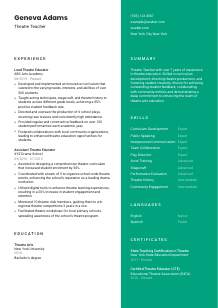
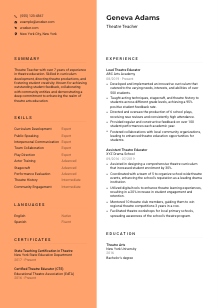
Guiding the spotlight, but your CV seems dim? Step on stage with this Theatre Teacher CV example, created with Wozber free CV builder. Learn how to blend your dramatic expertise with job expectations, ensuring your teaching journey receives a standing ovation!
A Theatre Teacher is hired for far more than a love of performance. Schools look for someone who can run a classroom, build a curriculum across grade levels, direct productions that actually come together on schedule, and give students useful artistic feedback. Your CV should make that range visible quickly, with teaching scope and production leadership carrying as much weight as creative passion.
When theatre CVs stay too general, hiring teams struggle to tell whether the candidate has mainly performed, mainly assisted, or actually led instruction and school productions. Using Wozber's free CV builder to tailor the language and structure into an ATS-compliant CV helps surface the teaching, directing, and student-development work that schools need to see first. That distinction matters early.
School hiring starts with practical details. Before anyone reads about productions or curriculum design, they need to know who you are, how to reach you, and whether basic requirements such as location and role alignment are already covered.
Use your full name in a larger, simple font so it is easy to spot on the first pass. For teaching roles, polished presentation matters, but clarity matters more. Keep it professional and easy to scan.
Place "Theatre Teacher" directly under your name if that is the role you are pursuing. This helps the school immediately place your background in the right lane, especially if your recent title was something adjacent such as Lead Theatre Educator, Drama Instructor, or Performing Arts Teacher.
Include a current phone number and a professional email address. School administrators often move quickly between interviews, reference checks, and scheduling, so your contact details should be immediate and friction-free. A straightforward format such as firstname.lastname@email.com works well.
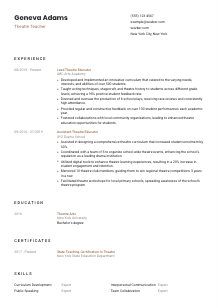
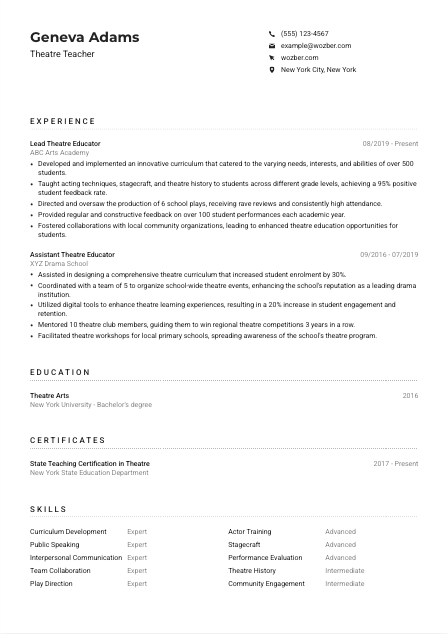
If a school specifies that candidates must be in a certain city or willing to relocate, reflect that in your personal details. In the example, listing New York City, New York directly supports the posting's location requirement and removes an avoidable question early in review.
A website, portfolio, or LinkedIn profile can strengthen this section if it shows relevant material such as production photos, program notes, directing credits, teaching philosophy, or school theatre achievements. Make sure anything linked feels current and consistent with the CV rather than acting as a separate, unfinished profile.
This section should answer the school's first practical questions in seconds. Once those details are clear, the rest of the CV can focus on your classroom results and production work.




For Theatre Teacher hiring, experience is where schools look for the real shape of your work. They want to see whether you have taught students regularly, built learning around different ability levels, managed productions, and worked with the wider school community without losing control of the classroom or rehearsal process.
List positions in reverse chronological order and use job titles that reflect your teaching responsibility clearly. If your title was slightly different from the target role, keep the official title but make the bullet points show theatre instruction, student coaching, and production leadership. That helps bridge titles such as Lead Theatre Educator to Theatre Teacher naturally.
Include the school, academy, or educational organisation for each role. Context matters here because teaching theatre in a school environment involves curriculum delivery, student assessment, rehearsals, and collaboration with faculty and families. A hiring team should be able to tell that your experience happened in an educational setting, not only in performance or private coaching.
Your strongest bullet points should cover the work schools actually hire for: curriculum development, acting instruction, stagecraft teaching, theatre history, production direction, and student feedback. The example does this well by showing both classroom instruction across grade levels and direction of six school plays, which speaks to day-to-day teaching and major program delivery.
Use metrics that reflect student reach, production volume, engagement, or program growth. Useful examples include number of students taught, productions directed, feedback scores, enrollment gains, workshop participation, or competition results. Metrics such as teaching 500 students, earning a 95% positive feedback rate, or increasing enrolment by 30% give scale to work that might otherwise sound generic.
Keep the section centered on experience that shows you can run a theatre program inside an educational environment. Performance credits, unrelated arts jobs, or general event work should only stay if they directly strengthen your case as a teacher, director, or student mentor. Every bullet should help a school picture you in the classroom, rehearsal room, or production calendar.
By the end of this section, a school should be able to see your teaching range, your production track record, and the scale of students or programs you have handled. That is what moves a Theatre Teacher CV from interesting to interview-worthy.
Academic background matters in theatre education because it establishes subject grounding and, in many schools, basic eligibility. This section should confirm that you have the formal preparation to teach theatre arts, while leaving the deeper proof of your classroom and production work to the experience section.
Start with the degree that matches the posting most closely, such as a Bachelor's degree in Theatre Arts, Education, or a related field. If your degree directly aligns with the requirement, say so clearly. In the example, "Bachelor's degree in Theatre Arts" immediately supports the employer's stated education criteria.
List degree, field of study, school, and graduation year in a clean order. For most Theatre Teacher applications, that is enough. A clear entry like New York University, Bachelor's degree, Theatre Arts, 2016 gives the reader what they need without making the section feel crowded.
If the job description names Theatre Arts, Education, Drama, or a related field, use the most precise official wording from your degree that overlaps with that language. This helps both human reviewers and ATS screening connect your education to the role without stretching the truth.
If you are earlier in your career, a few specifics can strengthen this section, especially coursework in acting pedagogy, directing, stagecraft, theatre history, child development, or arts education. If you have several years of teaching experience already, keep this brief unless the details genuinely add something new.
Workshops, conservatory intensives, or continuing study in directing, musical theatre, voice, movement, classroom management, or educational practice can add value, particularly if they sharpen how you teach or lead productions. Use them when they support the school's needs, not simply to lengthen the section.
This section should confirm that your formal training supports the subjects you teach. Once that foundation is visible, the rest of the CV can carry the stronger proof of how you teach and direct in practice.
For teaching jobs, certifications are often a screening point rather than a nice extra. If the posting asks for a valid state teaching certification in Theatre or Drama, your CV should make that credential obvious, current, and easy to find.
List the state teaching credential that qualifies you for the role using its official name. Do not bury it under optional professional memberships. In the example, "State Teaching Certification in Theatre" directly answers one of the posting's non-negotiable requirements.
After the required license, include certifications that reinforce your teaching practice or subject expertise. A credential such as Certified Theatre Educator can help show professional commitment, especially when it complements hands-on work directing productions and teaching performance skills.
Add the issuing body and the relevant date or active range so schools can see whether the credential is current. This is especially important for state licenses, which may need renewal or ongoing standing. Clean dating also helps avoid follow-up questions during screening.
If you are actively maintaining credentials or completing related training, include that selectively. For a Theatre Teacher, current development in drama pedagogy, arts integration, student performance assessment, or directing can reinforce that your practice is staying current with school and program needs.
A clear certifications section tells the school you meet the classroom requirement and take the profession seriously. That lets your experience section do the heavier work of proving how well you teach.
A Theatre Teacher skill list should sound like a working school program, not a generic arts profile. Schools want to see the mix of instructional ability, rehearsal leadership, student communication, and production knowledge that keeps both lessons and performances moving forward.
Read the job description closely and build your skills section from what appears there and what your experience genuinely supports. For this kind of role, that often includes curriculum development, acting techniques, stagecraft, theatre history, production direction, student evaluation, and collaboration with staff and families.
Do not list only performance-related strengths. A Theatre Teacher also needs classroom communication, feedback delivery, collaboration, and program coordination. The example skill set works because it combines theatre-specific strengths such as Play Direction and Stagecraft with Interpersonal Communication, Team Collaboration, and Performance Evaluation.
Choose the skills that best support the target role instead of trying to capture every capability from your career. A shorter, well-targeted list reads better in ATS screening and gives a clearer picture of what you can bring to a theatre department. Prioritise the abilities you would actually use in lesson planning, rehearsals, student critiques, and production prep.
When this section is chosen carefully, it backs up the experience rather than repeating it loosely. The result is a Theatre Teacher profile that feels specific to school instruction and live production work.
Language skills matter most here when they affect instruction, student communication, or family engagement. This section does not need to be long, but it should answer any explicit language requirement and highlight additional fluency that could be useful in a diverse school community.
If the posting says candidates must be linguistically adept in English, list English at the top with an accurate level such as Native or Fluent. That gives an immediate answer to a stated requirement and supports your ability to teach, direct, critique performances, and communicate with parents and colleagues.
Extra languages can strengthen your profile when they help with student rapport, community outreach, or cross-department collaboration. In the example, Spanish adds a useful dimension because bilingual communication can matter in school events, family contact, and broader community engagement.
Choose standard terms such as Native, Fluent, Intermediate, or Basic. Schools do not need creative descriptions here. They need a reliable sense of whether you can teach, converse, or support communication in another language.
Only include languages you would be comfortable using in authentic settings, whether that means classroom support, parent communication, or community partnerships. This section adds the most value when it reflects how you can contribute inside the school's actual student population and theatre program.
Theatre teaching relies on clear spoken feedback, demonstration, discussion, and ensemble-building. Your languages section should support that broader communication profile, especially if multilingual ability would help you work with a wider student and family base.
For most applicants, this section is brief. Its job is to confirm English proficiency first and then show any added language strengths that could support your teaching community.
Hiring teams often read the summary before they look at the details. For a Theatre Teacher, that opening should establish your teaching identity quickly, including the parts of your background that matter most in schools: classroom experience, directing work, curriculum ownership, and student development.
Start with a direct line that names you as a Theatre Teacher or theatre educator and states your experience level. That immediately separates you from candidates whose background is mainly performance-based. The example does this well by leading with more than 7 years in theatre education.
Follow with two or three role-specific strengths such as curriculum development, directing school productions, teaching acting and stagecraft, or mentoring student performers. Use the combination that best matches the job you are targeting rather than pasting in a generic theatre profile.
Aim for a concise paragraph of about 3 to 5 lines. Focus on what a school would want to know first, not on broad statements about passion or creativity. Specific phrases tied to teaching outcomes, production leadership, or student engagement will do more work than general enthusiasm.
End with a line that points toward your value in practice, such as strengthening theatre education, guiding student performers, or expanding production opportunities. In the example, the closing emphasis on community collaboration and commitment to theatre arts education helps the summary point beyond personal traits and toward program impact.
A sharp summary gives the reader the right lens before they reach your experience bullets. If you are building or refining it in Wozber's free CV builder, use the platform's ATS-friendly CV templates and ATS CV scanner to align your wording with the posting and keep the final CV easy for schools to review. The summary should make one thing clear right away: you can teach theatre, lead productions, and contribute to a student-centered program.
A Theatre Teacher CV works best when it balances classroom credibility with production leadership. Degrees, certification, and English proficiency may get you through the first screen, but interviews usually come from showing how you teach students, direct performances, build curriculum, and collaborate across a school community.
Use each section to reduce guesswork. If a school needs someone who can teach acting techniques, cover stagecraft and theatre history, direct plays or musicals, and give meaningful performance feedback, your CV should show where you have already done that and at what scale.
Wozber's free CV builder can help you shape that experience into an ATS-friendly CV format, while its AI CV builder features and ATS optimisation tools help align your wording with the job description more precisely. The finished CV should make it easy for a school to see you running both the classroom and the production calendar with confidence.