



Use Wozber and land your dream job
Create CV
No registration required
Mixing elements but getting a reaction on your CV? Bond with this Chemistry Teacher CV example, created with Wozber free CV builder. Learn how to create a professional blend of your instructional skills and scientific expertise that fits school requirements, ensuring your career compounds as successfully as your experiments!
Chemistry teaching is practical, visible work. Schools want someone who can turn abstract concepts into clear instruction, run safe and engaging lab activities, and help students at different ability levels keep up with the pace of the course. Your CV needs to show that classroom command, not just a list of schools and degrees.
Hiring teams often sort chemistry candidates quickly by looking for the overlap between subject expertise, secondary teaching experience, and day-to-day classroom execution. Wozber's free CV builder helps you shape that experience into an ATS-compliant CV, so curriculum planning, lab instruction, student assessment, and communication with families are easy to spot in the first pass.
This section is simple, but it still affects how smoothly your application moves. For a Chemistry Teacher, it should confirm who you are, how to reach you, and whether you match any practical requirement the school listed, without distracting from your teaching record.
Place your full name at the top, then use the job title directly beneath it. If you are applying for a Chemistry Teacher opening, say "Chemistry Teacher" rather than a broad label like "Educator" or "Science Professional." That immediate match helps both ATS systems and school administrators connect your profile to the position.
List a current phone number and a professional email address that uses your name. School hiring often moves through calls and follow-up emails for interviews, certification checks, and reference coordination, so accuracy matters. Keep this section clean and functional, with no unnecessary labels or outdated channels.
If a school requires candidates to be in a specific area or willing to relocate, reflect that clearly in your contact details. In the example, listing Denver, Colorado supports a posting that asked for candidates located in or open to relocating to Denver. That is a tailoring move for this application, not a rule for every chemistry teaching CV.
Include LinkedIn or a professional teaching portfolio if it strengthens your case. Useful additions might show classroom projects, lab safety work, curriculum materials, student competition involvement, or professional recommendations from department heads. If an online profile is sparse or outdated, leave it off until it reflects your current teaching practice.
Do not include age, marital status, nationality, or other personal identifiers unrelated to classroom performance. Schools need to see your credentials, teaching background, and communication readiness, not details that add no value to hiring decisions.
Your personal details should remove friction from the application process and reinforce any stated logistical requirement. Then the rest of the CV can stay focused on chemistry instruction, student outcomes, and classroom leadership.




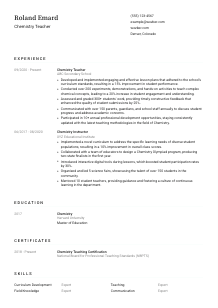
For a Chemistry Teacher, experience is where schools look for proof that you can manage a classroom, deliver content clearly, and produce measurable learning gains. Focus less on generic teaching duties and more on what you taught, how you taught it, and what improved as a result.
Start by identifying the experience signals the school is actually hiring for. Here, that includes more than 3 years in a secondary setting, curriculum development, lesson planning, hands-on instruction, assessment, and communication with parents and staff. Build your bullets around those themes so your classroom history lines up with the role instead of reading like a generic educator CV.
For every position, include the school name, your title, and employment dates in reverse chronological order. Use titles that reflect your actual work, such as Chemistry Teacher or Chemistry Instructor, especially when the role involved secondary science instruction. That context helps hiring teams quickly judge subject alignment and teaching level.
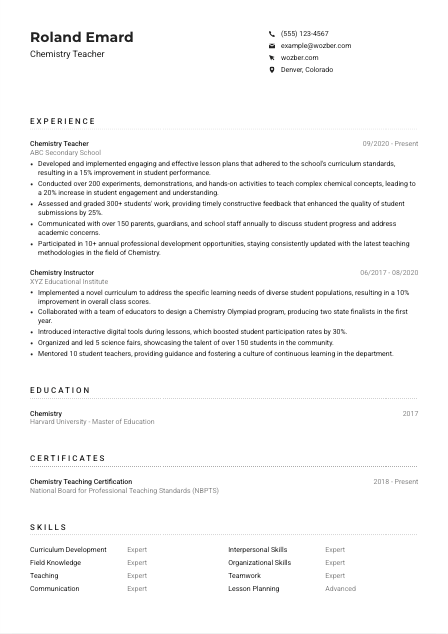
Quantified results work especially well in education when they reflect student performance, engagement, instructional volume, or class load. The sample CV does this effectively with points such as a 15% improvement in student performance, more than 200 experiments and demonstrations delivered, and feedback provided across 300+ students. Numbers like these give hiring teams a clearer picture of your classroom scale and impact.
Choose bullets that show chemistry teaching in action. Strong examples include designing standards-aligned lesson plans, running lab demonstrations safely, improving understanding of difficult topics such as stoichiometry or chemical bonding, using digital tools to increase participation, or preparing students for fairs, Olympiads, or end-of-course exams. Keep the emphasis on instructional decisions and student outcomes, not routine task lists.
Schools value teachers who stay current with curriculum changes, lab safety expectations, and instructional methods. Mention workshops, subject training, mentoring, department collaboration, or ongoing development that sharpened your teaching practice. In the example, annual professional development supports the job's expectation that candidates continue updating their methods and content knowledge.
A hiring team should be able to read this section and picture you planning lessons, running labs, grading effectively, and communicating with families. When your experience shows that level of classroom readiness, the rest of the CV becomes easier to trust.
Schools hiring for chemistry classes want to see two things quickly in the education section: subject depth and teaching preparation. Present your degrees so those points are obvious at a glance, especially when the posting mentions both a chemistry-related bachelor's degree and a preferred education-focused master's.
List your highest or most relevant degree first, especially if it helps you meet a stated preference. For this job, a bachelor's degree in Chemistry or a related field is required, and a master's in Education is preferred. The sample CV uses a Master of Education and a Bachelor of Science in Chemical Engineering, which together support both pedagogical training and science depth.
For each degree, include the degree name, field of study, school, and graduation year. This straightforward structure helps administrators and ATS systems process qualifications quickly. Avoid adding long descriptions unless the extra detail directly strengthens your fit for the teaching role.
If you are earlier in your teaching career, a short note on coursework can add useful context. Chemistry lab methods, inorganic or organic chemistry, adolescent learning, curriculum design, or classroom assessment can all reinforce your readiness. Skip this if you already have substantial secondary teaching experience and stronger evidence in your work history.
Research projects, teaching assistant work, academic honors, or science competition leadership can add value when they connect to classroom credibility. For example, research experience may support your comfort with experimental design, while education honors may reflect strength in instructional practice. Include these only if they help explain how you teach or how deeply you know the subject.
Additional study in education, science instruction, lab safety, or differentiated teaching can strengthen this section, especially if you are moving toward a more advanced school environment or updated curriculum framework. Keep it brief and directly tied to your classroom work.
This section should quickly confirm that you have the subject foundation to teach chemistry and the academic preparation to manage learning well. Once that is clear, the hiring team can focus on how you apply it in the classroom.
In K-12 hiring, certification is not a minor extra. It can determine whether your application moves forward at all. For chemistry teaching roles, your CV should make licensure and relevant instructional credentials easy to find and easy to understand.
If the posting asks for a valid state teaching certification in Chemistry or General Science, lead with that credential. Include the certificate name, issuing authority, and active dates or renewal status. This is one of the first items a school may check before reviewing your classroom achievements in detail.
After the required license, include certifications that reinforce your effectiveness in a secondary science classroom. Lab safety training, AP Chemistry teaching workshops, STEM instruction programs, or assessment-related credentials can all add value when they connect to the courses you teach and the students you serve.
Show when each certificate was earned and whether it is still active. For educators, currency matters because schools need to know you are qualified under current standards and ready to teach without administrative ambiguity.
Ongoing certification work can support your application, especially if it reflects stronger chemistry instruction, broader science coverage, or updated pedagogy. The example includes an NBPTS-issued Chemistry Teaching Certification, which adds a credible professional marker beyond baseline qualification. Use credentials like that to show sustained commitment to the field.
Your certificates section should answer two questions quickly: are you authorized to teach, and have you kept developing as an educator? If both answers are clear, this section is doing its job.
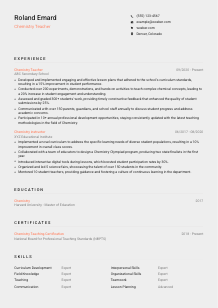
A Chemistry Teacher skills section works best when it reflects how the job is actually done. Schools expect a mix of subject knowledge, classroom planning, student assessment, and communication, so your list should look like it belongs to a real chemistry educator, not a generic teaching template.
Read the posting closely and capture both the explicit and implied skills. Here, curriculum development, lesson planning, communication, interpersonal ability, and strong chemistry knowledge are all directly relevant. You can also infer related skills such as lab instruction, classroom management, student assessment, and differentiated teaching for mixed-ability groups.
Order matters. Lead with the capabilities that are central to chemistry teaching and that appear in the job description, such as curriculum development, chemistry content knowledge, lesson planning, laboratory techniques, assessment, and communication with students and families. The sample CV's mix of curriculum development, lesson planning, teaching, and laboratory techniques is a useful model for balancing instruction and subject expertise.
Group skills in a way that reads clearly, whether by hard skills and soft skills or by instruction, subject, and collaboration. Avoid padding the section with vague traits. Terms like "organised" or "team player" only earn space if the rest of the CV shows how they matter in planning lessons, coordinating with staff, or managing lab-based instruction safely.
A well-built skills section should echo the work of the role itself: teaching chemistry clearly, planning lessons to standard, running labs responsibly, and communicating well with students, families, and colleagues.
Language ability matters in education because teaching depends on explanation, feedback, and relationships. In a Chemistry Teacher CV, this section should support classroom communication and, where relevant, your ability to work with students and families from different language backgrounds.
If the school states that candidates must articulate well in English, list English first and mark your proficiency accurately as Native or Fluent. That gives a direct answer to a stated hiring requirement and supports your readiness to teach, assess, and communicate in the classroom.
Extra languages can strengthen your application when they help with family communication, student support, or broader school community engagement. Spanish, for example, may be useful in many secondary school settings, but include any language only if you can use it confidently in real interactions.
Use honest labels such as Native, Fluent, Advanced, or Conversational. In education, overstatement becomes obvious quickly if you are expected to speak with parents, support multilingual learners, or collaborate across a diverse school community.
When a second language is relevant, think beyond the classroom lecture itself. It may help during parent meetings, student mentoring, extracurricular events, or written communication about progress and concerns. That practical connection is more useful than listing languages as a generic extra.
If you are actively improving a language and it supports the communities you teach, it can be worth noting. Keep it brief. The main point is to show communication range that would matter in a school environment, not to turn this into a broad personal-interest section.
This section should reinforce that you can explain chemistry clearly in English and, if applicable, build stronger connections with students and families through additional language skills.
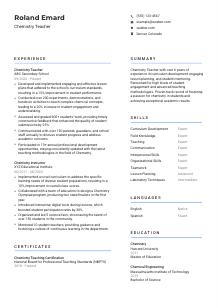
Your summary sits at the top of the CV, so it should establish your teaching level, chemistry background, and classroom strengths in a few direct lines. Skip broad claims and use this space to connect your experience to the school's immediate needs.
Start with your professional identity and years of relevant work. A line such as "Chemistry Teacher with 6+ years of secondary school experience" immediately gives the reader subject area, school level, and tenure. That is stronger than a generic opener about being passionate or dedicated.
Choose two or three strengths that match the posting closely. For this kind of role, that might include curriculum development, engaging lesson planning, lab-based instruction, student assessment, or strong communication with students and families. The sample summary points to curriculum development and student engagement, which align well with the school's stated priorities.
Stay concise. Three or four lines are usually enough to cover your experience, your chemistry teaching strengths, and one clear outcome or area of impact. You do not need to mention every qualification here if the experience and skills sections will support them in more detail.
A short note on how you teach can make the summary more distinctive when it stays grounded in classroom practice. You might emphasize making complex concepts accessible, using experiments to deepen understanding, or helping students build confidence in scientific thinking. That kind of line gives shape to your teaching style without drifting into philosophy for its own sake.
By the time someone finishes your summary, they should already understand that you can teach chemistry, manage a secondary classroom, and help students learn through clear instruction and practical application.
A Chemistry Teacher CV works best when it shows the full classroom picture: subject knowledge, lesson planning, lab instruction, assessment, certification, and communication with students and families. Tailor each section to the school you are applying to, and use Wozber to build an ATS-friendly CV template that keeps those priorities visible from the first scan.
With focused wording, accurate qualifications, and clear teaching outcomes, your CV should make one thing easy to judge: you are ready to lead chemistry learning in a secondary classroom.




