



Use Wozber and land your dream job
Create CV
No registration required
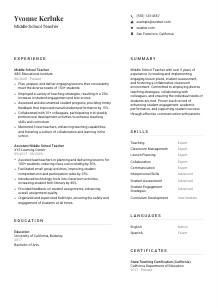
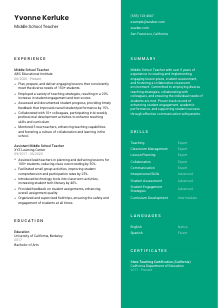
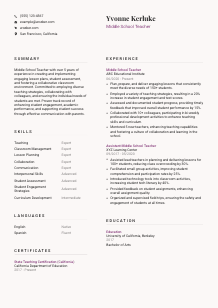
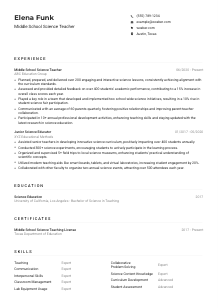
Shaping young minds, but your CV doesn't make the grade? Check out this Middle School Teacher CV example, built with Wozber free CV builder. Learn how to spotlight your educational wisdom and classroom charisma to match job requisites, making your teaching journey a straight-A success!
Middle school teaching asks for range. One period may call for tight classroom routines, the next for differentiated instruction that keeps a wide mix of learners engaged and on track. A CV for this work needs to show more than subject knowledge. It should make clear that you can plan lessons, manage a room, track progress, and build the kind of classroom climate where students can actually learn.
CV screening for teaching roles often narrows fast when grade-level experience, certification, or core instructional language is hard to find. Wozber's free CV builder helps you shape an ATS-compliant CV around the posting's wording, so hiring teams can quickly see your middle school background, teaching credentials, and the results you have delivered with students.
School leaders usually look at the top of the CV first for practical checks. Can this person be contacted easily, are they presenting themselves as a middle school educator, and do they meet any location requirement listed in the posting? Keep this section clean and professional so nothing slows that first pass.
Your name should be the most visible text on the CV. Use a clear, professional format so principals, department leads, or HR staff can identify your application quickly when reviewing a stack of candidates for the same grade band.
Place "Middle School Teacher" directly beneath your name when that matches the role you are pursuing. This helps frame your experience immediately, especially if your background includes adjacent titles such as assistant teacher, subject teacher, or homeroom teacher.
List a reliable phone number and a professional email address. If you include a website or LinkedIn profile, make sure it supports your teaching profile with items such as classroom projects, instructional philosophy, or school-based achievements rather than unrelated content.
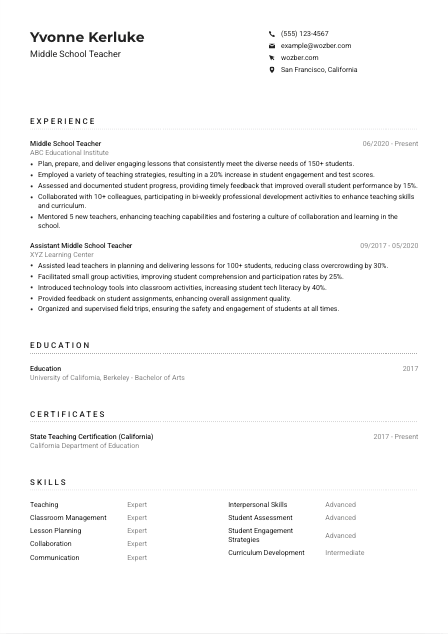
If a school specifies that the candidate must already be in a certain city or state, show that clearly in your personal details. In the example, listing San Francisco, California directly addresses the posting's location requirement and removes uncertainty about availability.
A teaching portfolio can be useful when it shows materials that matter to schools, such as unit plans, student-safe project samples, classroom newsletters, or curriculum work. Include it only if it is polished, easy to navigate, and relevant to middle school instruction.
This section does not need personality flourishes. It needs accuracy, professionalism, and any essential detail, such as location, that helps a school move your application forward without extra follow-up.




For middle school teaching, experience is where schools look for proof that you can run instruction day to day. They want to see what grades or student groups you taught, how you approached engagement and assessment, and what changed because of your work. Well-written bullets make your classroom practice visible.
Read the job description closely and mark the responsibilities that define the role. For a middle school teacher, that often includes lesson planning, differentiated instruction, student assessment, classroom climate, collaboration with families, and teamwork with colleagues. Those are the themes your experience bullets should reflect first.
List positions in reverse chronological order with your title, school or organisation name, and dates. This helps hiring teams quickly follow your grade-level progression, such as moving from assistant teaching into lead classroom instruction or expanding responsibility across subjects or student populations.
Avoid bullets that only restate a teacher job description. Show the scale of your work and the result. The example does this well with details like teaching 150+ students, improving engagement and test scores by 20%, and raising overall student performance by 15% through timely feedback.
Middle school CVs benefit from education-specific measures such as student load, assessment gains, participation rates, intervention outcomes, team size, or frequency of parent communication and professional development. Numbers help schools picture your workload and your effectiveness in a real classroom setting.
Prioritise accomplishments that reflect instruction, student growth, classroom management, inclusive learning, and school collaboration. If you include field trips, technology use, mentoring, or extracurricular support, connect them back to student learning, safety, or school contribution so the relevance is obvious.
A hiring team should be able to read this section and understand your classroom range, your student impact, and how you work with colleagues and families. That is what makes teaching experience persuasive.
Education credentials carry real weight in teaching because they establish both eligibility and preparation. Schools want to see that your degree supports the grade level or subject you teach, and that the information is easy to find without digging through the page.
If the posting asks for a bachelor's degree in Education or a related subject area, make sure that appears clearly. In this case, a Bachelor of Arts in Education directly supports the requirement and should not be buried behind less relevant academic detail.
List your degree, field of study, school, and graduation year in a clean structure. Hiring teams do not need a long academic narrative here. They need to confirm that your educational foundation matches the teaching role.
If your degree includes a middle grades focus, subject concentration, or teacher preparation track, include that wording when accurate. It helps schools connect your training to the instructional and developmental needs of middle school students.
Coursework, honors, student teaching placements, or capstone work can help early-career teachers, especially if they relate to adolescent development, literacy instruction, classroom assessment, or curriculum design. For more experienced teachers, keep this section lean unless the detail is especially relevant.
Professional growth matters in education, whether through workshops, graduate coursework, or district training in areas such as differentiated instruction, behaviour support, or curriculum alignment. If that learning is substantial, include it here or in certifications so schools can see that your practice stays current.
Your education section should quickly answer two questions: are you qualified to teach, and is your training relevant to the students and subjects in front of you. Clear formatting does that work well.
In teaching, certifications are not a bonus line. They are often a hiring checkpoint. A school may appreciate extra training, but the first thing they need to know is whether you hold the appropriate license for the grade level and subject area.
Put your state-issued teaching certification where it is easy to spot. For the example role, a California teaching credential is central because it directly addresses eligibility for the classroom. This should appear before optional certificates or supplemental training.
Include certifications that strengthen your profile as a middle school educator, such as ESL authorization, special education training, literacy intervention, or subject-specific endorsements. Skip certificates that do not add anything meaningful to your instructional credibility.
If a certificate is active, renewable, or tied to a validity period, add the date range or current status. That saves schools from having to guess whether your credential is current and ready for immediate use.
Recent training can help if it relates to real school needs, such as trauma-informed teaching, restorative practices, assessment methods, or inclusive classroom strategies. Choose the development that best supports your target role rather than listing every workshop you have attended.
For a middle school teaching CV, certification tells a school whether you can step into the role without delay. Any added training should reinforce how you teach and whom you can support well.
The skills section works best when it reflects how teaching is actually done. School leaders are looking for instructional strengths, classroom management, assessment ability, and collaboration habits that hold up in a real middle school environment, not a generic list of soft skills.
Pull in the abilities the school has already prioritised, such as lesson planning, student engagement strategies, classroom management, assessment, collaboration, and communication with parents or guardians. These terms help align your CV with both human review and ATS optimisation when they match your actual experience.
Put the most role-relevant skills first. For a middle school teacher, that usually means instructional planning, differentiated instruction, behaviour management, student assessment, and curriculum delivery before broader traits like professionalism or adaptability.
Choose terms that sound native to teaching practice. "Differentiated instruction," "formative assessment," "curriculum development," and "educational technology integration" say more than broad labels because they point to real classroom workflows and decisions.
A useful skills section should echo the language of the posting while sounding true to your classroom practice. When the wording is specific, schools can quickly connect your toolkit to their students' needs.
Language ability matters in schools because communication sits at the centre of the job. Teachers explain concepts, guide discussion, write feedback, meet with families, and collaborate with staff. If a posting names language fluency, your CV should address that directly and clearly.
When strong English fluency is listed as a requirement, include English with an accurate proficiency level such as Native or Fluent. That removes doubt about your ability to teach, assess written work, communicate with families, and handle school documentation effectively.
Additional languages can strengthen your profile, especially in diverse school settings where family communication and student connection matter. In the example, Spanish adds useful context because it may help with classroom rapport or parent outreach, even though it is not a universal requirement.
Use clear labels such as Native, Fluent, Advanced, or Intermediate rather than overstating your ability. Schools may rely on this information for family communication, student support, or team coordination, so accuracy matters.
If you speak more than one language, think about the practical value it adds. It can support family conferences, help students feel more included, and strengthen communication in communities where English is not the only language heard at home.
In education, language ability is not just an extra credential. It can support inclusive instruction, clearer family partnerships, and stronger cultural understanding across the school day. Include it when it adds real value to how you teach and communicate.
List languages in a way that helps a school understand how you will teach, communicate, and connect. That is the context that makes this section useful on a teacher CV.
The summary is your chance to establish teaching level, years of experience, and a few strengths that matter most for the role. For middle school positions, it should quickly signal classroom ownership, instructional approach, and student impact rather than drift into generic statements about passion for education.
Start with a direct line such as "Middle School Teacher with 5+ years of experience" if that is accurate. This tells the reader immediately whether you meet the experience range and whether your background is in the right school setting.
Work in a few core themes from the posting, such as engaging lesson delivery, assessment and feedback, inclusive classroom culture, or collaboration with colleagues and families. The example summary does this by emphasizing lesson planning, student assessment, and a collaborative classroom environment.
A summary becomes more credible when it includes a concrete result or area of impact, such as improving engagement, raising academic performance, or supporting diverse learners through varied teaching strategies. Keep it concise, but make it specific enough to sound earned.
Aim for a short paragraph of about 3 to 5 lines. That is enough space to frame your teaching profile without repeating bullets that belong in the experience section. Every phrase should help a school understand what kind of classroom practitioner you are.
By the time a school finishes this section, they should already know your grade-level background, your instructional strengths, and the kind of student outcomes you tend to influence. That gives the rest of the CV a clear direction.
A middle school teacher CV should make it easy to see three things fast: you are qualified to teach, you can manage and engage a classroom, and your work moves students forward. When each section is tailored to those realities, your application reads with far more confidence and clarity.
Use Wozber to build an ATS-friendly CV format that reflects the language of the posting, highlights the right teaching strengths, and keeps your credentials easy to find. The final result should make a school confident in your readiness to step into a middle school classroom.




