



Use Wozber and land your dream job
Create CV
No registration required
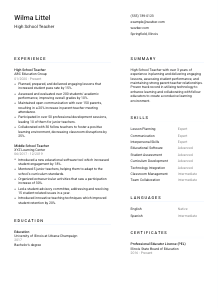
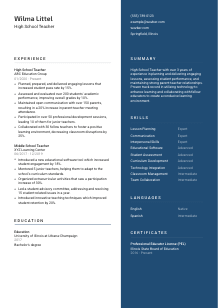
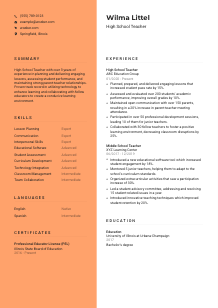
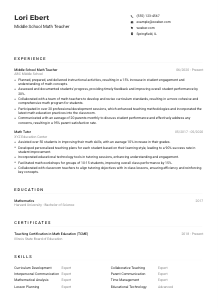
Guiding teen trajectories, but your CV feels stuck in freshman year? Browse this High School Teacher CV example, created with Wozber free CV builder. Learn how to chart your pedagogical prowess to match school expectations, ensuring your teaching journey always graduates with honors!
High school teaching CVs are read through the lens of day-to-day classroom work. Schools want to see whether you can plan standards-aligned lessons, manage a room of adolescents, track academic progress, communicate with families, and contribute to the wider school community without losing consistency across the school year.
A tailored CV changes how quickly those teaching strengths come through, especially when screening starts with an ATS and then moves to an assistant principal, department chair, or principal. Wozber's free CV builder helps you align your wording with the posting, keep an ATS-friendly CV format, and make your lesson planning, student outcomes, and school collaboration easy to recognize.
The top of your CV should identify you quickly and remove friction. For teaching roles, that means clear contact information, the exact target title, and any location detail that addresses practical hiring questions such as commute or relocation.
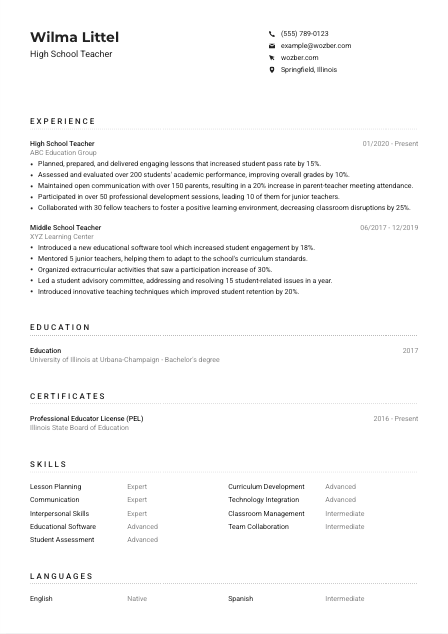
Put your full name at the top in the most prominent text, then add the role directly beneath it as "High School Teacher." This immediately places you in the right hiring lane, especially when schools are sorting applicants across grade levels or subject areas.
List a current phone number and a professional email address that you check regularly. Hiring teams often move quickly when scheduling interviews, demo lessons, or reference checks, so accuracy matters more than style here.
If the posting asks for local availability or relocation, include your city and state. In the example, "Springfield, Illinois" works well because it answers that requirement directly. If location is not part of the hiring criteria for another school, a city and state line is usually enough.
A LinkedIn profile or professional teaching portfolio can support your application when it reinforces what is already on the CV. This is particularly useful if you have curriculum materials, student program work, professional development activity, or leadership contributions that add context to your classroom record.
Do not include age, marital status, photo, or other personal details that have no bearing on classroom instruction, certification status, or school fit. Keep this section focused on the information a school actually uses to contact you and place you in the candidate pool.
When this section is done well, the school can identify you, contact you, and confirm any location requirement without searching for basics. That keeps attention on your teaching record instead of avoidable admin gaps.




For a high school teacher, experience has to do more than name employers. It should show how you taught, what improved, how you measured progress, and how you worked with students, families, and colleagues in a real school setting.
Start by marking the responsibilities that define the opening. Here, the school emphasizes lesson delivery, student assessment, parent communication, collaboration, and technology use. Those points should shape which bullets you keep, what language you mirror, and which results you place first.
Present your positions in reverse chronological order with job title, school or organisation name, and dates. This makes it easy to track your progression from earlier teaching work into high school instruction, as the sample does by moving from middle school teaching into a current high school role.
Schools already know a teacher delivers lessons and assesses students. Your bullets should show what changed because of your work. The example does this well with improvements in pass rate, grades, and parent-teacher meeting attendance. That kind of detail tells a hiring team how you perform inside the curriculum, not just what your contract required.
Quantify with measures that make sense in education, such as pass rates, grade improvement, attendance, family participation, disciplinary incidents, student load, club participation, or professional development sessions led. "Assessed over 200 students" or "decreased classroom disruptions by 25%" gives a much clearer picture than vague claims about impact.
Prioritise experience that reflects adolescent instruction, curriculum delivery, assessment, classroom management, and school collaboration. If you include adjacent experience, connect it back to the high school classroom. For example, a middle school role can stay if it shows transferable teaching methods, educational software use, or student engagement gains that support your current target.
By the end of this section, a principal or department lead should be able to picture your classroom practice, your results with students, and your reliability as a colleague. Keep each bullet tied to learning outcomes, school operations, or student support.
Education matters in teacher hiring because it establishes your formal preparation for instruction, subject knowledge, and eligibility for licensure. Present it cleanly so schools can confirm the academic foundation behind your classroom work.
If the posting asks for a bachelor's degree in Education or a related subject, make sure that degree is easy to find. In the example, "Bachelor's degree" in "Education" directly answers the requirement and removes any doubt about academic eligibility.
List the institution, degree, field of study, and graduation year or date. Schools are usually checking for baseline qualification first, so clarity is more useful here than extra formatting or long descriptions.
Use the exact field when it truthfully reflects your academic background. If your degree is in Education, English, Mathematics, Biology, or another subject area tied to what you teach, name it clearly so the connection is immediate.
Relevant coursework can help early-career teachers, career changers, or candidates applying for a specific subject-heavy assignment. Include it only if it supports the opening in a practical way, such as adolescent literacy, assessment design, classroom management, or content-area methods.
Honors, education research, student teaching distinctions, or leadership in teaching organizations can add value if they reinforce your preparation as an educator. Keep them brief and relevant to instruction, curriculum, or student development rather than listing every campus activity.
Your education section should quickly show that you meet the academic requirement and that your training supports the kind of teaching the school needs. Once that is clear, the reader can move on to your classroom results and certification status.
Licensure is a practical gate in teacher hiring, not a bonus detail. If a school needs a state-issued credential for high school instruction, this section should make your eligibility unmistakable.
Lead with the certification or license named in the posting when you have it. In this case, a state-issued teaching certification or license for high school education is essential, so it should appear before optional training or supplemental credentials.
Include licenses, endorsements, and certifications that strengthen your value as a secondary teacher. General professional development is better placed elsewhere unless it results in a formal credential connected to instruction, subject teaching, special education support, or educational technology.
Add issue dates and, where relevant, renewal or active dates so schools can see whether the credential is current. The sample's Professional Educator License listed as ongoing is a strong model because it signals active eligibility at a glance.
If you have renewed licensure, added endorsements, or completed recognized training in areas like classroom technology, subject instruction, or student support, include the most relevant ones. This shows that your practice is current with school standards and district expectations.
A school should not have to hunt for your license status. Put the required credential front and centre so the hiring conversation can stay on your teaching quality, subject expertise, and classroom results.
A teaching skills section works best when it reflects how the job is actually done. Schools are looking for instructional ability, student support, communication, technology use, and collaboration with staff, not a generic list of personality traits.
Start with the skills named or implied in the posting. Here that includes lesson planning, educational technology, communication, interpersonal strength, student assessment, and collaboration. These are stronger choices than broad terms with no classroom context.
Place the most job-relevant skills first, especially those tied to curriculum delivery, assessment, classroom management, and technology integration. The sample's mix of lesson planning, educational software, student assessment, and curriculum development speaks directly to classroom execution.
Organise your skills so a school can scan them quickly. A concise list of high-value teaching competencies is more persuasive than a long inventory padded with weak or obvious items. Choose skills you can support through experience bullets, certifications, or your summary.
This section should confirm that you can run a classroom, work within curriculum expectations, communicate with families and staff, and use school technology effectively. If the list feels generic, tighten it until it reflects real teaching practice.
Language ability can matter in education because communication extends beyond the classroom. It may shape how you teach, how you connect with families, and how effectively you support a diverse student population.
If the posting specifies effective English communication, list English clearly with an accurate proficiency level. For teaching roles, this is not a formality. It affects instruction, written feedback, parent communication, and collaboration with administrators.
Lead with English, then add any additional languages that could support student and family communication. In the example, Spanish adds practical value because bilingual ability can help in parent outreach, student support, and school community engagement, even when it is not a formal requirement.
Additional languages are worth listing when they reflect genuine proficiency and could be useful in your school context. They are especially relevant if you work with multilingual families, English learners, or community programs that rely on direct communication.
Choose clear levels such as native, fluent, intermediate, or basic. Schools may rely on this information when considering communication responsibilities, translation support, or family-facing tasks, so accuracy matters.
Language skills carry the most weight when they improve instruction, parent contact, student trust, or inclusivity. Keep the emphasis there rather than treating this section as a general personal interest list.
Handled well, this section shows how you communicate across the school community, not just what languages you know. That can strengthen your case in districts where family outreach and inclusive teaching matter every day.
Your summary sits near the top of the CV, so it should frame your classroom profile in a few lines. For a high school teacher, that usually means years of experience, instructional strengths, student outcomes, and the school-facing responsibilities you handle well.
Start with your title and experience level so the reader immediately understands your classroom scope. "High School Teacher with over 3 years of experience" works because it places the candidate in the right setting and seniority range from the first line.
Build the summary around core requirements such as lesson planning, student assessment, educational technology, parent communication, and collaboration with staff. The sample summary does this effectively by combining instruction, performance tracking, technology use, and family relationships.
Aim for a short paragraph that carries real information. Replace broad claims about passion or dedication with concrete teaching strengths and outcomes. If you mention impact, keep it tied to classroom realities such as student performance, engagement, or learning environment.
A summary can still sound human without drifting into slogans. Show what kind of educator you are through the work you emphasize, whether that is rigorous lesson planning, supportive classroom culture, data-informed instruction, or strong family communication.
A good summary gives a school a fast, accurate read on your teaching level, your core strengths, and the results you tend to produce. It should sound like a teacher with a proven classroom record, not a generic applicant.
A high school teacher CV works best when every section supports the same picture: you can teach your subject well, manage student progress, communicate with families, and contribute to the wider life of the school. Keep your examples grounded in classroom outcomes, school collaboration, and credentials the district can act on immediately.
Use Wozber to build an ATS-compliant CV that reflects the language of the posting, surfaces missing requirements, and keeps your experience in an ATS-friendly CV format. The finished document should make it easy for a school to see that you are ready for the classroom they need to fill.




