



Use Wozber and land your dream job
Create CV
No registration required
Igniting curiosity in the lab, but your CV feels like a failed experiment? Browse this Middle School Science Teacher CV example, created with Wozber free CV builder. Learn how to bring together your scientific savvy and job essentials, making your teaching career the next big discovery!
Middle school science teaching sits at a demanding intersection of instruction, classroom culture, and academic growth. Schools are not only looking for someone who can explain ecosystems, force, or chemical change. They want a teacher who can turn standards into lessons students actually engage with, run safe and inclusive labs, track progress across a full roster, and keep communication steady with families and colleagues. Your CV should make that day-to-day teaching range visible quickly.
When the CV is tailored well, hiring teams can immediately tell whether your experience matches middle school science specifically or reads like broader K-12 teaching. Wozber's free CV builder helps you line up your wording with the posting, keep an ATS-friendly CV format, and surface terms such as curriculum standards, assessment, parent communication, and science initiatives in the places schools expect to see them. That makes it easier to recognize your classroom impact and subject-matter alignment from the first scan.
Schools move fast once they find a teacher whose background fits the grade band, subject, and certification requirements. Your contact section should confirm those basics cleanly so nothing slows down the review.
Place your full name at the top in a readable format that stands out without looking decorative. In education hiring, your header should feel straightforward and credible, much like the rest of your CV. Skip nicknames unless they are the name you use professionally with students, families, and school staff.
Add "Middle School Science Teacher" directly under your name if that is the role you are pursuing. Matching the posted title helps both ATS screening and human review, especially when schools are sorting candidates across elementary, middle, and high school openings. It immediately frames your background around subject instruction, lab learning, and adolescent classroom management rather than general teaching.
List a current phone number and a professional email address. This sounds basic, but principals and school coordinators often move from CV review to interview outreach quickly, especially before a school year starts. Use an email format based on your name, and double-check every character so a missed digit does not cost you an interview.
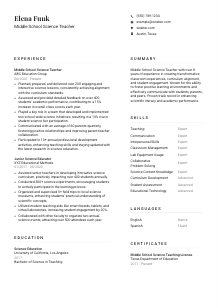
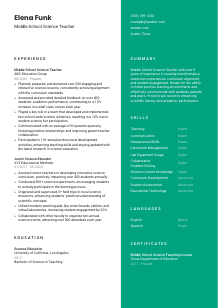
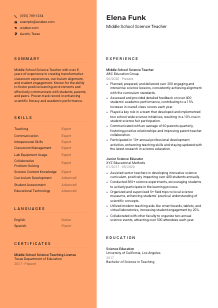
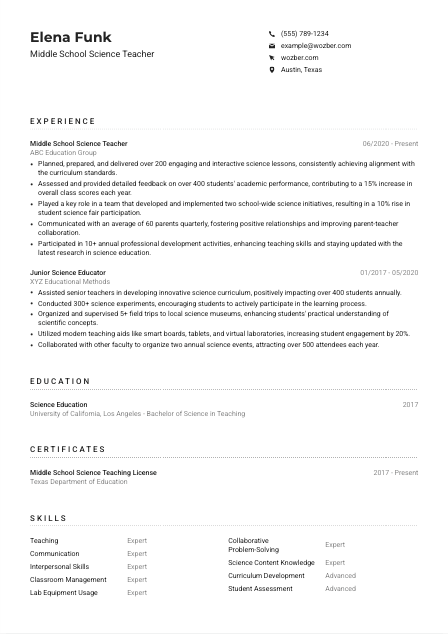
If the posting specifies that candidates must be in a certain area or willing to relocate, include the relevant city and state in your header. Here, Austin, Texas matters because it answers a stated requirement right away. Elena Funk's sample does this well by listing Austin, Texas without overexplaining it. For other applications, only include location details that actually help remove a hiring question.
A LinkedIn profile can help if it reinforces the same teaching history, certifications, subject focus, and school involvement shown on your CV. For educators, this is most useful when it adds context such as curriculum work, professional development, student program leadership, or endorsements from administrators and colleagues. If the profile is sparse or outdated, leave it off until it matches your application.
This section should answer immediate logistical questions: who you are, what role you teach, how to reach you, and whether you meet location expectations. Once that is clear, the school can focus on your classroom work.




This is the section school leaders study most closely. They want to see what grade levels you taught, how you delivered science instruction, how you measured learning, and what kind of classroom and school contribution followed from your work.
Start by pulling the core responsibilities from the job description and checking whether your experience addresses them directly. For a middle school science role, that usually includes lesson planning, standards alignment, student assessment, classroom safety, family communication, collaboration with colleagues, and ongoing professional learning. When those themes appear clearly in your bullets, your background reads as immediately relevant instead of loosely educational.
List positions in reverse chronological order, starting with your current or most recent classroom role. For teaching CVs, recency matters because schools want to know how recently you have managed a middle school classroom, delivered instruction, and worked with current curriculum expectations. If you moved from assistant or junior educator roles into full classroom responsibility, that progression is worth making easy to follow.
A bullet like "taught science lessons" is too thin. Show what you taught, how you taught it, and what changed because of it. The sample CV does this effectively with details such as delivering over 200 lessons aligned to curriculum standards and assessing more than 400 students, paired with a 15% increase in class scores. That combination tells a principal far more than a generic task statement ever could.
Use numbers tied to teaching reality: number of lessons delivered, students taught, score growth, family touchpoints, science fair participation, field trips led, or professional development hours completed. Education metrics do not need to sound corporate. They should show scope, consistency, and outcomes. Even one or two well-placed figures in each role can clarify the size of your classes, the rhythm of your assessment work, and the effect of your instruction.
Prioritise bullets that show subject-specific teaching and age-group relevance. Lab activities, inquiry-based instruction, use of educational technology, curriculum development, and collaboration on science initiatives all belong here. The sample's mention of experiments, virtual laboratories, and school-wide science events works because each point supports the case for science teaching directly. Save unrelated accomplishments for another application if they do not strengthen that case.
After reading your experience section, a school should be able to picture you planning standards-based lessons, managing a safe science classroom, tracking student progress, and contributing to the wider department. That is the level of clarity this section needs.
For teaching roles, education is more than a formality. It confirms subject preparation and shows whether your academic background lines up with the grade level and discipline you want to teach.
If the posting asks for a bachelor's degree in Science Education or a related field, make that match easy to find. List the degree, major or field, school, and graduation year in a clean format. When your degree aligns closely with the job, as it does in the sample with Science Education, it reinforces that your preparation fits the classroom content you will teach.
This section should be easy to scan in seconds. Keep the order consistent and avoid extra explanation unless something genuinely strengthens your candidacy. School leaders reviewing multiple applications want to confirm qualifications quickly, not work through dense wording.
Some educators hold degrees with titles like Teaching, Education, or Secondary Education. In those cases, include the science-related field or concentration so the connection is obvious. The sample's "Bachelor of Science in Teaching" becomes much stronger because it also specifies "Science Education," which matters more than the degree wording alone.
Newer teachers can use this section to show preparation in curriculum design, adolescent learning, lab instruction, classroom assessment, or science methods courses. If student teaching, lab-based coursework, or curriculum projects are more relevant than limited paid experience, include them selectively. Once you have several years in the classroom, those details usually become less important than your teaching record.
Honors, relevant education awards, or leadership in science or teaching organizations can support your profile if they connect to the role. For experienced teachers, recent professional learning and classroom results usually carry more weight than older campus activities. Keep the focus on what strengthens your case as an effective middle school science educator now.
Your education section should quickly answer one question: are you academically prepared to teach middle school science? When the answer is obvious, the rest of the CV can do the deeper work of showing how well you teach it.
Certification carries real weight in school hiring because it affects eligibility, compliance, and how quickly a teacher can be placed in front of students. If a valid license is required, this section needs to be unmistakable.
For this role, the most important credential is a valid state certification or license in Middle School Science. List it prominently, using the official title when possible. In the sample, the "Middle School Science Teaching License" issued by the Texas Department of Education directly answers the requirement and should be easy for both ATS screening and school administration to spot.
Include certificates tied to classroom instruction, science education, lab safety, curriculum design, or educational technology before more general training. Hiring teams care most about qualifications that affect your ability to teach the subject, meet compliance requirements, and contribute in a science department from day one.
Schools need to know whether a license is current. Include the issue date, expiration date, or an "active" range if that format fits your credential. This is especially important in regulated roles where certification status can determine whether you move forward in the process.
Additional credentials can help when they reflect current teaching methods or relevant tools, such as STEM integration, differentiated instruction, lab safety, or digital learning platforms. They work best when they deepen your profile as a science teacher rather than pad the page. Choose the ones that show you are keeping your instructional practice current.
A school should never have to hunt for your license status. Present your teaching credentials clearly and you make it easier for the hiring team to move from interest to interview.
A skills section works best when it reflects how middle school science is actually taught. That means balancing instructional ability, classroom execution, subject knowledge, and collaboration rather than dropping in a generic list of soft skills.
Read the job description closely and identify skills that are named directly or implied through responsibilities. In this case, curriculum knowledge, instructional best practices, communication, interpersonal skills, collaboration, and assessment all matter. Mirror that language where it truthfully matches your background so both the ATS and the hiring team can connect your experience to the role faster.
Prioritise skills that reflect actual middle school science instruction, such as classroom management, curriculum development, student assessment, lab equipment usage, educational technology, and science content knowledge. The sample skills list is effective because it combines subject-specific strengths with the teaching mechanics that make science learning work in a live classroom.
You do not need to include every skill you have developed across your career. A shorter list of highly relevant skills reads better and carries more weight. Choose the capabilities that support the job most directly, especially those you can back up elsewhere in your experience section through lesson delivery, student results, family communication, or collaborative school initiatives.
The right skills section reinforces the rest of your CV. If each item connects back to real classroom work, your profile feels consistent and credible.
Language ability matters in schools because instruction, feedback, and family communication all depend on it. For a teaching role, list languages in a way that helps the school understand how you can communicate with students, parents, and colleagues.
If the posting states that proficient English is necessary, say so clearly in your languages section or elsewhere on the CV. For a middle school science teacher, this matters not only for classroom instruction but also for writing feedback, explaining lab procedures, and communicating with families and staff. The sample handles this simply with "English - Native," which is easy to read.
Extra language ability can be valuable when it helps build stronger relationships with students and families or supports a diverse school community. In some districts, Spanish can be especially useful for parent outreach and day-to-day communication. Treat this as an added strength, not a substitute for the required teaching qualifications.
Terms such as Native, Fluent, Intermediate, and Basic are enough. Avoid vague descriptions that leave room for interpretation. Schools need a practical sense of how comfortably you can teach, discuss student progress, or communicate during conferences and school events.
List languages that genuinely add value to your application. If an additional language helps with parent engagement, multilingual classrooms, or community connection, it belongs here. If it has no practical bearing on the role, it is optional rather than essential.
For educators, language skills support inclusion, trust, and clearer communication around student progress. They can strengthen your profile when they connect to real school interactions such as parent meetings, classroom support, or collaboration with multilingual communities. That is the context hiring teams care about most.
Keep this section practical. Schools should be able to tell immediately how your language ability may support instruction, family communication, or a more inclusive learning environment.
Your summary should give a school an immediate sense of your teaching level, subject focus, and classroom strengths. In a few lines, it should answer why your background makes sense for a middle school science opening.
Open with your title, years of experience, and subject focus. That instantly tells the reader whether you match the role. The sample summary does this well by identifying the candidate as a Middle School Science Teacher with over 8 years of experience, which positions the rest of the CV before any deeper reading begins.
Focus on qualities tied to the actual work, such as lesson design, student engagement, curriculum alignment, classroom culture, and communication with families. Avoid broad statements about passion unless they are backed by specifics. Schools respond better to a summary that sounds like someone who has run effective science instruction, not someone writing in general education clichés.
Use a brief result or area of contribution that supports the responsibilities in the posting. That might be improving class performance, increasing student participation in science initiatives, or building strong parent communication routines. You do not need to pack the full CV into the summary, but one specific accomplishment can make the opening more credible.
Aim for 3 to 5 sentences with tight wording. Every sentence should help a principal understand your classroom scope, teaching approach, or measurable contribution. If you are applying to a school that emphasizes standards alignment, inquiry-based learning, or collaborative department work, reflect that emphasis naturally in your phrasing.
A well-written summary gives the hiring team an accurate first read on your teaching profile before they reach the detail below. For middle school science, that means clear subject alignment, real classroom experience, and a sense of the outcomes you deliver.
A middle school science teacher CV should show more than a love of the subject. It should show that you can plan standards-aligned lessons, manage a safe and engaging classroom, assess student learning, work with families, and contribute to the science team. When each section points back to that reality, your application becomes much easier for a school to trust.
Use Wozber's free CV builder to organise your experience, strengthen ATS optimisation, and build an ATS-compliant CV with clear subject-specific wording. With the right details in place, your CV will make it easy to see that you are ready to teach science well from the first day of school.




