



Use Wozber and land your dream job
Create CV
No registration required
Tackling equations in class, but your CV doesn't add up? Level up with this Middle School Math Teacher CV example, created with Wozber free CV builder. Learn how to align your numerical know-how with job expectations, putting your teaching talents at the core of learning!
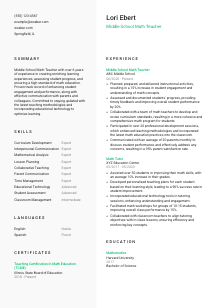
Middle school math teaching sits at a demanding intersection of content knowledge, classroom leadership, and adolescent learning. Schools want to see how you turn ratios, equations, and problem-solving into lessons students can actually engage with, while keeping progress visible through assessment, feedback, and steady instruction. Your CV should make that classroom impact easy to picture.
When that impact is tailored to the posting, the CV reads faster for both school leaders and screening systems. Wozber's free CV builder helps you align your teaching language with the job description, keep an ATS-compliant CV structure, and surface the details that matter first, such as grade-level experience, math instruction, and student progress.
School hiring teams need the contact section to answer practical questions quickly: who you are, what role you teach, and whether you meet location or communication expectations. For a middle school math teacher, this section should stay clean and factual while still reinforcing that you are applying for a math classroom, not a general education opening.
Use your full name at the top in a larger, readable font so it anchors the page immediately. In school hiring, CVs often move quickly between administrators, department leads, and HR, so visual clarity matters. Keep it simple and professional.
Place "Middle School Math Teacher" directly under your name if that is the role you are targeting. This helps distinguish you from elementary teachers, tutors, or high school math candidates whose experience may overlap but serves a different instructional setting. Matching the title also supports ATS alignment with the posting.
List a phone number you answer reliably and an email address that looks appropriate in a school setting. A straightforward format such as firstname.lastname@email.com works well. If a principal or HR coordinator wants to schedule an interview after reviewing your lesson delivery or assessment experience, they should not have to hunt for your contact details.
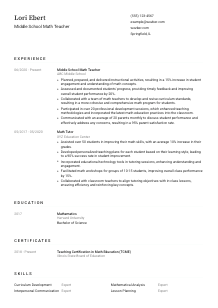
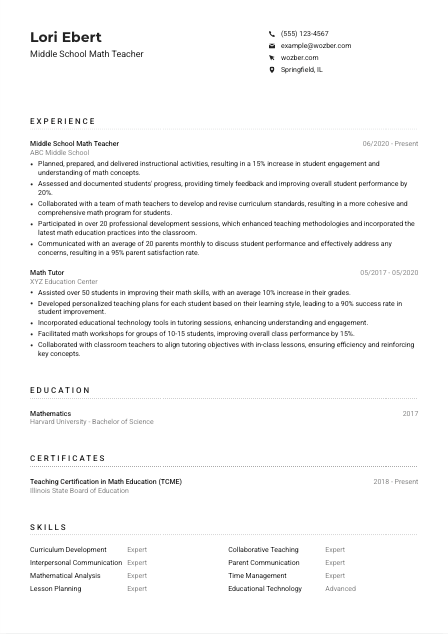
If the school requires local residency or a specific city, include that clearly in your header. Here, "Springfield, IL" helps address a stated requirement right away. Use location only as a factual match point, not as filler.
A LinkedIn profile, teaching portfolio, or school-safe professional site can help if it includes useful material such as curriculum samples, classroom projects, technology integration, or professional development highlights. Keep it current and consistent with the story your CV tells about math instruction and student growth.
This top block should remove logistical doubt in seconds. When it is accurate and tailored, the reader can move straight to your teaching record instead of pausing over missing basics.




For middle school math roles, experience is where schools look for proof that you can run instruction, track learning, and work with the people around the classroom. Job titles matter, but the real differentiator is how clearly you show lesson planning, student progress, collaboration, and the outcomes of your teaching decisions.
Before editing bullets, identify the duties the school repeats or emphasizes. For this role, that includes planning instruction, facilitating active math learning, assessing progress, collaborating on curriculum, communicating with families, and using educational technology. Your experience section should mirror those areas using your real classroom work, not generic teaching language.
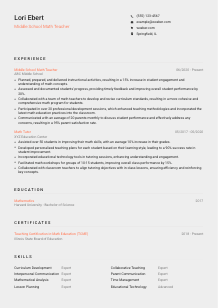
For every position, include your title, school or organisation name, and dates in reverse chronological order. That structure helps hiring teams quickly see whether you have middle school classroom experience, tutoring experience, or adjacent math instruction. In the sample CV, the progression from Math Tutor to Middle School Math Teacher makes the growth in responsibility easy to follow.
Strong teaching bullets show what changed because of your work. Use outcomes that make sense in education, such as improved assessment results, stronger engagement, better parent response rates, curriculum adoption, or the scale of students supported. The sample does this well with metrics like a 15% increase in student engagement and a 20% improvement in overall student performance.
Use verbs and phrases that match how middle school math work is described in postings: planned and delivered lessons, assessed student progress, provided timely feedback, collaborated with teachers, revised curriculum materials, and integrated digital tools. If you completed regular parent outreach or helped refine pacing guides and course content, say so directly. Those details speak to day-to-day teaching reliability.
If you have a mix of education roles, prioritise the experience that best supports a middle school math classroom. Tutoring, intervention, small-group instruction, and curriculum support can all help, as long as you frame them around math outcomes and instructional practice. Trim unrelated duties unless they explain a useful skill such as behaviour support, communication, or technology use.
A school should be able to scan this section and see your grade-level fit, your math teaching scope, and the results of your instruction. That is what turns experience into a hiring advantage.
This section confirms that you meet the academic baseline to teach math and gives context for your subject preparation. For a middle school math teacher, the most important point is the relevance of your degree to mathematics, math education, or a closely related field tied to classroom instruction.
List your bachelor's degree first, especially if it is in Mathematics, Mathematics Education, or another directly related discipline. That immediately addresses a stated hiring requirement. In the sample, a Bachelor of Science in Mathematics does that cleanly.
Include degree, field of study, school name, and graduation year or date in a format that is easy to skim. School hiring teams do not need long descriptions here. They need fast confirmation that your academic background supports the subject you teach.
If you are earlier in your career, a few targeted details can help. Courses in algebra, geometry, statistics, adolescent learning, or math methods may reinforce your preparation for middle grades instruction. Keep these additions selective and relevant rather than turning the education section into a transcript.
Academic honors, scholarships, or membership in subject-focused organizations can support your credibility, especially if they reflect math achievement or education leadership. They are secondary to your degree and certification, so include them briefly.
Professional learning can sit here if it is closely tied to instruction, assessment, intervention strategies, or technology in math teaching. Workshops on differentiated math instruction, standards-based grading, or digital classroom tools can reinforce that your methods have stayed current since graduation.
Your education section should confirm subject knowledge without slowing the reader down. Once the degree is clear, every extra detail should support your ability to teach math effectively in a middle school setting.
Teaching certificates carry more weight in K-12 hiring than they do in many other professions because they affect legal eligibility, staffing compliance, and classroom assignment. For a middle school math role, your certification should be visible, current, and worded clearly enough that a school can connect it to the grade band and subject area without guessing.
A state-issued certification in Math or Math Education for middle school grades belongs at the top of this section. It is a screening item, not a bonus. If you hold endorsements tied to specific grade levels or subject areas, list them in a way that makes the assignment match obvious.
After the required license, include additional credentials only if they support the work schools care about, such as math instruction, classroom technology, intervention, special populations, or curriculum development. Keep the section focused on credentials that matter in a school setting rather than adding unrelated certificates.
Add the issuing body and the certification dates so administrators can quickly confirm status. In the sample, the Illinois State Board of Education and the date range "2018 - Present" help communicate that the credential is active and relevant.
If you have newer certifications in digital learning platforms, assessment tools, or updated teaching practices, they can reinforce your classroom readiness. This is especially useful when the posting mentions educational technology or ongoing professional development as part of the role.
This section should leave no doubt that you are authorized and prepared to teach middle school math. Clear certification details save time for the school and strengthen your application immediately.
A skills section for a teacher works best when it reflects the actual mechanics of the job. For middle school math, that means balancing instructional skills, classroom communication, subject expertise, and the tools you use to deliver lessons, assess progress, and work with students, families, and colleagues.
Pull the most relevant skill language from the job description and match it to your background. Here, curriculum development, educational technology, communication, collaboration, student assessment, and lesson planning are all directly tied to the role. This helps the CV line up with both ATS terms and school expectations.
Include a mix of math-specific and school-specific strengths. Mathematical analysis and lesson planning show command of the subject and instruction. Interpersonal communication, parent communication, and collaborative teaching show that you can work across the classroom, team meetings, and family conversations. That balance matters in middle school environments where content and relationship management are closely linked.
Lead with the capabilities most relevant to the opening rather than listing every skill you have developed. If the posting highlights active learning, assessment, and digital tools, those should appear before broader traits. The sample CV handles this well by listing curriculum development, lesson planning, educational technology, and student assessment near the core of the section.
A hiring team should be able to look at this section and recognize the kind of math teacher you are. Keep the list focused on the tools, teaching practices, and communication strengths you use in real school work.
In a teaching CV, language ability is mainly about communication in the classroom and across the school community. English proficiency is essential for instruction, documentation, parent communication, and collaboration with staff. Additional languages can add value, especially in diverse school settings, but they should be presented clearly and honestly.
Because this role requires proficient English, include it in the language section with an accurate level such as Native or Fluent. That supports your ability to teach math concepts clearly, write feedback on student work, and communicate with families and administrators.
If you speak another language, include it when you can use it meaningfully with students or parents. This is especially helpful in communities where family outreach benefits from bilingual communication. In the sample, Spanish adds an extra layer of connection without replacing the central requirement of strong English proficiency.
Terms such as Native, Fluent, Advanced, or Intermediate are usually enough. Avoid vague descriptions. Schools need a practical sense of how comfortably you can speak, read, and communicate in professional or classroom contexts.
Language skills are most useful when they connect back to school work. Framing them around family outreach, clearer student support, or smoother collaboration in a multilingual community makes the section more grounded than treating extra languages as a general bonus.
If a school community includes multilingual families, language ability can strengthen parent meetings, written updates, and trust-building around student progress. Mentioning relevant language skills can show added range, as long as the levels are accurate and the rest of the CV already proves your teaching qualifications.
For a middle school math teacher, languages matter when they improve instruction and school-family connection. Keep the section factual, useful, and tied to real communication needs.
The summary sits near the top of the CV, so it needs to establish your teaching profile in a few lines. For middle school math roles, that usually means naming your experience level, your instructional strengths, and the outcomes or teaching priorities that define your work most clearly.
Read the posting closely before drafting your summary. If the school emphasizes active learning, assessment, collaboration, and technology use, reflect those themes in your opening lines using your own experience. This keeps the summary anchored in the actual classroom work the role requires.
Open with your title and years of experience so the reader gets immediate context. A line like the sample's "Middle School Math Teacher with over 6 years of experience" works because it quickly establishes both subject area and tenure.
Choose strengths that matter in school hiring, such as improving student performance, building engaging math lessons, using educational technology, or maintaining strong parent communication. The sample summary works because it pairs classroom impact with concrete areas of practice instead of relying on vague enthusiasm.
Aim for three to five lines. That is enough space to cover your role, experience level, and strongest teaching differentiators without repeating the experience section. Tight writing is especially important when principals or department chairs are reviewing several teacher CVs in one sitting.
A well-written summary should quickly tell a school what kind of math teacher you are, how you work, and what outcomes tend to follow. Once that is clear, the rest of the CV has a much easier job.
A middle school math teacher CV works best when it shows the classroom clearly: the lessons you plan, the progress you measure, the families and colleagues you work with, and the results your students achieve. When each section is tailored to those realities, the CV reads like a teacher schools can place with confidence.
Use Wozber's free CV builder to organise that experience into an ATS-friendly CV format, strengthen alignment with the posting, and refine the language schools see first. The final version should make one thing easy to judge: you are prepared to teach math well at the middle school level.