



Use Wozber and land your dream job
Create CV
No registration required
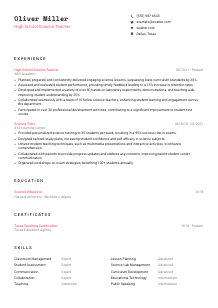
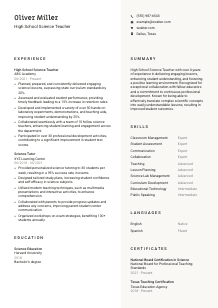
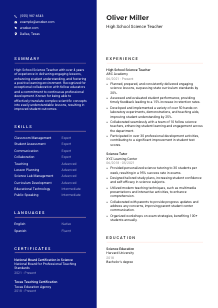
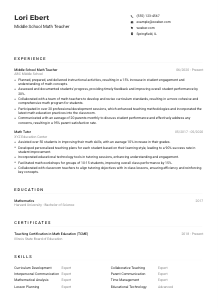
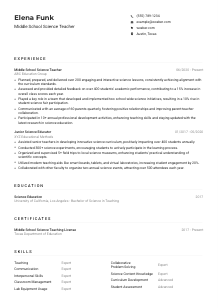
Unraveling mysteries, but your CV feels obscure? Check out this High School Science Teacher CV example, created with Wozber free CV builder. Learn how to connect your scientific adventures with the job requirements, putting your teaching journey front and centre with this tailored template!
High school science teaching sits at the intersection of subject mastery, classroom leadership, and student accountability. Schools need teachers who can turn biology, chemistry, or physics standards into lessons, labs, and assessments that students can actually grasp. Your CV should make that classroom reality visible, especially how you plan instruction, manage lab activity safely, track progress, and help students improve over time.
School leaders often scan first for a practical match between your teaching background and the courses, grade levels, and state requirements they need covered. Using Wozber's free CV builder helps you shape that experience into an ATS-compliant CV, so licensure, science teaching scope, and measurable student outcomes are easy to find. That gives hiring teams a faster read on whether you can step into the timetable and teach effectively from day one.
School hiring starts with a few essentials before anyone reads your lesson results or lab experience. Your header should confirm who you are, what role you teach, and whether basic logistics such as contact details and location line up with the opening.
Use your full name in a clear, readable format at the top of the page. Keep it slightly larger than the body text so it anchors the document immediately. In school hiring, your CV often moves between department chairs, principals, and HR, so simple visibility matters.
Place "High School Science Teacher" under your name if that reflects the role you are targeting. This helps frame your experience before the reader reaches your work history. If you teach a specific discipline such as Biology or Chemistry, use that only when it matches the posting and your background.
Hiring teams should be able to reach you without hunting through the page. Use the phone number you actually answer and a professional email address that looks appropriate in a school setting.
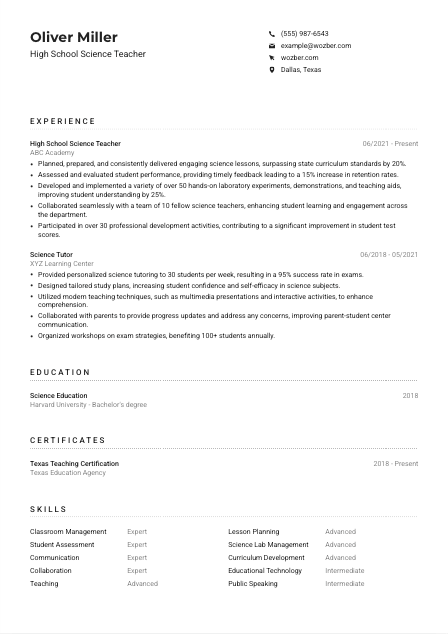
If the posting calls for a local candidate, include your city and state. For the example role, listing Dallas, Texas immediately answers a stated requirement and removes a common screening question. If you are relocating, make that status clear rather than leaving the employer to guess.
Include LinkedIn or another professional profile only if it strengthens the application. For a teacher, that may mean an updated profile with certification details, professional development, curriculum work, or student-facing science initiatives. Make sure the information matches your CV exactly, especially dates, titles, and licenses.
This section does not need personality flourishes. It needs accuracy, professional presentation, and any detail that removes friction from the school's first review.




This is where schools look for proof that you can run a classroom, deliver instruction against standards, and move students forward. Focus less on generic teaching duties and more on the way you plan lessons, manage labs, assess learning, and contribute to department goals.
Read the posting closely and align your bullets with the teaching work it emphasizes. For a high school science role, that usually means standards-based lesson planning, student assessment, lab instruction, classroom management, parent communication, and collaboration with other teachers. In the sample CV, the strongest bullets mirror those exact expectations rather than listing broad education tasks.
Use reverse chronological order so the hiring team sees your current teaching scope first. For each role, include the school or employer, your title, and dates. This format works especially well in education because it shows how long you have taught at the high school level and whether your recent work is directly classroom-based.
Replace generic lines such as "Responsible for teaching science" with specific contributions. Mention the kinds of lessons you planned, the labs you ran, the student groups you taught, and the outcomes you influenced. A bullet like "Developed and implemented over 50 hands-on laboratory experiments, improving student understanding by 25%" works because it connects instructional design to a student learning result.
Metrics make your impact easier to judge when they reflect real school outcomes. Good examples include changes in retention, pass rates, test scores, attendance, course completion, lab volume, student load, or the number of teachers or families you worked with. The sample's 15% retention gain and 30-plus professional development activities are useful because they show both classroom effect and professional engagement.
Prioritise experience that supports your case for teaching science at the high school level. If you include adjacent work such as tutoring, connect it to instruction, assessment, or science content mastery. The tutoring role in the example earns its place because it shows subject support, parent communication, and measurable exam success rather than unrelated part-time work.
The best experience sections let a principal picture you teaching, assessing, and managing a science classroom. If your bullets show scope, methods, and student outcomes, the hiring case becomes much easier to make.
For science teaching roles, education is a credential check and a context signal. Schools want to see the degree that qualifies you for the classroom, and they also look for subject alignment that supports the science disciplines you may be asked to teach.
Start by confirming that your academic background meets the posting. Here, the requirement is a bachelor's degree in Science Education or a related field. Put that degree in a straightforward format so the reviewer can confirm eligibility quickly.
Include your degree, school name, and graduation year or date. Avoid overloading this section with extra wording unless it adds hiring value. In education hiring, clarity matters because HR and school leadership may both review credentials.
If your degree is directly in Science Education, say so clearly. If it is in a related discipline, use the exact field name and let the rest of your CV support your teaching breadth through experience, certification, or coursework. The example works because "Bachelor's degree" and "Science Education" leave little room for doubt.
This is optional, but it can help if your degree title is broad or if you teach across disciplines. Listing coursework or concentrations in Biology, Chemistry, Physics, or lab methods can support postings that ask for the ability to teach multiple science subjects. Keep it concise and only include subjects that help the target role.
Honors, teaching awards, research projects, or education-related activities can add value when they reinforce your science or teaching profile. This is most useful early in your career, especially if those details show lab experience, curriculum design, or academic excellence in a teachable subject.
Your education section should confirm qualification first and specialization second. When the degree and field are easy to read, the hiring team can move quickly from eligibility to teaching potential.
Teaching roles are heavily credential-driven, and science positions are no exception. If licensure is required, schools want to find it fast, confirm that it is current, and see whether you bring any added certification that strengthens your value in the department.
Check the posting for the exact credential expected and list it clearly. For this opening, a state-issued science teaching certification or licensure is essential, so that credential should appear before optional certifications. If you hold certification in a specific science area, name the discipline accurately.
Do not bury the most relevant credentials under unrelated training. Teaching licensure, science endorsements, and nationally recognized education certifications belong at the top. In the example, the Texas Teaching Certification is the key item because it directly answers the job requirement.
Schools need to know whether a license is current. Add the year earned and, if applicable, the active period or renewal status. This is especially useful for state licensure and board certification, where validity affects immediate eligibility.
Additional certification can reinforce subject depth and commitment to growth. National Board Certification, laboratory safety training, AP science training, or curriculum-based endorsements can all strengthen your profile when they relate to the courses or standards you may teach.
Licensure should never be hard to find on a teaching CV. Put required certification first, keep status current, and use additional credentials to show depth within science education.
A useful skills section should read like the operating toolkit of a high school science teacher. Include capabilities that affect instruction, student management, lab delivery, assessment, and communication across the classroom and school community.
Start with the posting, then compare it with your day-to-day practice. For science teaching, that usually means lesson planning, classroom management, assessment, lab setup, safety procedures, curriculum alignment, communication with families, and collaboration with colleagues. Matching that language helps both ATS screening and human review.
Prioritise the abilities that matter most in a secondary science environment. Classroom Management, Student Assessment, Science Lab Management, and Curriculum Development carry more weight here than broad traits alone because they point to safe instruction, clear progress monitoring, and standards-based teaching. The sample skills list gets this right by combining teaching fundamentals with lab and curriculum work.
Do not turn this section into a catch-all. Choose skills you can support elsewhere in the CV through accomplishments, certifications, or summary language. A shorter list of relevant skills is more useful than a long inventory that says little about how you teach or manage a science classroom.
When this section is tailored well, it backs up the rest of the CV with the exact capabilities schools expect in a science classroom. Choose skills that connect directly to instruction, lab work, and student progress.
Language ability matters in teaching because instruction, feedback, parent communication, and classroom culture all depend on it. For a high school science role, list language proficiency in a way that confirms you can teach clearly and communicate effectively with students, colleagues, and families.
Some schools state language needs explicitly. In this case, English fluency is a critical requirement, so your CV should show it clearly rather than assuming it is understood. That is especially important when schools are screening many applications quickly.
Place English first and describe your proficiency honestly as Native or Fluent, whichever is accurate. For a teaching role, this is not a minor detail. It speaks directly to lesson delivery, written feedback, parent communication, and classroom management.
If you speak another language well, include it. This can be valuable in diverse school communities where family communication, student support, or collaborative learning benefits from bilingual ability. The example's Spanish proficiency adds practical value without distracting from the primary English requirement.
Keep ratings simple and believable, such as Native, Fluent, Advanced, or Conversational. Schools may rely on this information when assigning parent-facing responsibilities or student support needs, so precision matters more than sounding impressive.
Only include languages that add something meaningful to your candidacy. In a multicultural district, another language can support family outreach, improve classroom rapport, or help explain academic expectations. If it does not add value, there is no need to force it into the CV.
For teaching roles, language proficiency is part of how you reach students and families. Present it clearly, lead with required English fluency, and treat additional languages as a genuine school-community asset.
Your summary should quickly establish the kind of science teacher you are, how much classroom experience you bring, and what results or strengths define your practice. Keep it grounded in instruction, student outcomes, and the level or subject area you actually teach.
Before writing, identify the few points the school most needs confirmed. For this kind of role, that usually includes high school science teaching experience, subject knowledge, classroom management, standards-based instruction, and student assessment. Let those priorities shape the summary rather than writing a general teaching statement.
Your first line should tell the reader who you are professionally. A direct opening such as "High School Science Teacher with over 4 years of experience" works because it establishes both role and classroom tenure immediately. If relevant, add subject breadth or grade-level scope in the same sentence.
Choose strengths that matter in a science classroom and that your experience section can support. Good options include designing hands-on labs, improving student understanding, aligning lessons to standards, or collaborating across a science department. The sample summary works best when it points to translating complex scientific concepts into lessons students can understand.
Aim for 3 to 5 lines with no filler. Every phrase should earn its place by telling the school something useful about your teaching practice, subject expertise, or classroom impact. If a sentence could apply to any educator in any subject, sharpen it until it sounds clearly rooted in secondary science teaching.
A good summary gives the hiring team a quick, credible picture of your classroom value. When it names your experience, science teaching strengths, and student impact clearly, the rest of the CV lands more effectively.
A high school science teacher CV should make three things easy to confirm: you are qualified to teach, you can manage real classroom and lab instruction, and your students benefit from your work. When each section supports those points with clear credentials, relevant terminology, and measurable outcomes, the application reads with much more authority.
Use Wozber to organise that content into an ATS-friendly CV format, strengthen role-specific wording with AI support, and check alignment with an ATS CV scanner before you apply. The final result should let a principal or department head quickly see that you can step into the science department and teach with confidence.