



Use Wozber and land your dream job
Create CV
No registration required
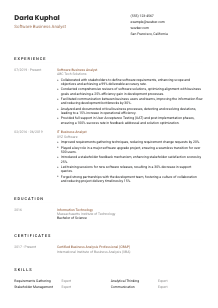
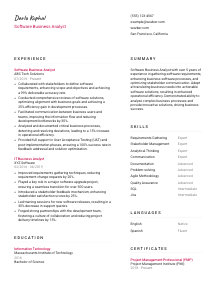
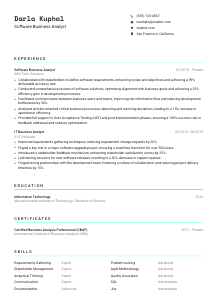
Decoding software needs, but your CV seems like a bug report? Check out this Software Business Analyst CV example, created with Wozber free CV builder. Learn how to map your analytical expertise to fit job specifics, ensuring your career trajectory stays in sync with the next software sprint!
Software Business Analysts sit in the middle of moving parts that rarely line up on their own. Business stakeholders describe needs in one language, delivery teams work in another, and the analyst has to turn loose requests into usable requirements, traceable decisions, and workable next steps. Your CV should make that translation work visible, not just list meetings attended or documents produced.
A tailored CV changes how quickly a hiring team can see whether you have handled requirement discovery, process analysis, UAT support, and stakeholder communication in a software setting. Wozber's free CV builder helps shape that experience into an ATS-compliant CV with language that matches the posting, so the first scan already shows where you can reduce ambiguity, support delivery, and keep business goals connected to the build.
This section is brief, but it still does practical work. For a Software Business Analyst, the header should immediately tell the reader who you are, what role you target, and whether basic application requirements such as location and contactability are already covered.
Use your full name at the top in a clean, readable style. Software Business Analyst hiring often moves quickly from CV review to recruiter screen, so your header should be easy to scan and easy to match across your CV, email, and LinkedIn profile.
Place "Software Business Analyst" directly under your name if that reflects your background and target role. This helps frame the rest of the CV around software requirements, business process analysis, stakeholder collaboration, and UAT support instead of leaving the reviewer to guess whether you are closer to a product, project, or systems profile.
Include a reliable phone number and a professional email address. Add LinkedIn or a personal website only if it supports your candidacy with relevant project work, analysis artifacts, or a clear career profile. For this profession, consistency matters because hiring teams often compare your CV with your online profile when checking title progression and domain experience.
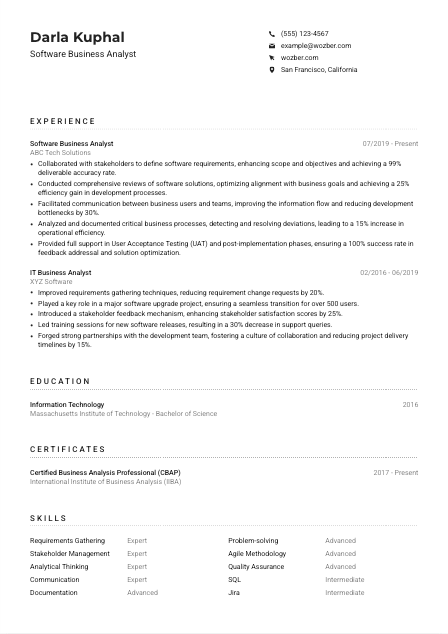
If a job requires local presence or names a city, show your city and state in the header. In the example, listing San Francisco, California directly addresses a stated requirement and removes a common screening question before it slows your application down.
Skip extras such as age, photo, marital status, or unrelated personal facts. A Software Business Analyst CV works best when the top of the page stays focused on role identity, communication access, and any logistical requirement that affects interview progression.
Your header should answer the first administrative questions immediately and hand the reader a clear Software Business Analyst profile. That keeps attention on your requirements work, process analysis, and delivery impact rather than on missing basics.




This is the section most likely to separate one analyst from another. Hiring teams want to see how you gathered requirements, clarified scope, improved processes, supported testing, and kept business and technical teams aligned when software decisions carried real delivery consequences.
Before rewriting bullets, mark the responsibilities that define the job. Here, the essentials are requirements gathering, documentation, stakeholder management, business process analysis, solution review, and UAT support. Those themes should appear in your experience section through actual work examples, not as a copied checklist.
List each role in reverse chronological order with company name, title, and dates. For Business Analyst work, titles matter because they signal whether you operated in software delivery, broader IT, or business operations. A title like "Software Business Analyst" or "IT Business Analyst" helps the reader place your work in the right delivery context from the start.
Replace duty-heavy statements with bullets that show what you analysed, who you worked with, and what changed because of your work. Strong examples mention deliverables such as requirements definitions, process maps, stakeholder workshops, UAT coordination, or post-implementation feedback loops. In the sample CV, bullets such as reducing development bottlenecks by 30% and improving operational efficiency by 15% work well because they connect analyst activities to delivery and business results.
Software Business Analysis often produces measurable effects through fewer change requests, cleaner handoffs, faster releases, better adoption, or more stable implementation outcomes. Use percentages, user counts, time savings, defect reduction, or process efficiency where you can support them. Metrics like a 20% drop in requirement change requests or support for a rollout affecting 500+ users give your analysis work operational weight.
If you have broader project, operations, or support experience, keep the bullets that strengthen your case for software-facing analysis work. Emphasize moments where you translated business needs into functional requirements, partnered with developers or QA, reviewed solution alignment, or supported UAT. That is more valuable here than unrelated leadership or administrative tasks, even if they were impressive in another setting.
Your experience section should make it easy to see how you move work from business need to implemented solution. When the bullets show requirements quality, stakeholder coordination, and measurable improvement, your value reads clearly.
Education is usually a supporting section for this role, but it still matters. A Software Business Analyst often needs enough business and technical grounding to understand systems, processes, and stakeholder priorities without losing the thread between them.
If the posting asks for a bachelor's degree in Business, Information Technology, or a related field, state your degree and field clearly. The example does this well with "Bachelor of Science" in "Information Technology," which directly supports a software-oriented analyst profile.
Include school, degree, field of study, and graduation year. Keep this section simple so a reviewer can confirm qualification level in seconds and move back to the experience section, where most hiring weight usually sits for analysts with 3+ years of work history.
If you are early in your career, relevant coursework, systems analysis projects, database work, process modeling, or software lifecycle assignments can help show readiness. Once you have solid experience with requirements documentation, process reviews, or UAT in production environments, academic detail should stay selective.
If you completed formal training in Agile, SQL, process improvement, or business analysis frameworks, decide whether it belongs better under education or certifications. Keeping those categories distinct makes your CV easier to scan and helps each qualification carry the right weight.
A recent graduate may need education to do more explanatory work. Someone with several years in software analysis should keep this section concise and let project outcomes, stakeholder work, and delivery support lead the case. Use space where it adds the most credibility for your current level.
This section should confirm that you have the academic foundation expected for software and IT-facing analysis work. Then let your professional record show how you applied it in real delivery environments.
Certifications help when they map to how the job is actually performed. For Software Business Analysts, the most useful ones usually signal stronger command of business analysis practice, delivery methods, or cross-functional project work.
When a role mentions CBAP or related credentials, list that certification prominently if you have it. In the example, CBAP earns immediate relevance because it supports the core work of requirements management, stakeholder engagement, and business analysis discipline.
Choose certifications that reinforce your work in software analysis, process improvement, Agile delivery, project coordination, or systems-facing business work. A shorter list of well-matched credentials reads better than a long inventory that drifts away from the job's actual needs.
Add issue dates or active status when relevant. That helps hiring teams understand whether the credential is current and whether your formal training reflects recent methods, standards, or frameworks used in modern software delivery.
Ongoing learning matters in roles that sit between changing business needs and changing technology stacks. If you keep your certifications current or add targeted coursework in areas such as Agile, process modeling, or testing support, that reinforces your ability to stay effective as delivery practices evolve.
Well-chosen credentials add weight to your business analysis profile, especially when they support the exact kind of software delivery work the role requires. Keep them relevant and easy to verify.
The skills section should read like the toolkit you use to move software work forward. For this role, that usually means a mix of analysis methods, documentation ability, stakeholder-facing communication, and a few delivery tools or technical concepts that help you work smoothly with development and QA teams.
Start with the skills the employer names explicitly. Here that includes requirements gathering, documentation, stakeholder management, analytical thinking, and problem-solving. Those should appear in your skills section only if your experience section also backs them up with concrete examples.
Put the most central Software Business Analyst skills first. Requirements elicitation, process analysis, stakeholder communication, UAT support, Agile ways of working, and documentation standards will usually matter more than secondary tools unless a posting makes a tool mandatory. The sample CV handles this well by leading with requirements gathering and stakeholder management before listing items like SQL and Jira.
A crowded skills section weakens the signal. Group your strongest skills around the work the job needs most, then add supporting tools or technical fluency that help in software environments. That usually creates a better hiring read than mixing core analysis competencies with unrelated software or soft-skill filler.
Your skills should reinforce the story told in your experience, not compete with it. When the section reflects real analyst workflows and delivery collaboration, it adds credibility fast.
Language matters in a role built around clarifying requirements, resolving misunderstandings, and guiding users through testing and implementation. Even when this section is short, it can still answer an explicit requirement and add useful context for cross-team communication.
If the job states that English is essential, list English first and state your level clearly. For a Software Business Analyst, this matters because requirement documents, workshop notes, UAT feedback, and stakeholder conversations all depend on precise communication.
Use plain labels such as Native, Fluent, Intermediate, or Basic. Avoid vague wording. A hiring team should be able to tell quickly whether you can lead meetings, document software requirements, and communicate implementation issues without confusion.
Additional languages can be useful if you work with distributed teams, international clients, or multilingual user groups. In the example, Spanish adds range, but English remains the key language because it is the stated requirement and the likely working language for documentation and stakeholder management.
Do not overrate yourself. Language claims are easy to test in interviews, especially in a role where clear spoken and written communication affects requirement quality, testing outcomes, and user adoption.
Not every Software Business Analyst role needs extra languages, but some do, especially in global product or implementation environments. If another language helps you run discovery sessions, support regional users, or interpret business context more effectively, it is worth including.
For this profession, language skills are most useful when they clarify how well you can gather requirements, document decisions, and work with business users. Keep the section honest and directly relevant.
Your summary should quickly position you within software delivery, not simply business analysis in the abstract. In a few lines, show your level of experience, the kind of analysis work you handle, and the business or delivery outcomes your work tends to improve.
Read the posting for the few themes that define success. Here, the summary should point toward software requirements, business process analysis, stakeholder collaboration, and support through testing or implementation. That gives the reader a focused lens before they reach your experience bullets.
A direct opening such as "Software Business Analyst with 5+ years of experience" gives immediate context. It works because it answers two high-value questions at once: what you do and how long you have done it in a relevant environment.
Choose strengths tied to the work, such as translating business needs into requirements, improving process efficiency, supporting UAT, or reducing change requests through better discovery. The example summary succeeds because it connects requirements work and stakeholder communication to operational efficiency rather than stopping at generic analytical ability.
Aim for a short paragraph that sounds grounded in software projects and business outcomes. Avoid broad statements that could apply to any analyst. A concise summary with the right terminology gives hiring teams a faster, sharper read than a long introduction filled with vague strengths.
A sharp summary tells the reader early that you understand software analysis work from discovery through implementation. When it names relevant strengths and outcomes, the rest of the CV lands with more context.
A Software Business Analyst CV should make one thing easy to see. You can turn business needs into clear requirements, keep stakeholders aligned, and support software delivery through review, testing, and implementation. Every section should help prove that through concrete responsibilities, tools, and measurable outcomes.
Use Wozber's free CV builder to organise that experience in an ATS-friendly CV format, then refine it with the ATS CV scanner and AI-powered tailoring so your wording matches the job's requirements naturally. The final result should give hiring teams a clean view of how you operate in real software projects.




