



Use Wozber and land your dream job
Create CV
No registration required
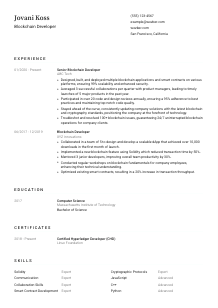
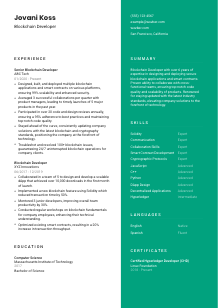
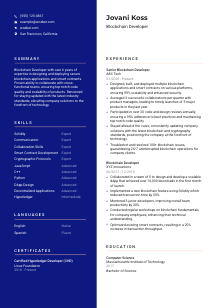
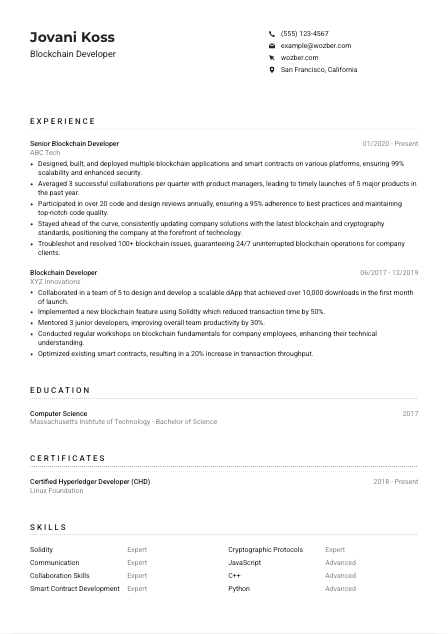
Building decentralized ledgers, but feel your CV is stuck in central databases? Check out this Blockchain Developer CV example, created with Wozber free CV builder. It shows how to clearly link your distributed expertise to job specifics, ensuring your career blocks are always on the chain!
Blockchain development work gets reviewed through a high bar for technical judgment. Hiring teams want to see whether you can build and ship smart contracts and decentralized applications that hold up under security scrutiny, scale under real transaction load, and fit into a broader product roadmap. Your CV needs to make that operating standard visible fast.
When the CV is tailored well, the first read becomes much more concrete. A team can quickly connect your experience with the stack and architecture concerns in the role, from Solidity and dApp delivery to cryptographic concepts and code review discipline. Wozber's free CV builder helps shape that into an ATS-compliant CV using the right role language, so your background reads clearly for both automated screening and engineers deciding whether you can contribute in production.
For a Blockchain Developer, the header should do one practical job right away: show that you are reachable, relevant, and aligned with any logistical requirements attached to the opening. Keep it clean, technical, and easy to scan.
Use your full name as the most visible text on the page. A straightforward, readable header works best. This role already asks the reader to process technical depth, so your contact section should remove friction rather than add visual styling that distracts from your engineering background.
Place "Blockchain Developer" directly under your name if that is the role you are applying for. If your current title is slightly different, such as "Senior Blockchain Developer," you can still align it to the target role when the experience supports it. This helps recruiters and hiring managers place you in the right pipeline immediately.
List a phone number and professional email address that you check regularly. One typo here can stop an interview request before it reaches you. If you include a website, make sure it leads to something useful, such as a portfolio, technical profile, or project repository related to smart contracts, protocol work, or backend engineering.
If a job specifies a city or on-site requirement, reflect that clearly in your personal details. In this example, "San Francisco, CA" matters because the employer explicitly asks for that location. When location is part of the screening filter, including it early prevents unnecessary doubt about availability or relocation.
A GitHub, LinkedIn, or personal site can strengthen this section if it supports your CV with real technical context. For blockchain roles, that might mean smart contract repos, dApp architecture writeups, protocol experiments, or open-source contributions. Only include links that are current and consistent with the experience and skills you claim elsewhere.
This section does not need personality flourishes. It should quickly confirm who you are, how to reach you, and whether basic role filters like title alignment and location are already satisfied.




Experience carries the most weight in blockchain hiring because the work is highly specific. Teams want to know what platforms you built on, what kind of smart contract or dApp work you handled, how you collaborated with product and engineering partners, and what changed because of your work in production.
Read the description closely and mark the technologies, architecture concerns, and workflow expectations that repeat. For this role, that includes blockchain application development, smart contracts, scalability, security, cryptographic understanding, code reviews, troubleshooting, and collaboration with product managers. Those priorities should shape which bullets you keep, rewrite, or move higher.
List positions in reverse chronological order with company name, job title, and dates. That structure matters because employers need to see how recently you worked with relevant blockchain stacks and whether your experience shows progression from implementation to architecture, review, or mentoring responsibilities.
Each bullet should show what you built, what environment you worked in, and what problem you solved. Generic software statements are not enough here. Say whether you designed smart contracts, deployed blockchain applications, optimised throughput, reduced transaction time, supported uninterrupted operations, or worked on dApp adoption. The sample CV does this well by tying work to deployment, reviews, and production support instead of vague ownership claims.
Numbers strengthen credibility when they reflect real blockchain work. Throughput gains, reduced transaction time, issue volume resolved, uptime, launch count, review participation, adoption figures, and security or performance improvements all help. For example, citing a 50% reduction in transaction time or 100+ resolved blockchain issues tells the reader more than broad claims about innovation.
Prioritise experience that shows blockchain development depth over unrelated software tasks. If you have broader backend or platform work, keep it only when it supports the story, such as distributed systems, security, API integration, or performance tuning that fed directly into blockchain delivery. The hiring team should come away with a clear view of your hands-on value in decentralized systems, not a mixed profile that could belong to any developer.
Your experience section should make it easy to trace what you built, how well it performed, and where you operated in the engineering workflow. That is what helps a blockchain team picture you reviewing code, shipping contracts, and handling production issues with confidence.
Education is usually a supporting section for experienced blockchain developers, but it still matters because many openings ask for a computer science or software engineering background. Present it clearly, then use it to reinforce the technical base behind your development work.
If the posting asks for a bachelor's degree in Computer Science, Software Engineering, or a related field, make sure your education section states that plainly. In the example, a Bachelor of Science in Computer Science lines up directly with the requirement, so there is no reason to bury or abbreviate it.
List the degree, field of study, school, and graduation year in a consistent order. Clean formatting helps both ATS parsing and human review. This section is usually scanned quickly, so clarity matters more than extra description unless your coursework or projects are especially relevant.
If your degree maps closely to the role, let that alignment do its job. Computer science, software engineering, information systems, and similar fields signal grounding in algorithms, systems design, and programming fundamentals that support blockchain development. Keep the wording direct and recognizable.
Earlier-career candidates can get more value from this section by naming coursework or academic projects tied to distributed systems, cryptography, computer networks, secure programming, or decentralized application design. That added detail helps when professional blockchain experience is still limited.
Blockchain tooling and standards evolve fast, from smart contract security practices to platform ecosystems and cryptographic approaches. If you have taken later courses, completed protocol-specific training, or studied relevant topics beyond your degree, include them when they sharpen your profile for the target job.
Keep this section straightforward, but make sure it supports the engineering story told elsewhere. For blockchain roles, education works best when it quietly reinforces your grounding in software fundamentals and security-minded thinking.
Certifications are not mandatory for every Blockchain Developer role, but they can strengthen your case when they map to the platforms, frameworks, or technical depth the employer values. Use them to reinforce specialization, not to fill space.
Start with the technical direction of the role. If the position mentions platforms such as Ethereum or Hyperledger, certifications tied to those ecosystems can add useful context. Even when a certificate is not required, it can show focused study in areas the team already cares about.
Choose certifications that connect to blockchain development work, smart contract implementation, distributed ledger platforms, or security-focused engineering. A credential such as "Certified Hyperledger Developer" is stronger here than a broad generic tech certificate because it points to platform-specific capability.
Add completion or active dates so the reader can judge how recent the credential is. That matters in a field where tooling, platform standards, and development practices shift quickly. Current dates also help show whether the certification still reflects your active technical range.
If certification fits your learning path, use it to stay current with smart contract security, enterprise blockchain platforms, cryptographic implementation, or adjacent cloud and backend tooling that supports deployment. The point is not to collect badges. It is to show that your knowledge keeps pace with the environments you want to work in.
A good certificate section adds one more layer of technical trust. It works best when every credential supports the blockchain platforms, development practices, or security concerns already visible in your experience.
Blockchain Developer skill sections work best when they read like a usable technical profile, not a crowded keyword dump. Employers are looking for stack familiarity, platform knowledge, and the collaboration skills needed to build with product, security, and engineering partners.
Start with the hard and soft skills the role names directly. Here that includes blockchain development, Ethereum, Solidity, Hyperledger, cryptographic protocols, consensus algorithms, decentralized applications, JavaScript, C++, Python, communication, and collaboration. Use that list to decide what belongs in your skills section and what should be left out.
Lead with the technologies and practices that define your day-to-day work, such as smart contract development, dApp design, cryptographic concepts, and programming languages. Then include collaboration and communication skills if they are backed by your experience, especially when the role involves defining requirements with product managers or participating in code and design reviews.
Put the most relevant skills first and avoid padding the list with every tool you have touched. If you use ratings, keep them honest and consistent. The sample profile groups Solidity, smart contract development, cryptographic protocols, and major programming languages in a way that quickly supports the target role. That kind of ordering helps both ATS matching and technical screening.
Every skill listed should feel connected to a project, deployment, review process, or troubleshooting task elsewhere on the page. That makes the section believable and gives the hiring team a cleaner picture of your technical range.
Most blockchain roles are technically screened first, but language skills still matter when the work involves product discussions, design reviews, cross-functional planning, or support across distributed teams. Keep this section brief and factual.
If the posting states that you must understand and speak English, list English clearly with an accurate proficiency level. This is especially important when the role includes collaboration with product managers, technical stakeholders, or client-facing troubleshooting.
Order languages by relevance to the role. English should appear at the top when it is explicitly required. That gives recruiters and hiring managers a fast answer to a direct requirement without making them hunt for it.
If you speak additional languages, include them when they are real working proficiencies. In global engineering teams or companies with distributed users and stakeholders, extra language capability can support smoother communication across functions or regions.
Use clear labels such as "Native," "Fluent," or "Professional Working Proficiency." Avoid inflated claims. A precise level is more useful than a vague statement, especially when meetings, documentation, and incident response depend on clear communication.
Additional spoken languages are rarely the main deciding factor for a Blockchain Developer, but they can strengthen your profile when the company works across borders or serves international users. They belong here as supporting context, not as a substitute for technical depth.
For this kind of role, language skills should quickly confirm that you can communicate in the environments the job requires. Once that is clear, let the rest of the CV carry the deeper technical argument.
The summary is where you frame your blockchain background in a few lines that an engineer, recruiter, or hiring manager can all understand quickly. It should present your level, your core technical strengths, and the kind of delivery record that matches the role.
Pull the requirements that define the role rather than trying to summarise everything you have ever done. For this job, that means blockchain development experience, smart contract and dApp work, security and scalability, cryptographic understanding, and cross-functional collaboration. Those themes should shape the language of your opening paragraph.
Open with your title, years of experience, and strongest technical focus. A line such as "Blockchain Developer with 6+ years of experience designing and deploying secure blockchain applications and smart contracts" works because it immediately establishes seniority and domain depth.
Use the next sentence to highlight strengths that matter to the target team. That could be production deployment, smart contract optimisation, protocol knowledge, code review discipline, or collaboration with product and engineering stakeholders. The sample summary does this by tying technical delivery to scalable products and cross-functional work.
Aim for a short paragraph that can be read in seconds. Skip broad personality claims and generic enthusiasm. Specific terms such as "smart contracts," "dApps," "cryptographic standards," or "scalable blockchain applications" do more work than filler because they immediately place you in the right technical lane.
A well-written summary gives the reader an accurate preview of the engineering profile that follows. By the time they reach your experience section, they should already understand your level, your blockchain focus, and the kind of systems work you are strongest in.
A Blockchain Developer CV should leave very little ambiguity about what you can build, which platforms and languages you know, and how your work performs under real conditions. When the sections above are tailored carefully, the reader can quickly connect your background to smart contract delivery, dApp development, security-minded engineering, and cross-functional execution.
Use Wozber's free CV builder to organise that experience into an ATS-friendly CV format, then refine it with role-specific language and measurable outcomes. Wozber's ATS CV scanner can also help surface missing requirements and tighten ATS optimisation so the final document makes your blockchain development range easy to judge.