



Use Wozber and land your dream job
Create CV
No registration required
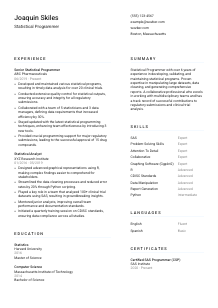
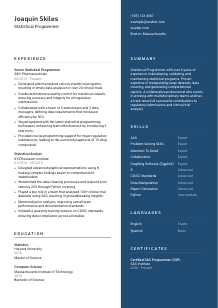
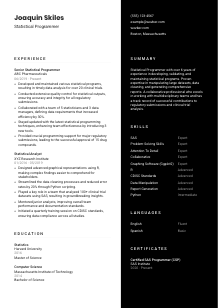
Crunching data, but your CV seems skewed? Check out this Statistical Programmer CV example, created with Wozber free CV builder. Learn how to cluster your statistical skills to meet job requirements, positioning your career trajectory on a perfectly normal distribution!
Statistical programming work is judged in the details. Hiring teams want to see that you can turn raw clinical data into reliable tables, listings, graphs, and submission-ready outputs without introducing errors along the way. Your CV needs to make that operating standard visible, especially around data validation, dataset handling, and the kind of regulated reporting environment you have worked in.
A tailored CV changes how quickly your background reads as relevant for statistical programming rather than general analytics. When your wording reflects the posting's language around clinical trials, CDISC, report generation, and programming support, Wozber's free CV builder helps you shape an ATS-compliant CV that surfaces the right experience early. That makes it easier for reviewers to recognize whether you can produce accurate analysis deliverables in a clinical setting.
This section is simple, but it still affects how your application is read. For a Statistical Programmer, the header should look orderly, exact, and easy to process, much like the work itself. Keep it clean and relevant so the attention stays on your programming background and clinical data experience.
Use your full name in a clear, readable format, then place "Statistical Programmer" directly beneath it. If your background is closer to senior-level work, you can use the title that reflects your actual experience, but keep it aligned with the target opening so the role focus is obvious immediately.
List a reliable phone number and a professional email address you check regularly. These details need to be error-free. A typo in your contact information creates the wrong impression in a field where accuracy in outputs, derivations, and validation checks matters every day.
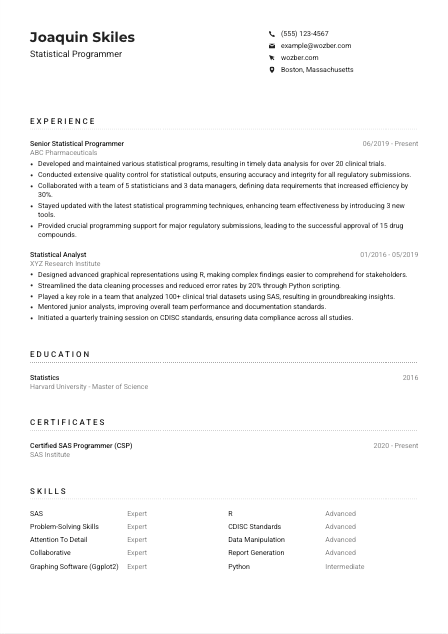
If the employer specifies a location requirement, include your city and state in the header. Here, "Boston, Massachusetts" directly addresses the stated location preference. When a posting does not require local presence, city and state are usually enough without a full street address.
A LinkedIn profile or personal website is useful when it supports your CV with consistent career history, publications, technical projects, or programming credentials. If you include one, make sure the titles, dates, and tools match your CV exactly.
Skip details such as age, marital status, photo, or anything else that does not help prove your ability to program, validate, and collaborate in a clinical research environment. Keep the section tight and professional.
Your header should read like a well-structured dataset definition. Clear, accurate, and directly relevant to the opening.




This is where Statistical Programmer CVs separate themselves from broader data roles. Employers look for concrete evidence that you have built analysis datasets, generated TLGs, cleaned large clinical datasets, performed QC, and supported statisticians or regulatory work. The stronger your bullets are, the less the reader has to infer.
Start by marking the repeated requirements in the posting. For this role, that includes statistical programming, large dataset manipulation, data cleaning, report generation, clinical trials, CDISC knowledge, quality control, and support for regulatory submissions. Those are the themes your experience bullets should reflect in natural language.
Use reverse chronological order and make each entry complete with title, employer, and dates. Clean structure matters for human reviewers and for ATS parsing. In a technical role where version control, documentation, and reproducibility matter, messy formatting works against you.
Show what you programmed, what environment you worked in, and what the result was. Good bullets for this profession mention outputs such as tables, listings, graphs, validation workflows, analysis support, or submission packages. The example CV does this well by tying programming work to more than 20 clinical trials and to regulatory submission support.
Quantify scope, throughput, efficiency, or quality improvements where you can. Trial counts, dataset volume, reduced error rates, faster turnaround, or submission outcomes all give useful context. A line about increasing team efficiency by 30% or reducing data cleaning errors by 20% tells the reader how your programming changed delivery, not just that you were involved.
Prioritise experience that shows clinical data standards, programming languages, validation discipline, and cross-functional work with statisticians or data managers. If an older role was more general, rewrite it to emphasize the parts most relevant to production reporting, QC, and regulated data environments.
By the end of your experience section, a hiring manager should be able to picture the studies, outputs, tools, and validation work you can handle with minimal supervision.
Education carries real weight in statistical programming because the work depends on statistical reasoning, structured programming, and comfort with clinical or analytical data. Present your degrees so the employer can quickly confirm that your academic background supports the technical demands of the role.
When a posting asks for a bachelor's degree or higher in Statistics, Computer Science, or a related field, make that alignment easy to spot. If you have a closely matched degree, list it clearly without overexplaining.
List your education in reverse chronological order. Include degree, field, school, and graduation year. For a Statistical Programmer, advanced study in Statistics, Biostatistics, Computer Science, or a comparable quantitative field is worth showing prominently.
Precise naming helps both ATS matching and human review. In the example, "Master of Science in Statistics" and "Bachelor of Science in Computer Science" map cleanly to the posted requirement and reinforce both statistical and programming strength.
Relevant coursework can help early-career candidates or career changers, especially if it covers biostatistics, clinical trial design, data structures, statistical computing, or database work. If you already have solid professional experience, keep this section concise.
Honors, research projects, or thesis work are worth including when they connect to analysis methods, reproducible research, or clinical data handling. Otherwise, let your experience section carry the heavier proof.
Your education section should confirm that you have the quantitative and technical foundation to work with statistical code, structured datasets, and regulated reporting.
Certifications are not always required for Statistical Programmer roles, but the right one can reinforce tool proficiency and ongoing development. This matters most when the certificate is tied to software or standards the employer already uses.
Prioritise credentials tied to statistical programming tools, clinical data standards, or regulated research workflows. A SAS certification is a strong example because it connects directly to one of the most common programming environments in clinical research.
You do not need a long certification section. One or two relevant credentials often carry more weight than a broad list of loosely related courses. Keep the emphasis on certifications that support your programming, validation, or domain expertise.
Dates help the reader understand whether your training is recent and still relevant. In fast-moving technical environments, current knowledge of programming practices, data standards, and reporting tools matters.
If you keep up with new tools, updated CDISC practices, or better ways to automate reporting and QC, your certificates can reflect that. This is especially useful when the role values efficiency improvements and modern programming techniques.
Relevant credentials work best when they back up the software, standards, and clinical programming work already shown elsewhere on the CV.
The skills section should read like a focused inventory of what you can actually use on the job. For Statistical Programmer roles, that usually means a mix of programming languages, clinical data standards, data handling capability, and the work habits needed for QC-heavy deliverables.
Pull required and repeated skills directly from the job description, then include them using the same professional language when it reflects your actual background. Here, SAS, R or Python, large dataset manipulation, data cleaning, report generation, CDISC knowledge, problem-solving, collaboration, and attention to detail all belong near the top.
Resist the urge to dump every tool you have touched. A Statistical Programmer benefits more from a concentrated list that highlights programming languages, standards, reporting tools, and data workflows than from a generic mix of software names.
Lead with core technical skills such as SAS, R, Python, CDISC standards, data manipulation, and reporting or graphing tools. Then add workflow-related strengths such as QC, problem-solving, and collaboration with statisticians or data managers. The example CV handles this well by pairing software with domain-specific abilities instead of listing only broad soft skills.
If someone reading your skills list can already picture you cleaning trial data, programming outputs, and checking submission-ready results, the section is doing its job.
Language ability is usually a smaller section on a Statistical Programmer CV, but it still matters when the role requires clear communication with statisticians, data managers, and regulatory stakeholders. Present it plainly and only where it adds value.
If the posting requires fluent English, state that clearly. Use a level such as "Fluent" only if it accurately reflects your ability to discuss programming issues, data queries, documentation, and meeting discussions in English.
Additional languages can be useful in global clinical teams or multinational research settings, but they should stay secondary to your programming and data experience. Include them when they are genuine and professionally relevant.
Use straightforward labels such as Fluent, Advanced, Intermediate, or Basic. Overstating fluency can become obvious quickly in interviews, especially in roles that require precise technical discussion and written documentation.
Include languages that make sense for the employers or study environments you are targeting. For many Statistical Programmer roles, English is the operational requirement, while additional languages are supportive rather than decisive.
Language skills should complement your profile, not compete with the technical sections. In this profession, communication matters most when it supports clean documentation, cross-functional coordination, and accurate interpretation of analysis requests.
Show that you can communicate clearly in the language the role requires, then let the rest of the CV carry the technical weight.
Your summary should quickly establish the kind of programming work you have done and in what setting. This is the place to connect years of experience with clinical data, statistical outputs, validation work, and collaboration, without repeating a list of skills verbatim.
Before writing the summary, decide which parts of the job matter most. For this opening, that is statistical programming in a clinical trials context, large dataset work, data cleaning, report generation, QC, and regulatory support. Your summary should reflect that core, not generic analytics language.
Start with your current professional identity and years of experience. "Statistical Programmer with 6+ years of experience" is clear and useful because it gives the reader immediate context about your level.
Choose two or three strengths that link directly to the work, such as developing and validating statistical programs, handling clinical trial datasets, generating TLGs or reports, or supporting submissions. The sample summary works because it combines technical scope with regulatory relevance and teamwork.
Aim for a tight paragraph that a reviewer can absorb quickly. Every phrase should earn its place by clarifying your programming environment, domain experience, or contribution to reliable analysis delivery.
A good summary tells the reader, within a few lines, whether you already work at the level this Statistical Programmer role demands.
A Statistical Programmer CV works when it shows controlled execution: clean programming language alignment, clinical data experience, measurable output, and careful validation. Those are the details that make hiring teams trust what comes next.
Use Wozber's free CV builder to organise that experience into an ATS-friendly CV format, then refine it with role-specific wording and ATS optimisation so the right programming, CDISC, and submission support work stands out early.
Once that is in place, your CV should make one thing easy to judge: whether you can deliver accurate statistical outputs in a clinical research setting.




