



Use Wozber and land your dream job
Create CV
No registration required
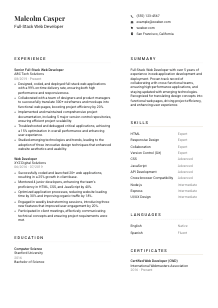
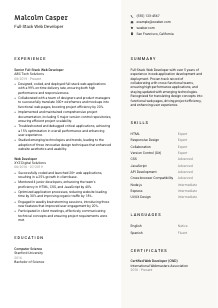
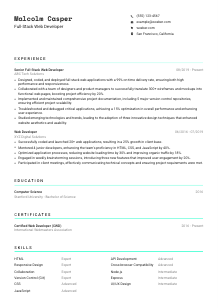
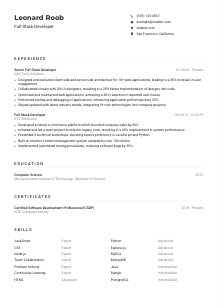
Juggling frontend and backend, but your CV feels like it's stuck in a single layer? Check out this Full-Stack Web Developer CV example, built with Wozber free CV builder. It shows how to stack up your web wizardry to match job needs, propelling your career to higher tiers of digital mastery!
Full-stack web development is evaluated through shipped work. Hiring teams want to see how you connect interface decisions with back-end logic, performance, debugging, and deployment, not just a list of languages or frameworks. Your CV should make that end-to-end ownership visible, from building responsive pages to supporting APIs, authentication flows, and production stability.
CV tailoring changes how quickly that ownership comes through in an ATS screen and a manual review. Wozber's free CV builder helps you align your wording with the posting, keep an ATS-friendly CV format, and surface the stack, delivery scope, and collaboration patterns that matter first. The result is a CV that reads like someone who can build, troubleshoot, and ship full-stack products in a working team.
For a Full-Stack Web Developer, the personal details section should be clean, current, and easy to scan. This role often moves quickly from CV review to technical screening, so basic information needs to remove friction right away, especially when the posting includes a location requirement or expects clear online contact points.
Put your name at the top in a size that stands out, then follow it with the title you want to be considered for. For this opening, using "Full-Stack Web Developer" immediately aligns your profile with the role instead of leaving the reviewer to infer whether you are primarily front-end, back-end, or general web support.
Mirror the posting's title when it accurately reflects your background. That small choice helps in both ATS matching and human review, especially for roles where adjacent titles like Software Engineer, Web Developer, or JavaScript Developer can blur your focus.
List a reliable phone number and a professional email address that you check regularly. Recruiters and engineering managers often move candidates into coding screens, portfolio reviews, or architecture conversations quickly, so your contact information should look current and dependable.
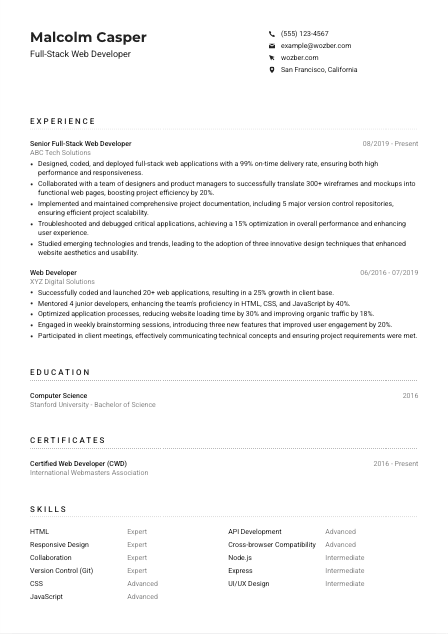
If a job specifies a city or state, show that detail clearly when it applies to you. Here, San Francisco, California is part of the requirement, so listing that location helps remove doubt about local eligibility or immediate availability. Treat this as posting-specific tailoring, not a rule for every full-stack role.
Include links that strengthen your technical profile, such as LinkedIn, a portfolio, GitHub, or a personal site with deployed work. For a full-stack role, these links can reinforce what your CV claims by showing code samples, shipped projects, API work, or product outcomes.
Age, marital status, photo, and other unrelated personal details do not help a hiring team understand your development work. Keep the section focused on professional access points and information tied to the role.
This section should help a recruiter or engineering lead contact you, confirm basic alignment, and move on to your technical background without distractions. If the posting includes a location filter, reflect it clearly and move forward.




Experience carries the most weight on a Full-Stack Web Developer CV because it shows how you build across the stack under real product constraints. Hiring teams look for proof of delivery, collaboration with design and product, debugging depth, and measurable improvement in speed, reliability, or user experience.
Read the responsibilities closely, then rewrite your recent experience so the overlap is easy to see. If the job emphasizes responsive web applications, API integration, performance, and collaboration with product and design, make those themes explicit in your bullets instead of hiding them behind generic development language.
List roles in reverse chronological order and include your title, company, and dates for each one. That structure helps the reader quickly understand your progression from implementation work into broader ownership, such as moving from building pages to deploying full-stack applications or maintaining shared repositories and documentation.
Full-stack work lends itself to concrete metrics. Use numbers tied to shipping velocity, page performance, application uptime, feature volume, conversion impact, or team efficiency. The example CV does this well with outcomes like a 99% on-time delivery rate, 300+ translated wireframes, and a 15% performance improvement, all of which say more than "responsible for development."
Debugging, optimisation, and cross-functional execution matter here. Include bullets that show how you worked with designers, product managers, QA, or other developers to turn wireframes into working interfaces, resolve defects, improve responsiveness, or secure application behaviour. This is also the right place to mention documentation, version control practices, and production troubleshooting.
Prioritise achievements that mirror the kind of work the employer needs now. For this kind of role, that often means front-end and back-end ownership, API work, database-backed features, cross-browser support, and collaboration across the product team. Older or less relevant bullets can be shortened so the strongest matching work gets the most space.
Your experience section should read like a record of shipped applications, solved problems, and measurable improvements. When the bullets show how you built, improved, and supported web products, your CV starts doing the screening work for you.
Education is usually a secondary screen for experienced developers, but it still matters when the posting asks for a specific degree. For full-stack roles, this section should confirm the academic background behind your programming, systems, and software development knowledge without taking attention away from practical experience.
If the posting asks for a Bachelor's degree in Computer Science or a related field, place that credential clearly. In this case, a Computer Science degree directly supports the employer's requirement and reinforces your grounding in software fundamentals beyond specific tools or frameworks.
List your field of study, degree, school, and graduation date or attendance range in a consistent format. Hiring teams typically use this section to confirm qualifications quickly, so clarity matters more than extra detail.
If you are still building experience, relevant coursework can help fill in technical context. Classes in databases, web development, software engineering, networking, or human-computer interaction can support a full-stack profile when professional experience is limited.
Honors, scholarships, teaching assistant roles, or leadership in engineering clubs are useful when they show technical commitment or collaborative work. Keep them brief and relevant to software development rather than listing every campus activity.
Projects can be worth adding if they involved application architecture, APIs, authentication, database design, deployment, or performance tuning. For junior candidates in particular, a well-described capstone can help bridge the gap between coursework and production-style development.
This section should quietly reinforce that you have the technical grounding the role asks for. Once that requirement is clear, let your experience and project outcomes carry the heavier weight.
Certifications are optional in many Full-Stack Web Developer searches, but they can strengthen your profile when they reflect tools, platforms, or practices the employer values. The key is relevance. A certificate should support your stack, your deployment environment, or your development workflow rather than sit on the page as a generic extra.
Start with the job description. This opening does not require a certification, so the section should remain selective and secondary. Add certificates only when they reinforce your technical profile instead of trying to compensate for missing experience.
Choose certifications that connect to web development, cloud deployment, security, JavaScript ecosystems, or related engineering practices. A credential is most convincing when the rest of the CV shows you have applied that knowledge in shipped products or production support.
Technology changes quickly, and recruiters notice whether a certificate is current. Listing the issue date, and expiration date when relevant, helps show whether the material reflects current standards, especially for cloud, security, or platform-based certifications.
Update the section when your work moves into new areas such as modern front-end frameworks, cloud infrastructure, testing, or secure authentication. Ongoing learning matters in full-stack work because the stack rarely stays still for long.
A certificate helps when it supports the technologies and delivery environment already visible in your CV. If it does not strengthen that story, leave the space for experience, projects, or skills that do.
The skills section should give a fast, accurate picture of the technologies and working strengths you bring to a web team. For Full-Stack Web Developer roles, that usually means a mix of front-end languages, back-end tools, databases, API work, security concepts, and collaboration habits that support shipping production-ready applications.
Start by extracting the stack and workflow terms the employer names directly. Here, that includes HTML, CSS, JavaScript, Node.js, Express, relational or non-relational databases, responsive design, cross-browser compatibility, API endpoints, and authentication or authorization concepts. Use the terms that honestly match your experience.
Grouping skills by proficiency can work well when the ratings are credible and balanced. The example CV separates expert and advanced skills across front-end development, API work, version control, and collaboration, which helps the reader quickly understand strengths without digging through the experience bullets.
Keep the list tight enough that every entry supports the kind of work you want. For a full-stack position, prioritise technologies you actively use to build interfaces, connect services, manage data, debug issues, and ship stable features. Leave out outdated tools or broad labels that do not help explain how you work.
A well-built skills section should tell a hiring manager, in seconds, whether your toolkit matches the application they need built and maintained. Accuracy matters more than volume.
Language skills are a practical hiring detail for developers when the work includes product discussions, documentation, client communication, or distributed collaboration. In full-stack roles, clear written and spoken communication often matters as much as coding when you need to explain tradeoffs, document changes, or coordinate with design and product partners.
If the posting specifies English fluency, list it clearly. That matters for reading requirements, discussing implementation details, writing documentation, and participating in standups or planning sessions without friction.
Additional languages can be useful in multilingual teams, client-facing development work, or global product environments. They are a plus when relevant, but they should not distract from the technical core of the CV.
Describe your level with familiar terms such as Native, Fluent, Intermediate, or Basic. Simple labels are easier to understand than custom scales and keep the section consistent with the rest of the CV.
Some web development jobs are heavily internal, while others involve customer calls, implementation handoffs, or documentation for broad user groups. Include extra languages when they genuinely strengthen your profile for that environment, not just because you know them.
A short, accurate list is enough. For example, listing English as Native and another language as Fluent can add context without taking space away from experience, stack depth, or project outcomes.
This section should confirm that you can communicate effectively in the environment the role requires. Once that is clear, let your technical sections stay in the foreground.
The summary should quickly establish what kind of Full-Stack Web Developer you are and what you have delivered. Hiring teams are looking for a compact read on your experience level, stack coverage, product collaboration, and the kinds of results you tend to produce in live web environments.
Pull two or three themes from the posting and make them the backbone of your opening lines. For this role, that could mean full-stack web application development, responsive front-end work, back-end implementation, collaboration with design and product, and performance or security-minded troubleshooting.
Start with your title and years of experience, then define your working range across the stack. A line such as "Full-Stack Web Developer with 5+ years of experience building and deploying web applications" gives immediate context and sets up the rest of the CV efficiently.
Use the middle of the summary to mention the kind of results you repeatedly deliver. The example CV points to high-performance applications, collaboration around wireframes and mockups, and user-experience improvements, which are all useful because they connect directly to the responsibilities in the posting.
Aim for three to five lines with no filler. The summary should read like an accurate technical introduction, not a career objective. If a detail is stronger as a metric or project bullet, save it for the experience section and keep the summary focused on scope and pattern of contribution.
When your summary clearly states your experience level, stack coverage, and delivery strengths, the rest of the CV becomes easier to read in context. It should set up the technical story that the experience section then proves.
With these sections aligned, your CV should show how you build across the stack, work with product and design, and improve application performance in ways a hiring team can quickly understand. Wozber's free CV builder helps organise that story into an ATS-compliant CV that keeps the technical substance easy to scan.
If you are refining an existing document or starting fresh, use Wozber's AI CV builder and ATS CV scanner to match your wording to the posting, surface missing requirements, and strengthen section-by-section alignment. The finished CV should make one thing clear fast: you can contribute to real full-stack web delivery from interface to deployment.




