



Use Wozber and land your dream job
Create CV
No registration required
Harnessing the cloud, but feel your CV is a bit foggy? Glide through this Salesforce Developer CV example, created with Wozber free CV builder. Learn how to spotlight your CRM coding prowess to match job goals, ensuring your career trajectory is as dynamic as a lightning component!
Salesforce development work gets judged in the details. Hiring teams want to see how you build on the platform, handle change safely, and keep orgs usable as requirements, integrations, and releases evolve. Your CV should make that visible through concrete delivery work, such as Apex development, Lightning component builds, integration support, defect resolution, and platform maintenance.
When that experience is tailored well, reviewers can quickly tell whether you have worked at the level the role requires instead of assuming you are a general CRM or full-stack developer. Wozber's free CV builder helps you shape that experience into an ATS-compliant CV by aligning role language, Salesforce terminology, and section structure so the hiring team can immediately see your platform depth.
This section is simple, but it still does real screening work. For Salesforce Developer roles, it should confirm who you are, how to reach you, and whether you meet any practical requirement that could affect interview selection, such as location or work eligibility expectations stated in the posting.
Use your full name in the most prominent text on the page. Keep it clean and easy to scan so it anchors the CV immediately. In technical hiring, the header should feel professional and efficient, much like the rest of your document.
Place "Salesforce Developer" directly under your name when that is the role you are pursuing. This creates instant alignment with the posting and helps frame the rest of your experience around platform development rather than broader software work. If your recent title was slightly different, such as CRM Developer, you can still target the CV title to the job while keeping job history accurate.
List a phone number you answer, a professional email address, and, if relevant, a portfolio, GitHub, or LinkedIn profile that supports your technical background. Double-check every character. Broken contact details can end a candidacy before anyone reads your Apex, API, or LWC work.
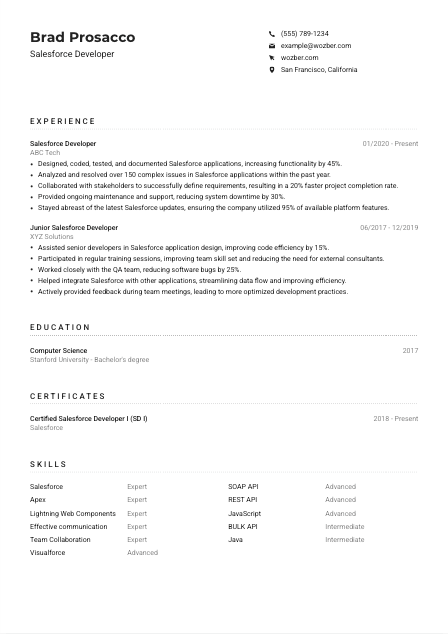
If a Salesforce Developer opening requires local presence, show your city and state clearly. Here, listing "San Francisco, California" works in your favor because the job specifically asks for candidates based there. Use this kind of location match when it addresses an explicit requirement, not as a universal rule for every application.
A strong web link can support your candidacy when it shows useful context, such as Salesforce project work, Trailhead activity, technical writing, or a polished LinkedIn profile. Keep it relevant. A hiring manager should find more proof of platform work, stakeholder collaboration, or system delivery, not unrelated personal content.
Your personal details should clear basic screening questions in seconds. When the header is accurate, relevant, and aligned with the posting, the reader can move straight to your Salesforce experience.




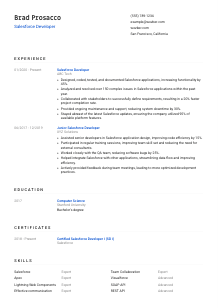
This is where your CV earns attention. Salesforce Developer hiring depends heavily on whether your experience shows platform-specific build work, practical troubleshooting, collaboration with non-technical stakeholders, and measurable results in a live org. Generic software bullets will not do that job.
Start by identifying the development work the employer actually named. In this case, that includes Apex, Visualforce, Lightning Web Components, troubleshooting complex applications, and integrating through SOAP, REST, and BULK API. Those requirements should shape which projects, bullets, and keywords appear first in your experience section.
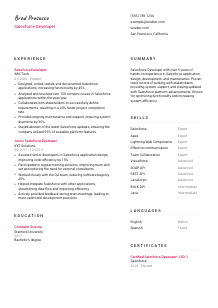
List your positions in reverse chronological order and give the most space to work that reflects actual Salesforce development. A recent Salesforce Developer role should naturally carry more weight than a loosely related engineering position. In the example CV, the move from Junior Salesforce Developer to Salesforce Developer shows a clear progression in platform ownership and delivery scope.
Hiring teams already know a Salesforce Developer writes code and supports the platform. What they need to see is what changed because of your work. Use bullets that connect platform activity to outcomes such as faster project delivery, reduced downtime, resolved defects, improved data flow, or higher feature adoption. The example's bullet about resolving more than 150 complex issues is effective because it ties troubleshooting directly to workload and impact.
Use metrics that fit Salesforce work naturally. Good examples include functionality improvements, ticket volume resolved, deployment frequency, downtime reduction, integration throughput, defect reduction, or release turnaround. Numbers like a 45% increase in functionality or a 30% drop in downtime make the scope of your contribution easier to understand than vague claims about improvement.
Keep the section centered on Salesforce development, integration work, stakeholder collaboration, testing, support, and platform upgrades. Remove bullets that do not support that story, even if they were important in another context. Every line should help the reader understand how you design, build, troubleshoot, and maintain Salesforce applications in a production setting.
A well-written experience section should show how you work inside Salesforce, what systems you improved, and what results followed. If the reader can picture your role in releases, integrations, support, and stakeholder delivery, this section is doing its job.
Education usually is not the most persuasive section for an experienced Salesforce Developer, but it still matters when the posting calls for a specific degree. Keep it straightforward and make sure it supports the technical baseline the employer asked for.
When a posting asks for a Bachelor's degree in Computer Science, Information Systems, or a related field, reflect that clearly in your education entry. This role does exactly that, so your degree should be easy to find and easy to match during screening.
List degree, field of study, school, and graduation year or date range in a consistent structure. Recruiters and hiring managers should be able to scan it quickly without sorting through extra text. Technical CVs benefit from clean formatting in every section, and education is no exception.
If you have a Bachelor's degree in Computer Science, say so plainly. The sample CV does this well with Stanford University and a Computer Science degree, which lines up neatly with the job requirement. If your degree is in a related field, keep the official title accurate and let your experience and certifications reinforce the technical match.
For early-career applicants, selected coursework can help if it connects to object-oriented programming, databases, web development, systems analysis, or integration concepts that support Salesforce work. For someone with several years of platform experience, coursework usually belongs off the page unless it fills an obvious gap.
Honors, technical projects, or relevant student organizations can strengthen this section when they connect to software engineering or enterprise systems. Keep them brief and only include them if they add something your work history does not already show. Once you have solid Salesforce experience, academic extras should stay secondary.
This section should confirm the required academic background without competing with your professional experience. Clear degree alignment is enough to support the rest of your case.
Salesforce is a platform where structured learning carries real weight. Certifications can strengthen your CV by showing current product knowledge, commitment to best practices, and investment in the ecosystem, especially when the role values platform depth and ongoing learning.
Not every Salesforce Developer job requires certifications, and this one does not list them as mandatory. Even so, relevant credentials can improve your positioning when they support the technical work in the posting. A certification like Salesforce Platform Developer I is directly useful because it connects to the platform development responsibilities employers care about.
List certifications that align with development, platform administration, architecture, or integration responsibilities you actually handle. For a developer CV, that usually means prioritising platform developer credentials over unrelated badges. Relevance matters more than volume.
Salesforce changes constantly through seasonal releases, feature updates, and evolving best practices. Certification dates help hiring teams understand how current your credential is and whether you have maintained platform knowledge over time. The example's certification entry works because it shows both the credential and its active timeframe.
If you are actively expanding your Salesforce knowledge through Trailhead, release reviews, or new certifications, keep that momentum visible where appropriate. For this field, continued learning is practical, not decorative. It shows that you can adapt to platform changes, new Lightning patterns, and updated integration or security standards.
A certification section works best when it reinforces the platform work already shown elsewhere on the CV. It should tell the reader that your Salesforce knowledge is both proven in practice and kept current.
For a Salesforce Developer, the skills section should read like a concise map of platform capability. It needs to cover the technologies, integration methods, and collaboration strengths that show up in the role, while staying grounded in tools and methods you have genuinely used.
Start with the technologies named directly, such as Apex, Visualforce, Lightning Web Components, SOAP, REST, and BULK API. Then add adjacent skills the work implies, like debugging, testing, stakeholder communication, and knowledge of Salesforce best practices. This gives you a skills section built around how the role is actually performed.
Use the same wording the employer uses when it accurately describes your experience. If the job asks for Lightning Web Components, do not hide that skill under a broader label like front-end development. The sample CV handles this well by listing Salesforce, Apex, Lightning Web Components, Visualforce, and API technologies separately, which improves both ATS matching and human readability.
Put the most important Salesforce capabilities first, then follow with supporting technical and interpersonal skills. Core platform technologies should lead. Secondary items like JavaScript, Java, or communication can follow if they support how you build, troubleshoot, and collaborate. Keep the list selective so the top of the section reflects the platform strengths the job is screening for.
A focused skills section should confirm your command of the Salesforce stack without turning into a keyword dump. If the listed skills line up naturally with your experience bullets, the section will feel credible and useful.
Language ability is often a secondary section on technical CVs, but it still matters when communication is part of the role. Salesforce Developers work with admins, users, product owners, QA, and other engineers, so language proficiency can support stakeholder alignment and smoother delivery.
If the posting asks for effective English communication, list English clearly and use an accurate proficiency label. That requirement appears here, so placing English at the top helps remove any doubt about your ability to work in meetings, gather requirements, document changes, and explain technical issues.
Additional languages are worth including when they are real working skills. They can be useful in global organizations, distributed development teams, or customer environments with multilingual stakeholders. In the example, Spanish adds breadth without distracting from the core technical profile.
Terms like Native, Fluent, Professional, or Intermediate are easier to interpret than creative descriptions. Keep them honest. If your role involves writing documentation, presenting updates, or handling support conversations, overstating language ability can create problems quickly.
Some Salesforce Developer roles involve more than coding. Requirement gathering, production issue triage, release notes, and user support all depend on clear communication. If a language genuinely helps you do that work, include it. If not, do not force this section to carry more weight than it should.
A short, accurate language section is enough. Its value is practical. It helps hiring teams understand how comfortably you can work across cross-functional conversations, user-facing explanations, and written technical communication.
For Salesforce work, language skills matter when they support clearer coordination with users, admins, and project teams. Keep the section brief, accurate, and relevant to how you actually work.
Your summary sits at the top of the CV, so it needs to establish your platform focus fast. For Salesforce Developer roles, that means leading with years of experience, core technologies, and the kind of business or system outcomes your work supports, all in a few tight lines.
Read the posting closely before writing a single line. If the role emphasizes Apex, Visualforce, Lightning Web Components, integrations, troubleshooting, and collaboration, those are the themes your summary should reflect. This keeps the top of the CV aligned with what the employer will look for first.
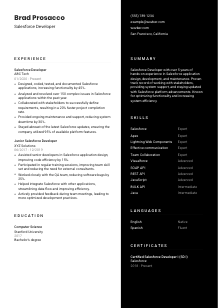
Start with a direct statement that tells the reader who you are professionally and how long you have been doing the work. The example summary does this effectively by leading with more than 5 years of hands-on Salesforce development experience. That kind of opening gives immediate context for everything that follows.
Use the next sentence to name two or three high-value areas, such as Salesforce application development, Lightning component work, system maintenance, integration support, or stakeholder collaboration. Match those points to your actual background and to the role's priorities. Do not try to list every tool you know.
Aim for a short paragraph that a hiring manager can scan in seconds. Replace vague phrases with concrete ones. "Designed and maintained Salesforce applications, resolved production issues, and supported platform improvements" says much more than broad claims about being results-driven or passionate about technology.
Your summary should quickly establish that you are a Salesforce Developer with relevant platform depth, practical delivery experience, and the communication range to work across teams. Once that frame is clear, the rest of the CV becomes easier to trust.
A Salesforce Developer CV should show more than platform familiarity. It should connect your Apex, LWC, Visualforce, integration, troubleshooting, and support work to outcomes that matter in a live Salesforce environment.
Use Wozber's free CV builder to organise that experience in an ATS-friendly CV format, strengthen phrasing with role-specific language, and improve ATS optimisation where the job description calls for it. The finished CV should make it easy to judge whether you can build, maintain, and improve Salesforce applications from day one.




