



Use Wozber and land your dream job
Create CV
No registration required
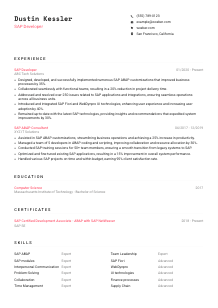
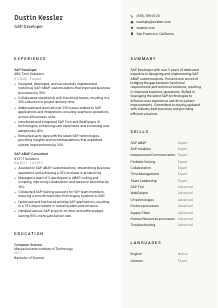
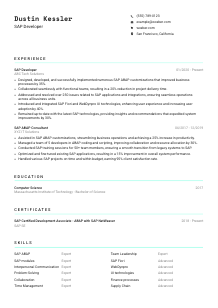
SAPping your skills, but your CV seems off the grid? Check out this SAP Developer CV example, created with Wozber free CV builder. It shows how to match your SAP expertise to job specifics and set your career trajectory straight into the cloud!
SAP development is reviewed through the systems it improves. Hiring teams want to see how you handled ABAP customizations, performance issues, UI work, and business-process gaps across modules such as Finance, Supply Chain, or HR. Your CV should make that technical scope visible fast, with enough context to show whether you build fixes, enhancements, and maintainable solutions inside a live SAP environment.
A targeted SAP Developer CV also helps separate pure coding experience from business-facing SAP delivery. When the language on the page reflects the role's modules, UI stack, and enhancement work, an ATS-compliant CV becomes easier to rank correctly and easier for reviewers to connect to the team's actual needs. Wozber's free CV builder helps you structure that alignment cleanly, so your SAP background reads as relevant implementation experience rather than general enterprise development.
The header section is simple, but it still carries screening value. For SAP roles, it should immediately confirm who you are, how to reach you, and whether you match any practical requirement that could affect hiring logistics.
Lead with your full name, then place the target title directly underneath it. Using "SAP Developer" is a clear match for the opening and keeps your positioning focused. That matters when your background includes adjacent titles such as SAP ABAP Consultant, SAP Technical Consultant, or ERP Developer.
Include a reliable phone number and a professional email address. SAP work often involves collaboration with functional analysts, project managers, and business stakeholders, so even small details such as a clean email format support the impression of professionalism and care.
If a role requires you to be in a specific market, state your city and state clearly. Here, listing San Francisco, California directly addresses the employer's location requirement and removes uncertainty around relocation or on-site availability. For other SAP openings, only include location detail when it helps answer a real screening question.
Include LinkedIn, a portfolio site, or another professional profile only if it supports your SAP work. For example, a profile that shows ABAP project history, SAP certifications, Fiori work, or enterprise systems experience adds value. Keep the content aligned with the CV so the hiring team sees one consistent professional record.
Age, gender, marital status, and similar details do not help a hiring team judge your ABAP development, SAP module knowledge, or cross-functional delivery. Keep the focus on information that supports contact, logistics, and role alignment.
Your personal details should answer the practical questions quickly and then get out of the way. Once the basics are clear, the rest of the CV can stay focused on SAP delivery, system improvement, and technical depth.




This is the section most hiring teams will study first. For SAP Developers, experience needs to show more than tenure. It should show what you built in ABAP, which business processes you supported, how you worked with functional teams, and what changed after your work went live.
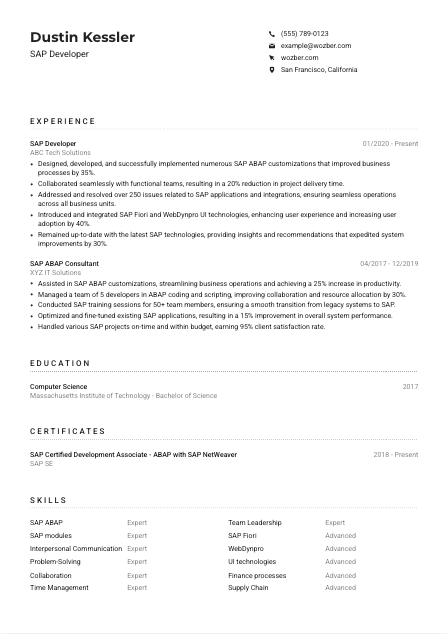
Pull the core responsibilities from the job description and reflect them through your own history. If the role emphasizes ABAP customizations, enhancements, troubleshooting, performance reviews, and cross-functional collaboration, those themes should appear in your bullets where they are true. The example CV does this well by using phrasing around designing and implementing SAP ABAP customizations, resolving application and integration issues, and introducing Fiori and WebDynpro improvements.
List your roles in reverse chronological order with job title, company name, and employment dates. That structure helps reviewers quickly confirm whether you meet requirements such as 4+ years of SAP ABAP development and whether your recent work is still closely tied to SAP rather than drifting into general software roles.
Each bullet should connect your technical work to a business or system result. Good SAP bullets mention what you developed, which process or application it affected, and the outcome. Metrics are especially useful here. In the example, improvements such as a 35% business-process gain, 20% faster delivery, 250+ resolved issues, and 40% higher user adoption make the work feel operational and measurable rather than generic.
Keep the emphasis on enterprise system work that matches the target role. ABAP enhancements, module support, integration troubleshooting, code reviews, UI modernization, and stakeholder collaboration belong near the top. Less relevant achievements can be cut or shortened. Each point should help the reader understand how you contribute inside an SAP landscape.
By the end of your experience section, a reviewer should understand your SAP scope without guessing. Use Wozber's ATS CV scanner to compare your wording with the posting and make sure your ABAP, module, UI, and support work are coming through in the same language the employer is using.
For SAP Developer roles, education is usually straightforward, but it still needs to support the hiring baseline. The main job here is to confirm the degree level and field quickly, especially when the posting specifies Computer Science, Information Technology, or a related discipline.
If the employer asks for a bachelor's degree in Computer Science, Information Technology, or a related field, present that information clearly and without extra wording. A degree such as Bachelor of Science in Computer Science, like the one in the example, lines up immediately with the requirement.
List degree, field of study, school, and graduation year or date in a simple order. That keeps the section easy to scan for both recruiters and ATS parsing. Technical CVs benefit from this kind of clean structure because it prevents key qualification details from getting buried.
When your degree is directly related to the role, make sure the field of study is visible, not abbreviated away. For SAP development, Computer Science, Information Systems, Software Engineering, and similar fields reinforce your foundation in programming, systems thinking, and enterprise technology.
Most mid-career SAP Developers do not need coursework, but it can help if you are early in your career or if a posting leans heavily toward a technical niche. Courses in database systems, enterprise applications, software engineering, or business systems can support the story when your work history is still developing.
This section does not need a long explanation. It needs to confirm that you meet the academic requirement and let the rest of the CV carry the heavier proof through SAP experience, tools, and outcomes.
SAP certifications can add real weight, especially when they align with the technical layer of the role. They help hiring teams place your knowledge faster, particularly when the work involves ABAP development, SAP platform experience, or newer SAP tools and practices.
Choose certifications that reinforce the exact kind of SAP work you do. A credential such as "SAP Certified Development Associate - ABAP with SAP NetWeaver" is highly relevant for an ABAP-focused developer opening because it maps directly to the technical core of the role.
A shorter list of relevant certifications is stronger than a long list of loosely related courses. Prioritise credentials tied to SAP development, module specialization, UI technologies, integration, or platform knowledge if they genuinely support the job target.
Add the year earned or validity period when appropriate. SAP ecosystems evolve, and dates help reviewers understand whether your certification reflects current platform knowledge or earlier-stage experience. In technical hiring, recency often shapes how credentials are interpreted.
Certificates will not replace hands-on SAP delivery, but they can sharpen your profile when they match the role closely. Present them clearly so they support your ABAP and SAP platform credibility instead of getting lost in the page.
A skills section should read like the toolkit you actually use, not a generic keyword dump. For SAP Developers, that usually means a mix of ABAP depth, SAP landscape knowledge, UI technologies, troubleshooting ability, and the collaboration skills needed to turn functional requirements into working solutions.
Start with the capabilities the employer is explicitly seeking. In this case, SAP ABAP development, customizations and enhancements, SAP modules, SAP Fiori, WebDynpro, and related UI technologies all deserve priority placement. Use the exact terms when they reflect your real experience so both ATS and human reviewers can connect your background to the role.
Do not stop at tool names. SAP development is collaborative work, so communication, stakeholder collaboration, problem-solving, and requirement translation matter when they are backed by experience. The example skill list combines ABAP and module knowledge with interpersonal communication and collaboration, which fits how many SAP teams actually operate.
Put the most job-critical skills first. For this kind of role, ABAP, SAP modules, Fiori, WebDynpro, troubleshooting, and process knowledge in areas such as Finance, Supply Chain, or HR should appear before broader professional skills. The sequence itself helps frame you as a SAP specialist rather than a general developer.
Your skills list should confirm your technical lane in seconds. Wozber's free CV builder can help you organise those terms in an ATS-friendly CV format so the most relevant SAP capabilities are easy to find and easy to match against the posting.
Language ability matters more in SAP work than many candidates assume. Developers often work with business users, functional consultants, offshore teams, and support stakeholders, so communication can affect requirement clarity, issue resolution, and rollout success.
When the posting names a language requirement, list it clearly with your proficiency. Here, English is a stated necessity, so it should appear first with an accurate level such as Native, Fluent, or Professional working proficiency, depending on your background.
Extra languages can be valuable, especially in multinational SAP programs, shared-service environments, or organizations with distributed support teams. If you speak another language well enough to collaborate on projects or training, include it. The example's German entry is useful because it suggests broader collaboration range, not because every SAP job requires it.
Use language levels you can defend in meetings, documentation, and problem-solving calls. SAP Developers are often expected to explain technical issues to non-technical stakeholders, so inflated proficiency claims can quickly become obvious.
List languages that affect communication on the job and state them honestly. That is enough to show whether you can operate comfortably in the meetings, documentation, and support exchanges the role requires.
The summary is your opening technical profile. In a few lines, it should tell the reader what kind of SAP Developer you are, how deep your ABAP experience runs, and what business or system outcomes tend to follow from your work.
Start with your title and the level of experience that matters most to the role. A line like "SAP Developer with 5+ years of experience in SAP ABAP customizations and enhancements" works because it tells the reader immediately whether you meet the technical baseline.
Use the next line or two to connect your background to the employer's needs. Mention areas such as translating functional requirements into technical solutions, supporting SAP modules, improving application performance, troubleshooting integrations, or delivering Fiori and WebDynpro work if those are part of your real experience. The example summary handles this well by linking ABAP expertise to business operations and system improvement.
Aim for 3 to 5 sentences with concrete wording. Avoid broad claims about being passionate, dynamic, or results-driven unless you immediately tie them to SAP work. The summary should prepare the reader for the experience section, not repeat it in softer language.
A well-written summary gives the hiring team a fast read on your SAP lane, your years of relevant development work, and the business context you support. With Wozber's AI CV builder and ATS-friendly CV templates, you can shape that opening so it aligns closely with the job description and leads naturally into the details that follow.
A SAP Developer CV works best when it shows how you build and improve enterprise processes, not just that you know the platform. If your ABAP work, module exposure, UI technologies, troubleshooting history, and collaboration with functional teams are all easy to find, the hiring conversation starts on stronger ground.
Use Wozber's free CV builder, ATS-friendly CV templates, and ATS CV scanner to tighten the match between your background and the target role. The finished CV should make one thing clear right away: you can turn SAP requirements into dependable technical solutions.




