



Use Wozber and land your dream job
Create CV
No registration required
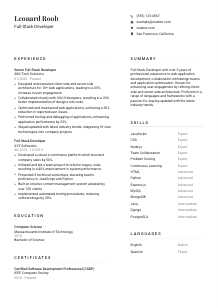
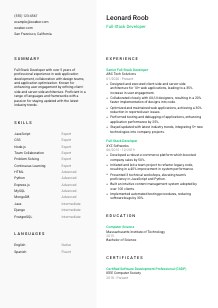
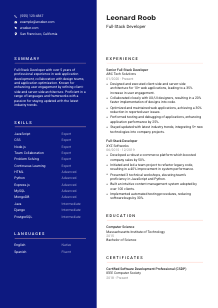
Navigating both front and back, but your CV lost in the stack? Check out this Full-Stack Developer CV example, created with Wozber free CV builder. Learn how to layer your full-stack skills to match job requirements, making sure your career stacks up just as impressively as your codebase!
Full-stack hiring moves quickly because teams need developers who can work across the application, not just contribute isolated code. Your CV needs to show how you handle front-end development, back-end logic, database work, testing, debugging, and collaboration with designers while still shipping maintainable features that perform well in production.
A tailored CV changes the first read from "general software engineer" to "developer who can cover this stack and workflow." Using Wozber's free CV builder and an ATS-friendly CV format helps you mirror the language of the job description, surface the right frameworks and databases, and make it easy for reviewers to see where your architecture decisions, delivery history, and performance work match the opening.
This section is simple, but it still carries useful signals. For a Full-Stack Developer, the header should immediately show who you are, how to reach you, and whether basic application requirements such as location and professional online presence are already covered.
Use your full name in the largest, cleanest text on the page. Keep it easy to scan. In technical hiring, a cluttered header can make the whole document feel less disciplined, which is the last impression you want when applying for work that depends on organised thinking and clean implementation.
Place the title "Full-Stack Developer" directly under your name if that is the role you are pursuing. This quickly positions you for openings that need both client-side and server-side capability. If your recent title is more senior, such as "Senior Full-Stack Developer," keep the wording aligned with the job you want rather than forcing a mismatch.
Include a current phone number and a professional email address. Double-check both. Engineering teams often move candidates forward quickly after a technical screen, so broken contact details can delay an interview more than any wording issue in the CV itself.
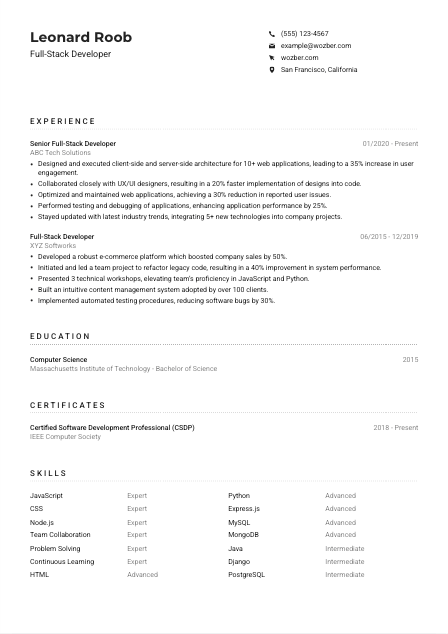
If a posting includes a location requirement, reflect it clearly in this section. Here, San Francisco, California is part of the stated criteria, so listing that location removes an avoidable question. For other applications, only include location details that actually help confirm eligibility or availability.
Include LinkedIn, a portfolio site, GitHub, or a personal website if it supports your technical story. For full-stack roles, a strong online profile can reinforce your stack, project scope, code samples, or product work. The example CV uses a website, which works well when the content behind it is current and consistent with the CV.
Your header should answer the basics in seconds: identity, role focus, contact details, and any location requirement tied to the job. Once that is clear, the rest of the CV can stay focused on engineering work.




This is where hiring teams look for technical depth translated into delivered work. A Full-Stack Developer CV should show what you built, which layers of the stack you handled, how you improved performance or reliability, and how your work affected users, product delivery, or system health.
Read the posting closely and identify the technical responsibilities behind it. For this one, that means architecture, full-stack web application development, testing and debugging, UX/UI collaboration, and staying current with tools and frameworks. Then pull matching examples from your own roles so each major requirement appears in your experience section with real context.
List your most recent role first, followed by earlier positions. For each entry, include title, company, and dates. This layout helps reviewers quickly track your progression from implementation work into broader ownership, such as architecture decisions, refactoring efforts, or mentoring. The sample CV does this well by moving from Full-Stack Developer into Senior Full-Stack Developer experience.
Each bullet should combine action, stack, and result. Instead of saying you "worked on web applications," show whether you designed client-side and server-side architecture, built APIs, improved database performance, implemented automated tests, or integrated designs from Figma or another handoff workflow into production code. The example bullet about designing architecture for 10+ web applications and increasing user engagement by 35% works because it connects responsibility to business outcome.
Numbers matter when they reflect how software work is judged. Use metrics like page speed improvement, reduction in reported bugs, increase in user engagement, deployment efficiency, conversion lift, uptime improvement, or adoption across clients or teams. The sample includes a 30% reduction in user issues and a 25% performance gain, which makes optimisation and debugging work much more credible than generic claims.
Prioritise experience that shows depth in web development, architecture, testing, databases, collaboration, and modern tooling. Side achievements that do not support engineering ability can stay off the page unless they directly strengthen the story. For this profession, space is better spent on frameworks used, systems improved, and product outcomes delivered.
Your experience section should make one point unmistakable: you have already built, maintained, and improved the kinds of web applications the role requires. The clearer your stack, scope, and outcomes are, the easier it is to picture you contributing quickly.
Education is rarely the main decision point for an experienced Full-Stack Developer, but it still matters when the posting asks for a specific degree. Present it cleanly so the required academic background is visible without distracting from your professional work.
If the job asks for a Bachelor's degree in Computer Science or a related field, make sure that information is easy to find. Do not bury the field of study. For this opening, a Computer Science degree directly supports the requirement and confirms formal grounding in software development concepts.
List degree, field of study, school, and graduation year. That is usually enough for experienced developers. Clean formatting helps reviewers scan quickly and keeps the emphasis on your technical experience, where most of the decision will be made.
If your degree aligns with the requirement, use clear wording that makes the match obvious. A Bachelor of Science in Computer Science, as shown in the example, directly addresses the education filter without any extra explanation. If your degree is adjacent, name the field precisely rather than stretching it.
For early-career candidates, relevant coursework, capstone projects, or software engineering clubs can help show exposure to web development, databases, or system design. For someone with 4+ years of experience, these details are optional unless they connect to the target stack in a meaningful way.
Awards, honors, or notable academic activities can stay if they add real value, but they should not crowd out recent engineering experience. Senior and mid-level full-stack hiring usually centers on shipped products, architecture, collaboration, and measurable improvements more than campus credentials.
If the degree requirement is met, make that obvious and move on. Education should support your technical profile, not compete with the work history that carries most of the hiring decision.
Certifications are useful when they strengthen your case around tools, frameworks, delivery practices, or ongoing professional development. In full-stack hiring, they matter most when they support the stack you work in or show continued investment in current engineering practice.
Lead with certifications tied to software development, cloud platforms, frameworks, security, testing, or architecture. Full-stack roles span several layers of the application, so the most useful certificates are the ones that reinforce practical development capability rather than generic participation badges.
Include the certifications that strengthen your target role and leave out the rest. A shorter list with clear relevance reads better than a crowded section filled with loosely connected topics. The example includes the Certified Software Development Professional credential, which supports broad engineering credibility.
Show when the certification was earned and whether it is still active if that applies. In a field where frameworks and practices change fast, timing helps employers understand whether the credential reflects current knowledge or an older stage of your development.
Technology stacks evolve, and full-stack developers are often expected to adapt across front-end frameworks, back-end services, testing approaches, and database tools. A current certification can support the same message as a strong experience bullet: you keep your skills current and usable in production environments.
Relevant certifications can strengthen your profile, especially when they back up the stack or engineering practices named elsewhere in the CV. Keep the section selective and current.
This section works best when it mirrors the technical reality of the job. For Full-Stack Developer roles, that usually means front-end languages, back-end languages and frameworks, databases, testing practices, and a few collaboration skills that matter in cross-functional product work.
Start with the tools and capabilities the employer has already named. Here, that includes JavaScript, CSS, HTML, Java, Python, Node.js, Express.js, Django, MySQL, PostgreSQL, MongoDB, and professional communication in English. Build your skills section from that list, then add adjacent technologies only if they genuinely support your profile.
For full-stack CVs, a grouped approach often reads better than one long mixed list. Separate front-end, back-end, databases, testing, and collaboration skills where the format allows. Even in a simple list, make sure your strongest and most relevant technologies appear first. The example does this well by foregrounding JavaScript, CSS, Node.js, HTML, Python, Express.js, and the database stack.
Do not stop at programming languages. Full-stack work often requires translating design into code, reviewing implementation tradeoffs, debugging with teammates, and communicating clearly across product, design, and engineering. Skills like team collaboration, problem solving, and continuous learning make sense here because they support how the work actually gets done.
Every skill on the page should hold up in an interview or coding discussion. Match the posting closely, order by relevance, and make sure the section reflects both your technical range and how you work with others to ship software.
Language ability matters in software roles when it affects daily collaboration, documentation, stakeholder communication, or client-facing work. If a posting names a required language, treat it as a formal requirement and make your proficiency clear.
If the role requires professional English, list English at the top of the section with an accurate proficiency level. In this case, English is explicitly required, so it should not be buried below secondary languages.
Additional languages can be helpful when teams are international, products serve multilingual markets, or client communication crosses regions. They are supporting strengths, not substitutes for the required language. The sample CV adds Spanish, which broadens communication range without distracting from the core requirement.
Use clear labels such as Native, Fluent, Advanced, or Conversational. Avoid vague wording. Engineering teams rely on accurate communication in standups, code reviews, documentation, and debugging discussions, so overstatement here can create problems later.
If the job includes regular interaction with designers, product managers, customers, or distributed teams, language skills become more relevant. For many full-stack roles, the ability to explain technical choices clearly in English is as important as writing the code itself.
Only list languages you can use at the level stated. If you are actively improving one, wait until your proficiency is usable in a work setting. Accuracy matters more than breadth, especially in roles that depend on precise written and spoken communication.
For this section, precision wins. Confirm the required language first, then add any extra languages that genuinely strengthen your ability to collaborate, document, or support users.
Your summary should give a hiring manager or technical recruiter a fast read on the kind of Full-Stack Developer you are. It works best when it combines years of experience, core technologies, and a few concrete outcomes instead of broad claims about passion or potential.
Start with your role, level, and years of experience. For example, "Full-Stack Developer with 5+ years of experience building and optimising web applications" immediately gives useful context. This works better than a generic opener because it tells the reader what kind of engineering background you bring.
Include the languages, frameworks, databases, or development responsibilities most relevant to the target role. For this job, that could mean JavaScript, HTML, CSS, Node.js, Python, Java, Express.js, Django, MySQL, PostgreSQL, MongoDB, architecture design, testing, debugging, and UX/UI collaboration. You do not need every term, only the ones you truly use and that define your fit for the opening.
Give the reader a reason to keep your profile in the interview pile by referencing actual outcomes. The example summary works because it points to user engagement improvement and application optimisation instead of repeating a list of tools. A short metric or business result can do a lot of work here.
Aim for 3 to 5 lines. That is enough room to cover your level, stack, and impact without repeating the experience section. Every sentence should earn its place by clarifying what kinds of applications you build and what kind of results you tend to deliver.
A well-written summary should tell the reader, within a few lines, whether you have the stack, delivery record, and cross-functional range the role requires. Keep it specific enough that the rest of the CV feels like proof, not explanation.
A Full-Stack Developer CV works when it makes your technical range easy to trust. That means clear stack alignment, solid project outcomes, readable structure, and experience bullets that show how you design, build, test, debug, and improve web applications in real environments.
Wozber's free CV builder helps turn that experience into an ATS-compliant CV with stronger keyword alignment, cleaner structure, and faster tailoring. Pair it with Wozber's ATS CV scanner and an ATS-friendly CV template to sharpen how your architecture work, framework knowledge, database experience, and collaboration history come through for both automated screening and human review.
When the CV is tailored well, hiring teams can quickly see whether you are ready to contribute across the stack from day one.




