



Use Wozber and land your dream job
Create CV
No registration required
Brushing off blemishes, but your CV still feels flawed? Review this Quality Control Inspector CV example, created with Wozber free CV builder. Learn how to match your careful scrutiny to job requirements, keeping your career trajectory as impeccable as the products you examine!
Quality control inspection sits where production speed meets product risk. Hiring teams want to see whether you can catch non-conformities before they turn into rework, customer complaints, audit findings, or scrap costs. Your CV should make that operating reality visible by showing how you inspect, document, escalate, and improve quality in actual manufacturing or production environments.
When the CV is tailored well, reviewers can quickly separate hands-on inspectors from broader quality candidates whose experience is heavier on systems support than direct inspection work. Wozber's free CV builder helps you align your wording with the posting and organise it in an ATS-friendly CV format, so inspection scope, compliance knowledge, and corrective-action involvement are easy to read by both the ATS and the quality team.
The top of the CV should answer practical screening questions fast. For a Quality Control Inspector, that usually means clear identity, reachable contact details, and location alignment when the employer needs someone on site for plant, line, or warehouse inspections.
Use your full name as the heading and keep it easy to read. Quality hiring tends to be straightforward, and a clean header sets the same tone as the rest of the CV. Save design flourishes for portfolios, not inspection roles where clarity and documentation discipline matter more.
Place "Quality Control Inspector" under your name if that is the role you are pursuing. Matching the posting title helps position your background correctly, especially when employers are sorting applicants across adjacent roles such as Quality Technician, Quality Assurance Specialist, or Quality Engineer.
List a reliable phone number and a professional email address. If you include a LinkedIn profile or professional site, make sure it reflects the same titles, dates, and quality-related achievements shown on the CV. Inconsistency in basic records can work against candidates in a field built on traceability and documentation.
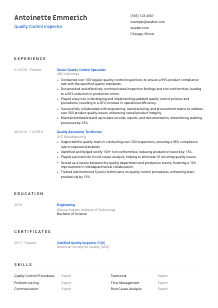
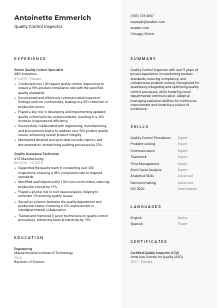
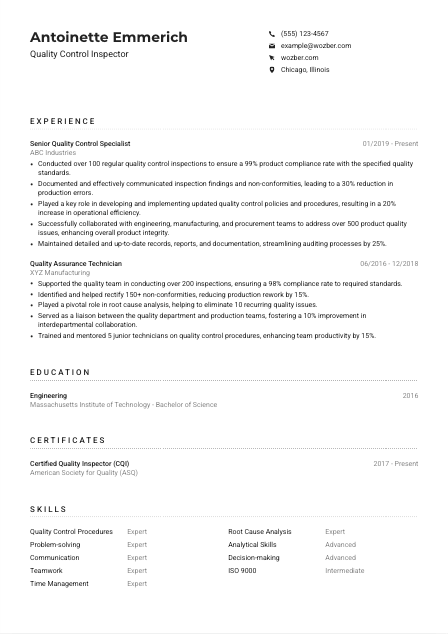
If the job calls for local availability, state your city and state clearly. In the example, listing "Chicago, Illinois" immediately supports a stated requirement. For other openings, use the location format that best reflects whether you are local, relocating, or already authorized to work on site.
A LinkedIn profile, certifications page, or industry profile can add useful context if it reinforces your inspection background, audit exposure, or quality systems knowledge. Skip links that do not help an employer understand your production-floor experience, reporting discipline, or technical credibility.
Your header should remove basic doubts before the hiring team reaches your experience. Make it easy for them to see who you are, where you are, and which quality role you are targeting.




This is where a Quality Control Inspector CV earns attention. Employers need more than a list of duties. They want proof that you can run inspections consistently, document findings accurately, work with production on corrective action, and help keep quality metrics moving in the right direction.
Read the responsibilities line by line and build your bullets around matching work. If the posting emphasizes regular inspections, non-conformity reporting, procedure development, and cross-functional collaboration, your experience should show those same activities through real examples. The sample CV does this well by covering inspections, documentation, policy updates, and issue resolution instead of relying on generic quality language.
List your positions in reverse chronological order and make the title history easy to follow. A move from Quality Assurance Technician to Senior Quality Control Specialist, for example, tells a useful story about increased scope, stronger judgment, and deeper involvement in inspection and process control. Include employer name, title, and dates with no missing basics.
Numbers matter when they reflect how quality work is measured. Good examples include inspection volume, compliance rate, defect reduction, rework reduction, audit efficiency, recurring issue elimination, or the number of quality issues resolved. In the example, achievements such as "99% product compliance," "30% reduction in production errors," and "25% faster auditing processes" make the inspector's contribution concrete.
Focus each bullet on inspection, documentation, quality decisions, corrective action support, and collaboration with manufacturing or engineering. Cut duties that do not strengthen that picture. A hiring manager for an inspection role will pay more attention to your handling of non-conformities, CAPA participation, and recordkeeping than to broad claims about being hardworking or detail-oriented.
Choose terminology you actually use on the job, such as non-conformities, root cause analysis, corrective actions, compliance, audit readiness, quality control procedures, and ISO-related standards where relevant. This improves ATS optimisation and also helps the CV sound like it came from someone who has worked inside a quality system, not around it.
Your experience section should show a reliable inspector who improves quality outcomes, not just someone who observed the process. If a reader can picture the lines you inspected, the issues you documented, and the results you helped improve, this section is doing its job.
For many Quality Control Inspector openings, education is a screening requirement before anyone reviews the finer details of your experience. Present it clearly so the employer can confirm the degree level and field without digging.
If the posting asks for a Bachelor's degree in Engineering, Quality Assurance, or a related field, list your degree in that same plain language. The example CV handles this cleanly with a Bachelor of Science in Engineering, which aligns directly with the requirement.
Include degree, field of study, school name, and graduation year or date. Quality roles often value orderly documentation, and this section should reflect that mindset. Keep the format consistent with the rest of the CV.
If your degree includes a concentration tied to manufacturing quality, process control, industrial engineering, or quality assurance, include it when it strengthens your match. This is especially helpful when your job titles are broad and the employer needs a clearer view of your technical foundation.
Coursework is most useful for early-career candidates or when it connects directly to inspection methods, statistics, manufacturing systems, metrology, or regulatory compliance. Once you have several years of hands-on quality work, keep academic detail selective and job-relevant.
Honors, technical projects, lab work, or leadership in engineering and quality-related programs can support your profile if they show analytical rigor or familiarity with structured problem-solving. Keep these additions brief and tied to inspection or process quality, not general campus activity.
Education should quickly establish that you meet the baseline technical requirement. Once that is clear, the rest of the CV can focus on inspection results, process discipline, and quality judgment.
Certifications carry real weight in quality hiring because they show formal knowledge of standards, inspection methods, and controlled processes. Use this section to highlight credentials that back up your hands-on work with recognized quality training.
If the employer mentions ISO 9000 training, Certified Quality Inspector, or another quality management credential, move matching certifications to the top. This is a direct way to answer a preferred qualification without making the reader hunt for it.
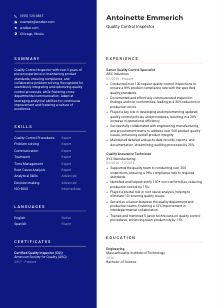
Place inspection, quality systems, auditing, and compliance-related credentials ahead of general professional development courses. In this example, the Certified Quality Inspector credential is exactly the kind of certification that supports an inspection-focused application.
Add issue dates and renewal status if the certification is current or periodically maintained. That tells employers your knowledge of standards and procedures is active, which matters in environments shaped by audits, controlled documentation, and changing compliance expectations.
Quality work changes with standards, customer requirements, and production methods. Ongoing certification in areas like quality systems, internal auditing, root cause analysis, or statistical process control can strengthen your profile over time, especially if you want to move into senior inspection or broader quality roles.
Use certifications to show that your inspection experience is backed by recognized quality training. For employers working under formal standards, that combination is often what moves a CV higher in the stack.
The skills section works best when it mirrors the practical mix of inspection knowledge, analytical ability, and production-side communication the role calls for. Keep it targeted and credible.
Pull out the abilities the employer names directly and include the ones you genuinely have. For this role, that includes quality control procedures, analytical skills, problem-solving, decision-making, and communication. Matching these terms helps with ATS alignment and also keeps your CV closely tied to the work the employer needs done.
Inspection roles need both. You may be checking product dimensions, recording non-conformities, and applying quality procedures one moment, then discussing findings with production supervisors the next. The example skills list works because it combines technical items like root cause analysis and ISO 9000 with role-critical soft skills such as teamwork and communication.
Group similar skills or order them by relevance so the employer can read them quickly. Put inspection methods, quality systems knowledge, and analytical tools near the top, then follow with communication and collaboration skills. A well-ordered list mirrors the disciplined documentation style expected in quality functions.
Your skills section should read like the toolkit of someone who can inspect, document, analyse, and coordinate action on the floor. If the list feels generic, tighten it until it reflects the actual language of quality control work.
Language skills matter in quality roles when findings, deviations, and corrective actions need to be documented clearly and communicated without ambiguity. Treat this section as part of your operating effectiveness, not a side note.
If the posting requires fluency in English, list English clearly with an accurate proficiency level. That matters because inspection notes, reports, escalation emails, and procedure-related communication all depend on precise language.
Additional languages can be valuable in manufacturing and supply environments where teams, vendors, or operators may work across languages. In the example, Spanish is a useful added capability, though the core requirement remains English fluency.
Use standard levels such as Native, Fluent, Intermediate, or Basic. Overstating language ability can become a problem quickly in a role where you may need to explain a defect, clarify a specification, or document a non-conformity precisely.
List extra languages when they strengthen your ability to communicate on the shop floor, with cross-functional teams, or across international supply chains. They are useful additions, but they should not overshadow your inspection and quality credentials.
For quality professionals, communication is part of control. Clear language supports cleaner reports, smoother handoffs, and fewer misunderstandings around specifications or corrective actions. Present your language skills in that practical light.
At minimum, the employer should be able to confirm that you can handle the language demands of inspections and reporting. Any additional language capability is a bonus when it improves coordination across teams or sites.
The summary should give a hiring manager a fast read on your inspection background, industry relevance, and the kind of quality outcomes you influence. Keep it brief, but make it specific enough to sound grounded in real QC work.
Before writing the summary, identify the few points that matter most in the target posting. For a Quality Control Inspector, that usually means inspection experience, quality standards knowledge, documentation discipline, and collaboration on corrective action. Build the summary around those priorities rather than around broad career adjectives.
Begin with your title and years of experience, then anchor that experience in quality control, manufacturing, product inspection, or process compliance. The sample summary does this well by establishing more than 5 years of quality-focused work from the first line.
Choose strengths that show how you work, such as maintaining product standards, improving compliance, supporting root cause analysis, or coordinating with production teams to solve recurring issues. This gives the reader an immediate sense of your operating value.
Aim for 3 to 5 lines. Avoid vague claims about passion or excellence unless they are backed by specific quality outcomes elsewhere in the CV. A concise summary should sound consistent with the inspection metrics, certifications, and standards knowledge that appear in the rest of your application.
A useful summary makes it easy to place you in the quality function before the reader reaches the first bullet point. It should quickly establish your inspection scope, your quality mindset, and the kind of environment where you add value.
A Quality Control Inspector CV works best when it is structured with the same discipline the job requires on the floor. Clear records, accurate terminology, measurable inspection results, and direct alignment with the posting all matter. Wozber's AI CV builder and ATS CV scanner can help you tighten that alignment, surface missing requirements, and present your background in an ATS-compliant CV that is easy for both systems and hiring teams to review.
When your CV makes your inspection work, documentation habits, and quality judgment easy to recognize, you give employers a much clearer reason to move you forward.




