



Use Wozber and land your dream job
Create CV
No registration required
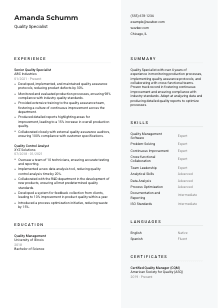
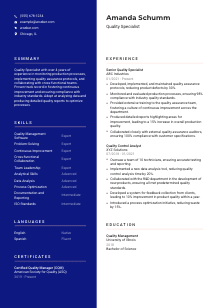
Ensuring excellence, but your CV doesn't stand out? Check out this Quality Specialist CV example, created with Wozber free CV builder. Learn how to show your meticulous attention to detail and process improvement skills in line with job requirements, weaving a career story that's as compelling as your quality outcomes!
Quality Specialist hiring turns quickly on whether your CV shows control over real operating conditions. Teams want to see how you monitor production or service workflows, tighten quality procedures, investigate failures, and keep standards from drifting under day-to-day pressure. If that work stays buried under generic claims about being detail-oriented, your CV will miss what the role actually demands.
A tailored CV changes the first read from "quality-related background" to clear ownership of audits, corrective action, reporting, and process compliance. Wozber's free CV builder helps organise that experience into an ATS-compliant CV that mirrors the language of the posting without sounding forced, so hiring teams can immediately see where you have improved quality performance and supported cross-functional execution.
For a Quality Specialist, the header should do one practical job well: confirm who you are, how to reach you, and whether you meet any immediate screening requirement. Keep it clean, accurate, and professional so the review can move quickly to your process, compliance, and improvement work.
Use your full name in a larger, readable font at the top of the page. This is standard, but it matters. Quality roles value orderly documentation, and a polished header sets that tone before a reviewer reaches your audits, defect reduction work, or reporting experience.
Place your target title directly under your name. If the posting is for a "Quality Specialist," use that wording unless your background makes a close variant more accurate. Matching the title helps frame your experience around quality assurance, quality control, process compliance, and continuous improvement from the first line.
List a phone number you answer and a professional email address that looks current and business-ready. One typo can stop interview scheduling cold. In a role built on accurate records, correct contact information is a small but telling detail.
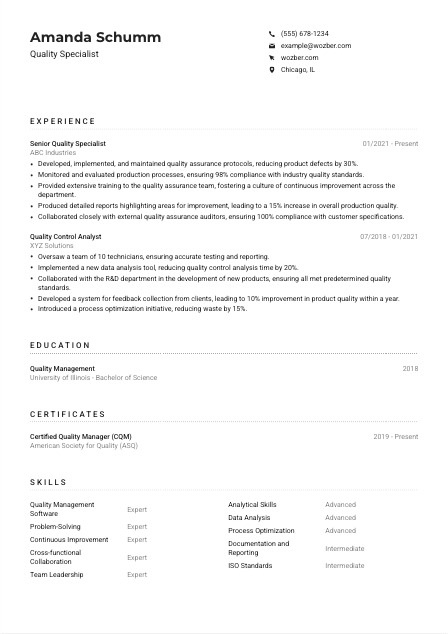
If a role specifies a location, show it clearly in your header. Here, "Chicago, IL" matters because the employer asked for it directly. When a posting includes a location filter, adding it removes an avoidable screening question early in the process.
A LinkedIn profile or professional site can add value if it reinforces your CV with the same titles, dates, certifications, and quality-focused achievements. Keep it aligned. If your CV mentions audit support, CAPA work, or quality reporting, your online profile should not tell a different story.
Your header should answer the easy questions immediately and leave no administrative loose ends. That keeps the attention where it belongs, on your quality systems experience and process results.




This section carries the most weight for Quality Specialist hiring. Reviewers are looking for proof that you improved quality performance in a real operating environment, whether that meant monitoring production, maintaining procedures, analysing trends, coordinating corrective action, or working through audit findings with other teams.
Mark the responsibilities that define the role before you write or revise anything. For this posting, that includes monitoring internal processes, maintaining quality assurance protocols, analysing data, training teams, and coordinating with external auditors. Those are the themes your bullets should address directly, using accurate quality language rather than broad operational wording.
List each position in reverse chronological order with employer name, title, and dates. Then make sure the role titles and bullet points show a progression in scope. A move from Quality Control Analyst to Senior Quality Specialist, for example, naturally supports growth from testing and analysis into protocol ownership, team support, and broader compliance responsibility.
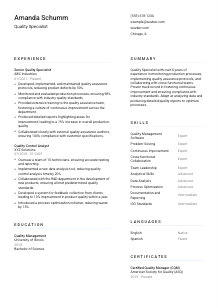
Numbers make quality work concrete when they reflect how performance is measured. Defect reduction, compliance rate, audit results, waste reduction, turnaround time, and process improvement are all credible measures here. The sample CV does this well with results like reducing product defects by 30% and achieving 98% compliance with quality standards.
Each accomplishment should connect to a specific part of the work: inspection, documentation, root cause analysis, protocol development, CAPA execution, training, reporting, or cross-functional follow-through. If the posting mentions customer specifications or external auditors, include bullets that show how you handled those demands. That helps both human reviewers and ATS screening understand your relevance quickly.
Choose achievements that show how you improved consistency, reduced failures, strengthened compliance, or supported production quality. Leave out bullets that are impressive but unrelated to quality systems or process control. Even when your background spans operations or product work, the CV should keep steering back to the outcomes a Quality Specialist is hired to manage.
Your experience section should make it easy to trace how you handled standards, process variation, reporting, and improvement over time. In Wozber, shaping these bullets into an ATS-friendly CV format also helps the right quality terms surface clearly in both screening and human review.
Education usually serves as a checkpoint in Quality Specialist hiring, but it still matters. A relevant degree helps confirm that you understand quality systems, process control, documentation discipline, and the analytical side of assurance or control work.
If the posting asks for a bachelor's degree in a related field, make that easy to spot. List the degree name, field, school, and graduation year. A Bachelor of Science in Quality Management is an especially direct match, but related areas such as engineering, manufacturing, industrial technology, or life sciences can also be relevant depending on the industry.
Use a consistent structure so the education section reads quickly. Degree, field, institution, year. Hiring teams are usually checking baseline qualification here, not looking for narrative. Clear formatting keeps the section efficient and professional.
When your field of study aligns closely with the job, let that relevance work for you. In the example CV, Quality Management supports the role naturally because the work centers on protocols, compliance, and process improvement. If your degree is in a broader discipline, your experience and certifications can do more of the specialization work.
Honors, coursework, or projects are worth including if they directly support the target role, especially earlier in your career. Courses in statistics, quality systems, process improvement, manufacturing controls, or regulatory compliance can be useful additions when you do not yet have many years of experience.
If you have completed workshops, technical training, or additional study in audit preparation, ISO standards, CAPA, Lean, Six Sigma, or quality software, include them when they add real value. Ongoing learning is especially useful when the role emphasizes continuous improvement or regulated processes.
Your education should quickly establish that you meet the academic baseline and have a credible foundation for quality work. Keep it concise, relevant, and easy to connect to the rest of your CV.
Certifications carry real weight in quality roles because they point to structured knowledge, current standards, and a commitment to disciplined practice. When a posting references a credential such as CQM, this section becomes more than a bonus. It becomes part of the qualification picture.
When a certification appears in the job description, include it prominently if you hold it. For this role, a Quality Management credential such as Certified Quality Manager aligns well with the employer's requirements and supports your expertise in systems, standards, and quality leadership.
Focus on credentials connected to quality assurance, quality control, auditing, compliance, continuous improvement, or process excellence. A shorter list of relevant certifications is more effective than a long list of unrelated training items.
List the issuing body and the date or active range when it helps establish that the credential is current. In quality roles, current certification can reinforce credibility, especially when the work involves evolving standards, audit expectations, or customer requirements.
The field changes with new standards, software, regulatory expectations, and improvement methods. Adding newer coursework or certifications in areas such as internal auditing, root cause analysis, Lean, or ISO frameworks can make your CV stronger for more specialised quality openings.
Relevant certifications sharpen your profile by showing formal commitment to quality practice. When the credential aligns with the posting, it reinforces that you can step into procedure-driven, standards-based work with less ramp-up.
A Quality Specialist skills section should read like the toolkit behind your results. That means a practical mix of technical capability, analytical judgment, documentation discipline, and cross-functional communication, all expressed in terms that match how quality work is actually done.
Start with the language in the job description and keep only what you genuinely use. Here, analytical problem-solving, attention to detail, quality management software, and collaboration across teams are all central. Those terms belong in your skills section because they connect directly to the work.
Quality work is not only about standards and software. It also involves training operators, working with production or engineering teams, documenting findings clearly, and helping corrective actions stick. Pair technical skills such as quality management software, data analysis, and ISO familiarity with collaboration, reporting, and training capabilities.
Order matters. Lead with the competencies most tied to the target role, especially those named in the posting. In the sample CV, quality management software, continuous improvement, cross-functional collaboration, and data analysis all support the stated responsibilities well. Start with the skills that best explain your quality outcomes.
Your skills list should support the rest of the CV, not repeat generic strengths. Keep it targeted enough that a reviewer can immediately connect those skills to audits, reporting, process control, and quality improvement work.
Language is usually a supporting section for Quality Specialists, but it can still matter. Clear communication affects training, audit coordination, documentation, and interactions with production teams, suppliers, or customers, so list languages in a way that reflects real working ability.
If the job specifies English proficiency, list English clearly and near the top. That is especially important when the role includes reporting, training, audit communication, or cross-functional coordination, as this one does.
Include additional languages when you can use them professionally. In some manufacturing, distribution, or supplier-facing environments, another language can help with training consistency, issue resolution, or communication across teams. Treat it as added value, not filler.
Describe your level with straightforward terms such as Native, Fluent, Intermediate, or Basic. Avoid vague claims. Quality work depends on precision, and your language section should reflect that same standard.
Additional languages matter most when the environment includes multilingual teams, international suppliers, or customer-facing quality communication. If that is relevant to the jobs you target, this section can quietly strengthen your profile.
Do not overbuild this section unless languages are central to the role. For most Quality Specialist positions, English proficiency is the key requirement, and any other language should sit as a useful secondary asset.
List language ability with the same accuracy you would use in a quality report. That gives employers a realistic sense of how you can communicate in training, documentation, and audit-related work.
The summary sits at the top of the CV, so it needs to identify you quickly and in the right terms. For a Quality Specialist, that usually means years of experience, core quality functions, and one or two outcomes that show you can improve compliance, process consistency, or product quality.
Before writing the summary, pull out the few themes that matter most in the posting. In this case, process monitoring, protocol maintenance, reporting, training, and audit coordination all stand out. Your summary should touch the strongest of these areas based on your background.
Lead with your title and experience level in a straightforward line. "Quality Specialist with 4+ years of experience" works because it establishes relevance immediately. If your background is broader, anchor it with the quality functions you own, such as QA protocols, compliance monitoring, or process improvement.
Use the next sentence or two to connect your core skills to outcomes. The sample summary mentions production process monitoring, quality assurance protocols, cross-functional collaboration, and detailed reporting. You can strengthen this even more by adding one measurable result, such as defect reduction, compliance improvement, or waste reduction, when it fits naturally.
Aim for three to five lines that a hiring manager can scan in seconds. Avoid buzzwords and avoid repeating every skill from the body of the CV. Focus on the parts of your background that best explain why you can manage quality standards, process issues, and improvement efforts in the target environment.
A good summary gives the reviewer a clear quality profile before they reach the detail below. It should quickly position you as someone who can protect standards, analyse issues, and improve process performance.
A Quality Specialist CV should show more than careful wording. It should map your background to the work itself: process monitoring, standards compliance, reporting, corrective action, team support, and measurable improvement.
Use Wozber's free CV builder, ATS-friendly CV templates, and ATS CV scanner to shape that experience into a CV tailored to the posting and easy to read in an ATS-friendly CV format. The end result should make one thing clear fast: you know how to improve quality in a real operating environment.