



Use Wozber and land your dream job
Create CV
No registration required
Guardian of perfection, but your CV seems flawed? Check out this Quality Assurance Specialist CV example, created with Wozber free CV builder. Learn how to match your keen eye for quality to job standards, so your career shines as flawlessly as the products you certify!

Quality Assurance Specialists are trusted with the part of operations that cannot drift. When production defects, audit findings, or process gaps slip through, the cost shows up fast in rework, compliance risk, and customer complaints. Your CV needs to make that responsibility visible by showing how you maintain standards, investigate issues, and push corrective actions through to a measurable outcome.
Screening for this role often turns on whether your CV clearly connects quality work to real systems and results, not just inspection tasks. Using Wozber's free CV builder helps you shape an ATS-compliant CV around the language employers use for quality management systems, ISO standards, nonconformance handling, and KPI reporting, so hiring teams can quickly see where you have already improved compliance, defect rates, or audit performance.
For a Quality Assurance Specialist, even the contact section quietly signals discipline. Hiring teams notice clean formatting, accurate information, and whether you meet practical requirements such as location before they ever reach your process improvement work or audit experience.
Place your full name at the top in a format that's easy to scan. Keep it simple and polished. In a field where documentation accuracy matters, this section should already feel controlled and intentional.
Add a headline under your name that matches the role you are pursuing, such as "Quality Assurance Specialist," if that is the position you want and your background supports it. This helps align your CV with the posting right away and sets the context for your experience in compliance, defect analysis, and quality systems.
List a reliable phone number and a professional email address, ideally based on your name. A missed digit or an outdated inbox undermines credibility fast, especially in a role built on accurate reporting and follow-through.
If the employer asks for a specific location, reflect that clearly in your contact details. Here, listing San Francisco, California directly supports a stated requirement and removes early uncertainty about availability or relocation.
Add LinkedIn or a personal website only if it strengthens your application. For QA professionals, that might mean a profile that reinforces your work with ISO standards, audits, CAPA, quality metrics, or cross-functional improvement projects. Keep the content consistent with your CV.
This section should confirm the basics without friction. Clean contact details, a relevant title, and any required location information help move attention quickly to the parts of your CV that prove how you manage quality standards in practice.




This is the section hiring managers read to understand how you operate inside a quality function. They want to see whether you have worked with quality systems, handled defects, partnered with production or engineering, and improved outcomes that matter on the floor, in audits, or in customer-facing quality issues.
Before editing bullets, mark the recurring requirements in the job description. For this role, that includes quality control systems, ISO standards, production sample review, issue resolution, staff training, and KPI tracking. Those themes should shape which accomplishments you lead with and which terms you mirror naturally in your wording.
List roles in reverse chronological order with title, company, and dates clearly shown. That structure helps reviewers quickly confirm whether you meet the experience threshold, such as 3+ years in quality assurance or quality control work, and how your scope has grown over time.
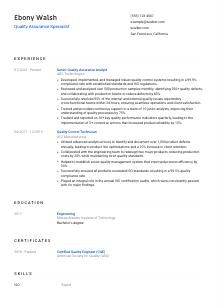
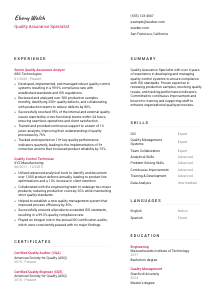
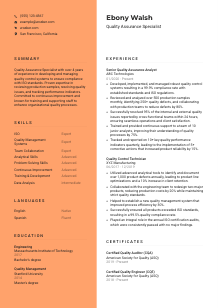
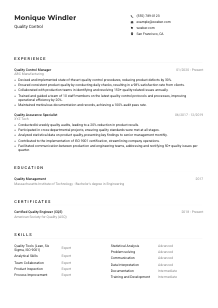
Quality work is judged through what changed after your intervention. Instead of saying you were responsible for quality control, show what you built, fixed, or improved. The sample CV does this well with a bullet about developing and managing quality control systems that drove a 99.9% compliance rate. That kind of phrasing ties process ownership to a business result.
Use metrics that belong naturally to quality work: defect volume, compliance rate, turnaround time, sample volume, audit findings, product reliability, corrective actions, or reduction in recurring issues. "Reviewed 500 production samples monthly" and "reduced defects by 80%" tell a much clearer story than broad claims about quality improvement.
Focus your space on experience that shows direct alignment with the target role. For a Quality Assurance Specialist, that usually means quality systems, root cause analysis, CAPA support, ISO compliance, cross-functional issue resolution, and reporting. If you have broader manufacturing or operations experience, keep it only when it strengthens those quality themes.
Your experience section should show that you can do more than inspect. It should make clear that you can manage standards, identify defects, coordinate corrective action, and improve quality performance in ways a team can measure.
Education carries real weight in QA when the posting asks for a degree tied to engineering, quality management, or a related discipline. It helps establish your grounding in process thinking, data analysis, systems, and the structured problem-solving expected in regulated or standards-driven environments.
If the role asks for a Bachelor's degree in Engineering, Quality Management, or a related field, make that easy to spot. Use the official degree and field names so the connection is immediate. In the example, a Bachelor's in Engineering aligns directly with the requirement.
For each degree, list the school, degree, field of study, and graduation year or date. Straightforward formatting helps reviewers confirm qualifications quickly and keeps this section consistent with the documentation discipline expected in quality work.
If you hold a master's degree or specialised academic training, include it when it strengthens your fit. A graduate degree in Quality Management, for example, can reinforce your understanding of quality systems, audit frameworks, and continuous improvement methods without replacing the need for practical experience.
Early-career candidates can use relevant coursework to support limited hands-on experience. Focus on subjects that connect to QA practice, such as statistical quality control, process validation, quality systems, root cause analysis, or operations management.
Honors, projects, research, or technical student work belong here only if they support the role. A capstone on process optimisation or a project involving defect analysis adds more value than unrelated extracurricular detail.
This section should confirm that your training supports the kind of structured analysis and standards-based work the role requires. Clear, relevant education strengthens the technical side of your QA profile without taking space from stronger professional proof.
Certifications matter in quality assurance because they show formal training in standards, auditing, and process discipline. When a posting names credentials such as CQE or CQA, that is a clear cue to make them prominent rather than burying them near the end of the CV.
When a job description prefers Certified Quality Engineer or Certified Quality Auditor, list those credentials clearly if you have them. They map directly to the role's emphasis on ISO knowledge, quality systems, and structured corrective action. The example CV uses both, which immediately strengthens alignment.
Include certifications that support the work you will actually be doing, such as auditing, quality engineering, process improvement, or regulatory compliance. A short list of closely matched credentials is more persuasive than a long list of unrelated certificates.
Add issue dates and renewal periods where relevant. In QA, current certification status can matter, especially for audit-facing or standards-driven roles, so make it easy to see whether a credential is active.
Quality standards, audit expectations, and improvement methods evolve. Updating certifications or adding new ones can strengthen your profile, particularly if your recent experience is light on formal system ownership or external audit work.
Relevant credentials tell employers that your quality knowledge has been tested against recognized standards. When they align with the posting, they strengthen your case for roles involving ISO compliance, audits, and quality system management.
A Quality Assurance Specialist skills section should read like a focused operating toolkit, not a generic list. Employers are looking for the systems knowledge, analytical judgment, and cross-functional working style that keep products compliant and quality issues from repeating.
Read the job description for explicit skill language and the work behind it. Here, the obvious matches include quality management systems, ISO standards, analytical and problem-solving skills, and collaboration. Those should appear if they reflect your real background.
Lead with the capabilities most tied to the role's actual work. For many QA positions, that means QMS, ISO compliance, root cause analysis, CAPA, auditing, data analysis, documentation control, and stakeholder communication. In the example, "ISO" and "Quality Management Systems" are rightly positioned near the top because they connect directly to the posting.
Choose skills that reinforce one another instead of trying to cover everything. A shorter list with clear relevance is easier for both ATS screening and human review. If you use proficiency labels, keep them believable and consistent with what your experience section already proves.
This section should quickly confirm the tools, frameworks, and working strengths behind your achievements. When it matches the language of the role and the proof in your experience bullets, the CV reads as a coherent QA profile rather than a collection of disconnected terms.
Quality assurance depends on precise communication. Audit notes, defect reports, SOPs, training materials, and corrective action records all need clear language, so any stated communication requirement deserves direct attention on the CV.
If the posting states strong English proficiency as fundamental, list English clearly with an honest proficiency level. That matters in QA because reporting quality issues, writing documentation, and coordinating with stakeholders all depend on exact wording.
Other languages can strengthen your profile if the company works across sites, suppliers, or international standards environments. They are especially useful when the role involves training, audits, or issue resolution across multilingual teams.
Choose direct terms such as Native, Fluent, Advanced, or Intermediate. Avoid vague wording. Hiring teams need a realistic sense of whether you can handle documentation, meetings, and follow-up communication in each language listed.
If the role touches suppliers, clients, or teams across regions, language skills can support smoother corrective action follow-through and fewer misunderstandings in quality reporting. Include them when that operational context is relevant, not just because you happen to know another language.
Language skills should add practical information, not filler. In the example, English is listed as Native and Spanish as Fluent, which works because both are easy to interpret and do not overstate ability.
List languages in a way that supports the role's documentation and collaboration demands. Clear proficiency levels help employers understand how you will handle reporting, training, and issue resolution across teams.
The summary is where you quickly frame yourself as a QA professional with the right mix of systems knowledge and practical results. For this role, that usually means making your experience with compliance, defect analysis, corrective action, and performance reporting visible in just a few lines.
Before writing, identify the two or three themes the employer cares about most. In this case, quality control systems, ISO standards, analytical problem-solving, and KPI reporting stand out. Your summary should reflect that focus rather than trying to cover your entire background.
State your title and years of experience plainly. A line such as "Quality Assurance Specialist with over 4 years of experience" immediately gives the reader the level context they need and works well when it matches the rest of the CV.
Choose strengths that are central to QA work and supported by your history, such as managing quality systems, reviewing production samples, reducing defects, supporting audits, or improving reliability. The example summary works because it mentions ISO standards, quality control systems, issue resolution, and KPI tracking instead of generic strengths.
Aim for three to five lines. Every phrase should earn its place by clarifying your quality scope, standards knowledge, or measurable contribution. Save detailed examples for the experience section, where they can be quantified properly.
A good summary helps the reader understand your quality background before they reach the first bullet point. It should quickly establish that you know how to maintain standards, solve recurring issues, and improve quality outcomes in a structured environment.
A Quality Assurance Specialist CV should leave little ambiguity about how you work. It should show that you understand standards, can analyse defects and process failures, communicate clearly across teams, and turn findings into corrective action that improves compliance, reliability, or throughput.
Wozber helps you build that case in an ATS-friendly CV format with tailored language, structured sections, and AI-assisted refinement that matches your background to the job description. Use it to tighten your wording, strengthen ATS optimisation, and present the kind of quality-focused track record that hiring teams can evaluate quickly and confidently.