



Use Wozber and land your dream job
Create CV
No registration required
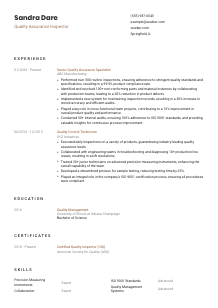
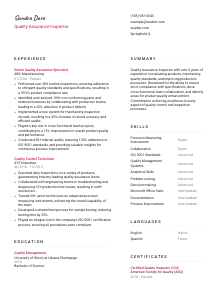
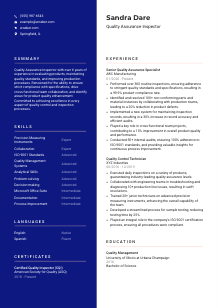
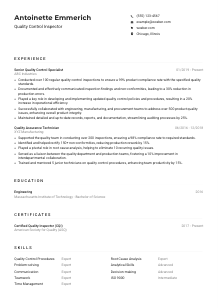
Inspecting products to perfection, but your CV doesn't measure up? Review this Quality Assurance Inspector CV example, created with Wozber free CV builder. Learn how to present your keen attention to detail to meet job standards, ensuring your career trajectory is as top-notch as the items you approve!
Quality Assurance Inspectors work where small deviations become expensive problems. Hiring teams want to see that you can read specifications, inspect against tolerances, document findings accurately, and step in when non-conforming parts or process issues start affecting output. Your CV should make that operational discipline visible from the first section.
When the CV reflects the language of inspections, audits, record control, and manufacturing quality systems, it is easier for both reviewers and ATS screening to place your background in the right lane. Wozber's free CV builder helps you shape that into an ATS-compliant CV that reads clearly, while keeping the focus on what matters most here: your ability to protect product quality and improve consistency on the floor.
In manufacturing hiring, the top of the CV needs to answer basic practical questions fast. Can the employer contact you easily, do you match the target role, and are you already in the required location or prepared to move there if the posting asks for it?
Use your full name as the clearest line at the top of the page. Keep the font professional and readable. For a Quality Assurance Inspector, that clean presentation already supports the image you want to project: organised, exact, and dependable with documented information.
Place the exact or near-exact job title below your name when it truthfully matches your background. Using "Quality Assurance Inspector" immediately connects your CV to inspection, compliance, and product-quality work, and it also helps ATS systems classify your CV correctly.
List a current phone number and a professional email address with no errors. Accuracy matters in this field. If a hiring manager notices careless contact details on a CV for an inspector role, it raises the wrong question about how you handle inspection records, audit logs, or nonconformance reports.
If the posting requires Springfield, IL or relocation, show that clearly in your contact details when it applies to you. In the example CV, listing Springfield, Illinois directly removes a practical objection early. If you are relocating, signal that plainly so the employer does not have to guess.
Include LinkedIn or a professional website only if it strengthens your application. For this profession, that could mean a profile that reinforces manufacturing quality experience, internal audit exposure, ISO-related work, or progression from quality technician to inspector or specialist roles. Make sure the dates and titles match your CV.
This section should read like a well-kept inspection header: clear identification, correct contact data, and no missing basics. Once that is in place, the reader can move straight to your manufacturing quality experience.




For Quality Assurance Inspectors, experience is where employers look for proof that you can maintain standards in a live manufacturing environment. They want to see inspections performed, defects identified, records maintained, audits supported, and measurable improvements tied to your work.
Read the posting the way you would read a control plan or specification sheet. Mark the work that appears repeatedly or carries operational weight, such as routine inspections, non-conforming parts, inspection records, cross-functional problem solving, and internal audits. Those are the threads your experience bullets should pick up.
Start with your most recent role and work backward. That structure makes sense for manufacturing hiring because it puts your current inspection scope, quality systems exposure, and recent process-improvement work first, where a hiring manager will look before anything else.
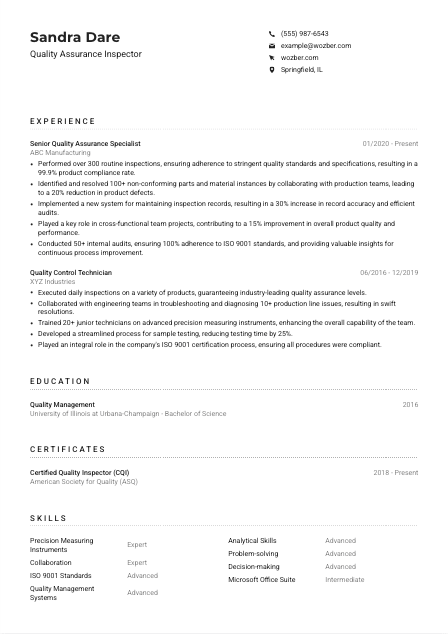
Write bullets that connect your past work directly to the target role. The example does this well with lines such as "Performed over 300 routine inspections" and "Identified and resolved 100+ non-conforming parts." Those phrases map cleanly to the posting's need for routine inspections, defect handling, and collaboration with relevant teams.
Quantify performance with measures that matter in manufacturing. Compliance rates, defect reduction, audit counts, inspection volume, record accuracy, testing time, scrap reduction, or improvement percentages all give your work concrete weight. A result like 99.9% product compliance or a 30% gain in record accuracy says much more than "responsible for quality checks."
Prioritise experience that shows inspection discipline, use of gauges or measuring instruments, quality documentation, root-cause support, and collaboration with production or engineering. If you include older or less relevant work, trim it to the parts that still support inspection judgment, process control, or product-quality improvement.
Your experience section should leave no doubt that you can inspect against standards, document what you find, and help the operation correct issues. That is the core of how this role earns trust.
Education matters here because it signals technical grounding, especially when the role asks for a bachelor's degree or equivalent experience. Keep the section straightforward and let it support your manufacturing quality background rather than compete with it.
If the employer asks for a bachelor's degree in a related field or equivalent experience, make sure your CV answers that requirement directly. Do not leave the reader guessing whether your education meets the baseline for quality, manufacturing, engineering support, or a related discipline.
List the degree, field of study, school, and graduation year in a clean order. This helps both ATS parsing and human review. For technical manufacturing roles, readers usually want to confirm the credential quickly and move back to your inspection and audit experience.
If your degree ties directly to quality management, manufacturing, industrial technology, engineering, or a similar area, make that connection visible. In the example, a Bachelor of Science in Quality Management strengthens the match immediately because it supports the role's focus on standards, systems, and controlled processes.
Coursework can help if you are earlier in your career or if it fills a gap the job description emphasizes. Include topics such as statistical quality control, metrology, manufacturing systems, auditing, or ISO-based quality management only if they sharpen the match and do not crowd the section.
Honors, capstone projects, or lab-based work are worth adding when they relate to inspection, process improvement, manufacturing analysis, or documentation discipline. Keep these details selective. They should reinforce your readiness for quality work, not turn the section into a transcript.
This section should quickly show that you meet the academic expectation and understand structured quality work. Then let your experience carry the heavier proof.
Certifications can strengthen a Quality Assurance Inspector CV because they show formal training in inspection methods, quality systems, or auditing standards. They are especially useful when they line up with the way the employer runs its manufacturing quality program.
Even when certificates are listed as optional or only mentioned as a plus, include the ones that reinforce your inspection credibility. A credential such as Certified Quality Inspector fits naturally because it connects to measurement, sampling, documentation, and defect evaluation.
Hiring teams care more about relevance than volume. Prioritise certifications tied to quality inspection, ISO 9001, internal auditing, lean process improvement, or manufacturing quality systems. A shorter list with clear alignment usually reads better than a broad catalogue of unrelated courses.
Show certification dates or active status when that helps the employer understand whether your knowledge is current. In a field shaped by procedures, standards, and audit expectations, recent or ongoing certification status can strengthen your professional credibility.
If you are actively developing your credentials, pursue certifications that match the roles you want next. ISO 9001-related training, internal auditor coursework, or advanced inspection credentials can all add value, especially if your target jobs involve audits, compliance documentation, or process-correction work.
Use this section to show recognized training in the methods and standards behind your work. For a quality-focused employer, that extra validation can help separate you from candidates with similar job titles.
A Quality Assurance Inspector skills section should read like a practical toolkit for manufacturing quality. Focus on the instruments, systems, and judgment-based abilities that affect inspection accuracy, defect handling, audit readiness, and process consistency.
Start with the exact capabilities the employer names. Here, that includes precision measuring instruments and gauges, analytical thinking, problem solving, decision making, and familiarity with ISO 9001. Those terms belong on the CV when they reflect your real experience because they connect directly to both ATS matching and role relevance.
Put the most job-critical skills first. For this kind of role, that usually means measurement tools, inspection methods, quality management systems, documentation, audit support, and root-cause collaboration. The sample skill list works well because it gives top placement to precision measuring instruments and ISO 9001 rather than generic office skills.
Do not overload the section with every skill you have used. Choose the ones that best support manufacturing inspection performance. A concentrated list is more useful than a scattered one, especially when the rest of the CV already shows your broader experience through achievements and project outcomes.
When this section is done well, the employer can quickly see the tools, standards, and judgment you bring to inspection work. That clarity supports everything your experience section claims.
Language ability matters in quality roles because inspection findings, audit notes, and cross-functional issue discussions depend on precise communication. Even when only one language is required, the way you present it should support the documentation-heavy nature of the job.
If the posting asks for proficient English speaking skills, make sure English appears in your languages section and reflects your actual level. For a Quality Assurance Inspector, that matters not only for conversation but also for reporting nonconformities, discussing corrective actions, and following procedures accurately.
Lead with English when it is the working language of the role. This keeps the requirement visible and easy to confirm. In the provided example, listing English first supports the employer's stated need without making the section feel overstated.
If you speak other languages, add them when they are relevant and truthful. On some manufacturing teams, another language can help with training, shift communication, supplier interaction, or floor-level coordination, though it is usually a secondary advantage rather than a core hiring requirement.
Use clear levels such as Native, Fluent, Advanced, or Intermediate, and avoid exaggeration. In quality work, credibility matters. If your CV overstates language ability, it can create problems quickly in audits, documentation reviews, or production meetings.
Not every Quality Assurance Inspector role needs multiple languages, but some operations benefit from them. If your additional language skills have helped with operator communication, supplier quality conversations, or training support, they can strengthen your profile when presented accurately.
This section is simple, but it still reflects how carefully you present facts. Keep it truthful, relevant, and easy to scan.
The summary should give a hiring manager a quick read on your inspection background, manufacturing context, and quality strengths before they reach the bullet points. In this profession, a useful summary is specific about standards, production quality, and the kind of problems you help prevent or solve.
Before writing, identify the core of your background. Are you strongest in routine inspection, nonconformance handling, audits, record control, process improvement, or cross-functional manufacturing support? Your summary should reflect the work you have actually done most credibly.
Start with a direct line that names your title or closest equivalent, your years of experience, and the manufacturing or production context. The sample summary does this effectively by leading with more than 6 years in evaluating products, maintaining quality standards, and improving production processes.
Use the next lines to highlight strengths that match the target job, such as inspection accuracy, defect reduction, ISO 9001 exposure, audit support, collaboration with production teams, or disciplined documentation. Keep these claims grounded in the experience section so the summary feels earned rather than promotional.
Aim for a short paragraph of about 3 to 5 lines. That is enough space to establish your quality background and the business value you bring without repeating full bullet points. The summary should prepare the reader for the detailed record that follows, not compete with it.
A well-written summary should quickly tell the employer that you understand standards, can work within a manufacturing quality system, and know how to protect product performance through disciplined inspection.
Your CV should now show the same qualities the job demands on the floor: accuracy, traceable results, sound judgment, and clear documentation. Keep every section aligned to manufacturing inspection work, from routine checks and gauge use to nonconformance reporting and audit support.
Use Wozber's free CV builder to organise that experience in an ATS-friendly CV format, and use the ATS CV scanner to align your wording with the posting's quality requirements. The final result should make it easy to see that you can uphold standards, document issues correctly, and contribute to better product quality from day one.




