



Use Wozber and land your dream job
Create CV
No registration required
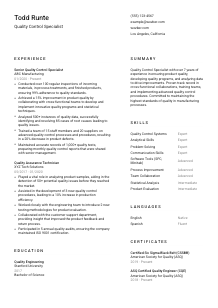
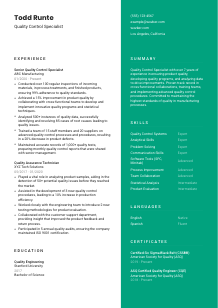
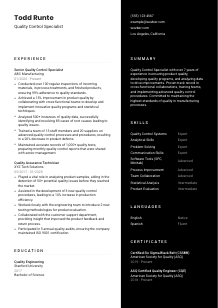
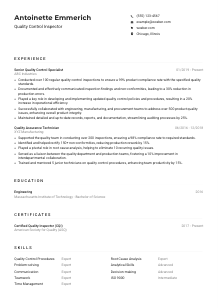
Setting high standards, but your CV's quality control seems off? Check out this Quality Control Specialist CV example, created with Wozber free CV builder. Learn how to present your precision and process knowledge clearly to match job criteria, propelling your career towards top-tier consistency!
Quality control work leaves very little room for vague claims. Whether you inspect incoming materials, monitor in-process checks, or sign off on finished products, the role is judged by how consistently you catch issues, document findings, and help prevent defects from repeating. Your CV should make that operating standard visible from the first few lines.
Screening for a Quality Control Specialist usually starts with a practical question: can this person handle the inspection, reporting, and improvement cycle our operation depends on? Wozber's free CV builder helps you shape that story into an ATS-compliant CV, so quality systems knowledge, root cause analysis, and cross-functional work are easy to recognize in both an ATS scan and a hiring manager's review.
For quality control positions, contact details do more than identify you. They confirm basic fit before anyone reads your inspections history, software knowledge, or reporting experience. Keep this section clean, exact, and aligned with the job requirements.
Use your full name in a clear font and slightly larger size than the rest of the text. Quality Control Specialists are trusted with precision, documentation, and compliance records, so even basic formatting should look orderly and controlled.
Place "Quality Control Specialist" under your name when that is the role you are pursuing. This keeps your CV aligned with the opening and helps frame your experience around inspections, quality programs, nonconformance tracking, and corrective action work rather than broader or adjacent quality titles.
Hiring teams should be able to reach you without friction, especially when the process moves quickly after an interview or plant visit.
Some Quality Control Specialist jobs include an on-site or local requirement because inspections, supplier checks, and production-floor coordination happen in person. Here, Los Angeles, California is specifically requested, so listing that location in your header immediately answers a screening question. If a future opening does not require a specific location, city and state are usually enough.
A LinkedIn profile can support your application if it matches the CV and includes relevant quality work such as audit participation, manufacturing environments, certifications, or process improvement projects. Only include it when it strengthens the picture, not as filler.
Your personal details should quickly confirm who you are, how to reach you, and whether you meet any location-based requirement. Keep it as accurate and controlled as the records you would maintain in a quality environment.




This section carries the most weight for a Quality Control Specialist. Employers want to see what you inspected, how you analysed defects, which teams you worked with, and what changed because of your work. Titles matter, but outcomes, process knowledge, and reporting discipline matter more.
Read the posting and mark the responsibilities that define the role's daily work. In this case, that includes inspecting incoming materials and finished products, analysing quality data, identifying root causes, training staff and suppliers, and preparing reports. These are the terms and workflows your experience bullets should reflect when they honestly match what you have done.
List your roles in reverse chronological order and make the progression easy to follow. A move from a Quality Assurance Technician position into a Senior Quality Control Specialist role, for example, shows growth from testing support into broader ownership of inspections, procedures, and quality improvement initiatives.
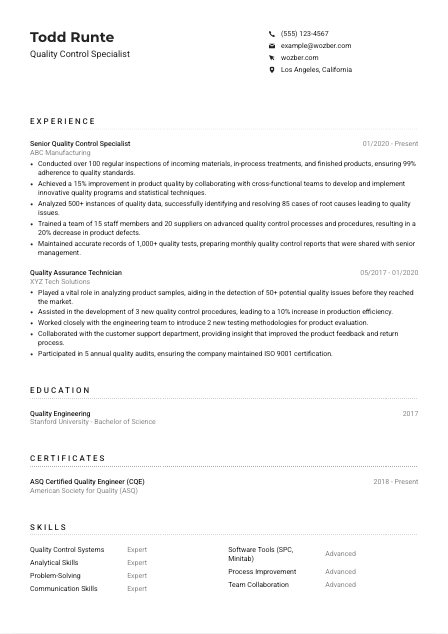
Each bullet should show a concrete action and the result. Instead of saying you were responsible for inspections, say how many inspections you conducted, what standards you maintained, or which process issue you helped correct. The sample CV does this well with points like conducting 100+ inspections and improving product quality by 15%, which gives the reader a clear sense of scale and impact.
Quality CVs benefit from metrics tied to defect reduction, adherence rates, audit performance, process efficiency, test volume, or root cause resolution. Figures such as 99% adherence to quality standards, 500+ data instances analysed, or monthly reporting cadence tell a stronger story than general claims about being detail-oriented.
Keep the section focused on inspection work, quality systems, statistical methods, supplier or staff training, audits, reporting, and cross-functional problem solving. If an achievement does not help prove that you can manage product quality, resolve recurring issues, or support compliance in production, leave it out.
By the end of your experience section, the reader should understand your inspection scope, your comfort with quality data, and the improvements you helped drive. Wozber's free CV builder can help you align that experience with the posting's language while keeping the structure clear for ATS optimisation.
Education matters in quality hiring because it helps explain your technical foundation. For many openings, a bachelor's degree in Quality Engineering, Industrial Engineering, or a related field is a baseline requirement, especially when the work involves statistical methods, process control, and formal documentation.
If the job asks for a bachelor's degree in a related field, make sure that qualification is easy to find. A degree such as a Bachelor of Science in Quality Engineering directly supports work in inspection systems, statistical analysis, and continuous improvement, so it should appear clearly and without abbreviations that create ambiguity.
List the degree, field of study, school name, and graduation year in a consistent order. Simple formatting works best here because recruiters and ATS tools are scanning for educational fit, not decorative presentation.
When your education closely matches the role, do not bury the field name. A major tied to quality, industrial systems, manufacturing, engineering, or a comparable discipline helps reinforce that your knowledge base fits the work described in the posting.
If you are earlier in your career, relevant coursework in statistical process control, quality management, manufacturing systems, or root cause analysis can strengthen the section. For more experienced candidates, that space is usually better spent on work achievements unless the training fills a clear gap.
Honors, projects, or related academic work can help when they connect to quality methods, testing, process analysis, or regulated production environments. If you already have several years of direct experience, keep these details brief so the CV stays centered on professional results.
This section should confirm that you meet the role's academic baseline and have the technical grounding to work with quality systems, data, and controlled processes. Clarity matters more than detail here.
Certifications carry real weight in quality roles because they point to formal training in process control, auditing, root cause analysis, and quality management standards. Even when they are listed as preferred rather than required, they can sharpen your profile quickly.
When a posting mentions a credential such as ASQ Certified Quality Engineer, include it exactly if you hold it. That direct alignment matters because it connects your CV to a stated preference without forcing the reader to interpret equivalent wording.
Lead with certifications that support the actual work of the job, such as quality engineering, Six Sigma, auditing, or quality management. For this profession, the strongest certifications are the ones that suggest disciplined problem solving, process improvement, and familiarity with formal quality standards.
Include the year earned and, if relevant, the active date range. This is especially useful for certifications that are maintained through renewal because it shows your knowledge is current rather than historical.
Quality expectations shift by sector, whether you work in manufacturing, medical devices, consumer products, or another controlled environment. Continue adding certifications that support the standards, audit expectations, and process controls most relevant to the jobs you want next.
A well-chosen certification section strengthens your technical credibility fast. It tells employers that your approach to inspections, corrective action, and process improvement is backed by recognized quality training.
A Quality Control Specialist's skills section should read like a practical toolkit, not a generic list of strengths. Focus on the systems, methods, and working abilities that support inspections, data analysis, root cause investigation, reporting, and collaboration with production or engineering teams.
Start with the obvious requirements such as quality control systems, analytical skills, problem-solving, and communication. Then add supporting capabilities the work naturally requires, such as statistical analysis, process improvement, supplier training, documentation control, or software used for SPC and quality reporting.
Order matters. Put the skills closest to the job first, especially the ones tied to inspection workflows, data interpretation, and quality systems. In the example CV, tools like SPC and Minitab, along with quality control systems and process improvement, reinforce the responsibilities listed in the posting.
Choose a concise set of skills that you can support elsewhere in the CV. It is better to show a tight list of relevant capabilities than to crowd the section with broad soft skills that never appear in your experience bullets.
Your skills should help the reader picture you handling inspections, analysing quality trends, and working across functions to reduce defects. Wozber's ATS CV scanner can help you spot missing terminology and strengthen ATS optimisation without turning the section into a keyword dump.
Language ability matters in quality roles when the work involves documentation, training, supplier communication, or reporting findings to operations and management. Even when only one language is required, listing it clearly removes uncertainty about your ability to work in that environment.
If the posting states that you must use English effectively in a professional setting, include English with an accurate proficiency level. This is especially important in roles where inspection records, quality reports, and corrective action documentation must be precise.
Lead with the language the job depends on, then list any additional languages that could help with supplier communication, training, or multi-site coordination. Prioritization keeps the section aligned with the role rather than turning it into background information.
Stick to clear levels such as Native, Fluent, Intermediate, or Basic. Overstating language ability can become a problem quickly in a role where procedures, specifications, and audit conversations need exact understanding.
Additional languages can be useful in diverse production environments or supplier-facing settings. For example, Spanish may be valuable in some teams or regions, but it should remain a secondary advantage unless the employer specifically asks for it.
In this field, language skills matter most when they support accurate training, issue escalation, report writing, and coordination across departments or suppliers. Frame them as working tools, not just personal attributes.
This section should quickly show that you can communicate clearly in the languages the role actually uses, especially for records, reports, and quality discussions that cannot afford confusion.
The summary should give a compact view of your experience level, your quality specialty, and the kind of outcomes you deliver. For a Quality Control Specialist, that usually means inspections, data analysis, process improvement, documentation discipline, and cross-functional work that reduces defects or strengthens standards.
Before writing, identify the few themes that matter most in the target job. Here, that would include inspection activity, quality program support, root cause analysis, reporting, and training. Use those themes to shape the summary rather than relying on broad statements about being hardworking or detail-oriented.
A direct first line works well, such as stating that you are a Quality Control Specialist with 7+ years of experience. That opening gives immediate context and helps the reader place your background within the level of responsibility expected for the role.
Choose strengths that connect to the posting and to your track record, such as quality systems knowledge, statistical analysis, cross-functional collaboration, or training teams on control procedures. The sample summary is strongest where it ties experience to concrete quality functions rather than generic ambition.
Aim for a short paragraph that can be scanned quickly. If a sentence does not mention a relevant quality activity, measurable outcome, or technical strength, revise it or remove it. The best summaries create a clear frame for the inspection, reporting, and improvement work shown below.
Your summary should quickly tell a hiring team what kind of quality professional you are and where your value shows up in the workflow. With Wozber's AI CV builder, you can refine that opening for stronger ATS optimisation and clearer alignment with the exact language of the role.
A Quality Control Specialist CV works when it shows disciplined inspection work, reliable documentation, useful analysis, and measurable improvement. Each section should support that picture, from your location and credentials to the way you describe audits, defect reduction, training, and reporting.
Use Wozber's free CV builder to turn that experience into an ATS-friendly CV format, check alignment with the job description through the ATS CV scanner, and strengthen phrasing where needed. The finished CV should make it easy to judge one thing quickly: you can protect product quality, communicate findings clearly, and improve the process behind the numbers.




