




Use Wozber and land your dream job
Create CV
No registration required
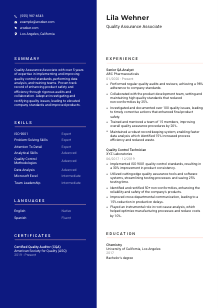
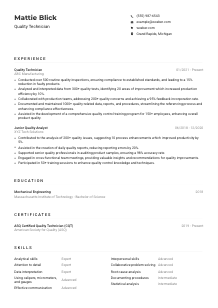
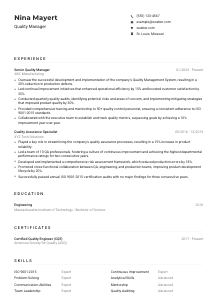
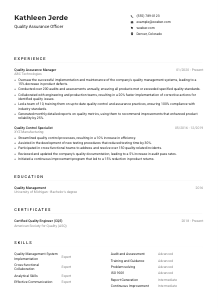
Maintaining excellence, but your CV feels like it's skipping quality checks? Check out this Quality Assurance Associate CV example, created with Wozber free CV builder. Learn how to showcase your attention to detail and process compliance, aligning your career standards with job requirements for a spotless fit!
Quality Assurance Associate hiring often turns on one practical question fast: can this person protect standards when products, processes, or documentation start to drift? CVs in this field work best when they show how you handle audits, investigate non-conformities, maintain records, and push corrective actions through to measurable improvement.
Early screening usually separates broad operations experience from true quality work. When your CV uses the language of audits, ISO frameworks, CAPA-style follow-through, trend analysis, and training support, hiring teams can place you correctly much faster. Wozber's free CV builder helps you shape that experience into an ATS-compliant CV that reads clearly for both screening systems and the people looking for dependable quality judgment.
Quality roles value accuracy from the first line. Your contact section should be clean, complete, and easy to verify, because small inconsistencies here can undermine the detail-oriented impression you need for work tied to audits, documentation, and compliance.
Display your name clearly at the top in a professional, readable format. For a Quality Assurance Associate, neat presentation matters because the role itself depends on controlled documentation and precision.
Match your headline to the role you are pursuing. If the posting says "Quality Assurance Associate," use that wording rather than a broader label, especially when your background includes adjacent roles such as QA Analyst or Quality Control Technician. It makes your CV easier to sort in both ATS filters and manual review.
Use a phone number you answer, an email built around your name, and links that work. This section is basic, but in quality work, basic accuracy counts. A broken link or casual email address creates the wrong impression for a role that deals with standards, records, and corrective action tracking.
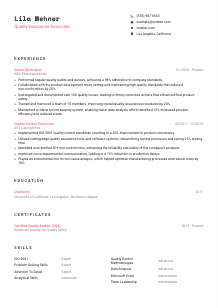
If a role has a stated location requirement, reflect it directly in your personal details. In the example here, listing Los Angeles, California helps address the employer's stated requirement without forcing the issue elsewhere in the CV.
Include LinkedIn or another professional profile only if it supports your application with aligned titles, dates, and quality-related work. If your profile mentions audit support, ISO exposure, validation work, or compliance projects, it can reinforce the story your CV already tells.
Your personal details should confirm that you are organised, reachable, and aligned with the posting from the start. For a quality-focused job, that baseline precision matters more than many candidates realize.




This is the section most likely to decide whether you move forward. Quality Assurance Associate experience should show how you monitored standards, handled findings, worked across teams, and used data to reduce repeat issues or improve compliance.
Read the posting and mark the recurring quality activities. For this role, the priorities include audits, collaboration with product development, investigation of non-conformities, training, record maintenance, and data analysis. Those are not just keywords. They are the operating duties your bullets should reflect if they match your background.
Start with your most recent role and include title, employer, and dates. Quality hiring teams want to see progression in regulated or standards-driven work, whether that growth came through QA, QC, manufacturing support, lab environments, or process improvement responsibilities.
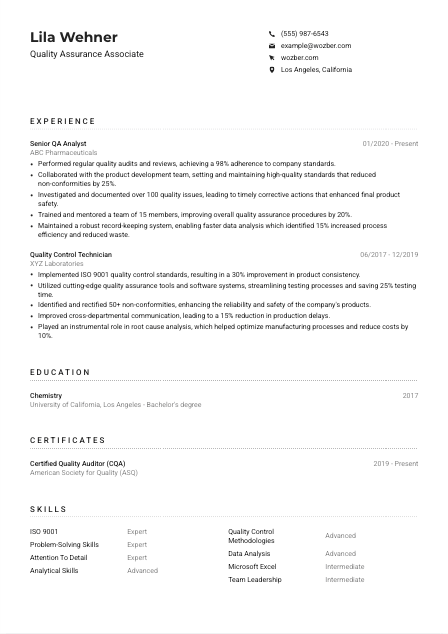
Focus each bullet on a meaningful action and outcome. Good QA bullets often describe audits completed, deviations investigated, corrective actions documented, specifications supported, or training delivered. The example CV does this well by tying audit work to 98% adherence and linking collaboration with development teams to a 25% drop in non-conformities.
Use numbers that fit the work: adherence rates, reduction in non-conformities, issue volumes, turnaround time, scrap or waste reduction, process efficiency gains, or training impact. Metrics make your contribution tangible. "Investigated over 100 quality issues" and "saved 25% testing time" tell a much sharper story than broad claims about improvement.
Keep the section focused on work that strengthens your case for audits, compliance, standards, and problem-solving. If an older role does not connect to product quality, documentation control, testing, root cause analysis, or process discipline, reduce it or remove it so the CV stays centered on quality assurance work.
Your experience section should make it easy to trace how you apply standards, investigate problems, and improve quality outcomes. If the reader can quickly see audit exposure, corrective action work, cross-functional support, and measurable results, this section is doing its job.
Many Quality Assurance Associate roles ask for a science or engineering foundation because the work involves specifications, testing logic, controlled processes, and disciplined documentation. Your education section should confirm that technical base quickly and clearly.
When a posting asks for a bachelor's degree in Biology, Chemistry, Engineering, or a related field, make that information easy to find. Put your degree, field, and school in a straightforward format so the requirement is confirmed at a glance.
List the degree, area of study, institution, and graduation year. A clean format helps both ATS parsing and fast human review, especially when the employer is screening for a minimum academic requirement before reading deeper into your experience.
If your degree matches the role closely, let that work for you. In the example CV, a Chemistry degree lines up well with quality work in laboratory and product-controlled environments. If your background is in another related field, keep the wording precise so the connection is still obvious.
Early-career candidates can include relevant coursework, lab work, or projects tied to quality systems, analytical methods, process control, validation, or data analysis. If you already have solid QA experience, those details usually matter less than your audit, compliance, and improvement results on the job.
If you have completed additional study in quality systems, regulatory topics, statistical methods, or process improvement, mention it where appropriate. Ongoing learning supports the kind of standards-based work employers expect in QA environments.
Education should answer the technical eligibility question quickly and without clutter. Once that foundation is clear, the rest of your CV can focus on how you have applied it in real quality settings.
Certifications are not required for every Quality Assurance Associate role, but the right one can add weight, especially when it connects directly to audits, standards, and quality systems. Use this section to reinforce specialised knowledge, not to pad the page.
Prioritise credentials recognized in quality assurance, auditing, compliance, process improvement, or related regulated work. A certification such as Certified Quality Auditor fits naturally because it supports the kind of audit and standards work many QA Associate roles involve.
A short list of directly relevant certifications reads better than a long list of marginal ones. Focus on credentials that strengthen your case for ISO-based work, internal audits, root cause analysis, or structured quality methodologies.
Show certification dates when they help demonstrate current standing or recent professional development. That is especially useful for credentials tied to active standards knowledge or ongoing maintenance.
Quality work changes with new procedures, updated frameworks, and company-specific compliance expectations. Keeping your certifications current shows that your knowledge of audit methods, quality systems, and corrective action practices is not dated.
This section should reinforce that you understand formal quality practices beyond day-to-day execution. One respected QA certification can meaningfully strengthen a profile built around audits, documentation, and continuous improvement.
The best skills sections in quality assurance do not read like generic strengths lists. They reflect the standards, tools, analytical habits, and communication demands that show up in audits, investigations, documentation review, and process improvement.
Start with the language the employer already uses. For this role, that includes ISO 9001, quality control standards and methodologies, quality assurance tools and software systems, analytical skills, problem-solving, and attention to detail. Use exact wording where it matches your experience.
Lead with the abilities most relevant to quality execution. Standards knowledge, audit support, non-conformity investigation, data analysis, documentation discipline, and QA software proficiency usually matter more here than broad workplace traits. The sample CV handles this well by placing ISO 9001, analytical skills, and quality methodologies near the top.
Group related skills in a way that helps the reader process them fast. You might separate standards and methodologies from software, analysis, and communication capabilities. If you use an ATS-friendly CV format in Wozber, this section stays readable while still matching the terminology employers search for.
Your skills should confirm that you can operate inside a controlled quality environment, not just that you are generally capable. Prioritised, job-matched terms help the employer see where you can contribute from day one.
Quality assurance depends on accurate communication. Audit notes, deviation reports, SOP updates, and training instructions all rely on clear language, so your languages section should support that part of the role rather than sit on the page as filler.
If the job requires English fluency, list English clearly with an honest proficiency level. That matters in QA because documentation, issue investigation, and cross-functional communication often depend on precise wording.
Lead with English when it is explicitly requested, then add any additional languages after it. This makes the match easy to spot in both ATS review and human screening.
Additional languages can be useful in manufacturing, lab, supplier, or cross-functional environments where training or day-to-day communication spans diverse teams. In the example CV, Spanish adds practical range without distracting from the required English proficiency.
Terms such as "Native," "Fluent," and "Intermediate" are easy to understand. Avoid vague descriptions. In a role built around controlled communication and documentation, precision even in this small section helps your overall presentation.
Only expand on language skills when they add something meaningful to the role. For most Quality Assurance Associate positions, the key point is that you can communicate clearly in the language used for reports, standards, and training materials.
Language details should support your ability to document, explain, and escalate quality matters clearly. When the required fluency is obvious and any added languages are relevant, the section does exactly what it should.
Your summary should quickly establish the type of quality professional you are and the kind of results you deliver. Focus on the areas that matter most in QA hiring: standards knowledge, audit and investigation work, analytical strength, and measurable improvement.
Review the role and pull out the few themes that matter most. For this position, that means quality assurance experience, ISO 9001 knowledge, analytical problem-solving, training support, and documentation of quality issues and corrective actions. Those themes should guide your wording.
Start with a clear line such as your title and years of relevant experience. "Quality Assurance Associate with 5+ years of experience" works because it immediately places you in the field and tells the reader your level of exposure to standards-driven work.
Bring in a small set of specifics that connect to the role. Audits, non-conformity reduction, product safety, process efficiency, training, or trend analysis are all strong options when they reflect your record. The example summary succeeds because it ties audits, data analysis, and team training to improved safety and efficiency.
Aim for a short paragraph of three to five lines. Avoid soft claims about passion or excellence unless you anchor them in actual QA work. A concise summary with standards, scope, and results gives hiring teams a clear read before they move into your experience section.
A well-written summary should position you as someone who can maintain standards, investigate issues, and improve quality performance in a real operating environment. When those points are clear up front, the rest of the CV lands with much more force.
A Quality Assurance Associate CV should leave little ambiguity about the kind of work you can handle. Audits, standards knowledge, non-conformity investigation, documentation discipline, training support, and measurable improvement all need to appear in the right places.
Use Wozber to tighten that alignment with an ATS-friendly CV template, targeted wording, and ATS CV scanner support that helps you match your experience to the posting without losing clarity. The final read should make one thing easy to judge: you can step into a quality environment and help keep standards on track.