



Use Wozber and land your dream job
Create CV
No registration required
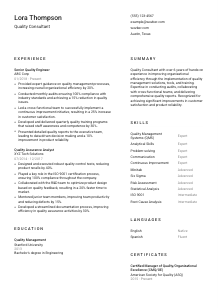
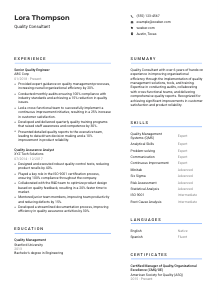
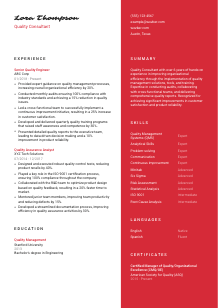
Ensuring standards shine, but your CV doesn't sparkle? Check out this Quality Consultant CV example, created with Wozber free CV builder. Learn how to blend your quality assurance expertise smoothly with job requirements, making your career path as flawless as the processes you optimise!
Quality consulting work sits at the point where process discipline meets business performance. Hiring teams want to see whether you have actually improved a system, tightened compliance, reduced defects, or helped teams use quality methods well, not just whether you have worked in QA or QC. Your CV needs to make that operating impact visible early.
When the CV is tailored to the target role, your audits, QMS work, training programs, and improvement results are much easier to connect to the employer's priorities. Wozber's free CV builder helps structure that experience into an ATS-compliant CV, so screening systems and hiring managers can quickly see where your background matches the quality problems they need solved.
For a Quality Consultant, even the header should reflect accuracy and alignment. This section is simple, but it still helps confirm practical details such as role match, contact availability, and in some cases location requirements tied to on-site consulting or stakeholder access.
Use your full name as the clearest element at the top of the page. Keep it readable and consistent with your LinkedIn profile, certifications, and any publications or training records tied to quality systems work. Wozber's ATS-friendly CV template helps keep that header clean and easy to scan.
Add the job title you are pursuing when it accurately reflects your background. If the posting is for a "Quality Consultant," use that title instead of a broader label like "Quality Professional" or "QA Specialist." It immediately places your experience in the right lane for consulting, audits, and process improvement work.
Include a current phone number and a professional email address. Quality roles often involve interviews with operations leaders, plant managers, or senior stakeholders, so make it easy for them to reach you without sorting through casual usernames or outdated contact info. A clear ATS-friendly CV format keeps these details visible without clutter.
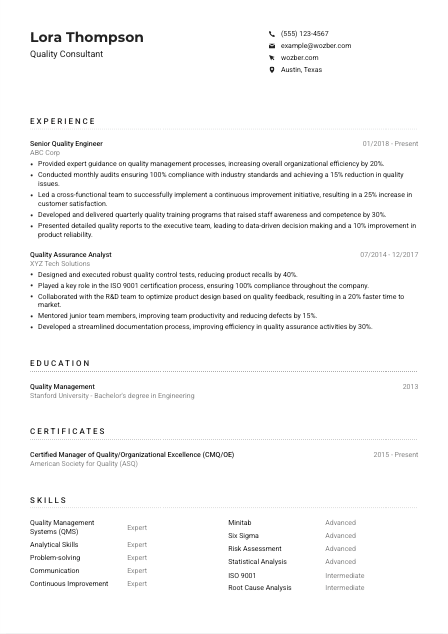
If the employer specifies a city or relocation expectation, reflect that in your header when truthful. In this example, listing Austin, Texas directly answers a stated requirement and removes doubt about availability for local consulting work. If you are relocating, say so clearly rather than leaving the employer to guess.
A LinkedIn profile, portfolio, or professional site can strengthen this section when it reinforces your quality background. That is especially useful if it includes ISO work, audit scope, process improvement projects, training delivery, or industry credentials. Make sure the content matches your CV wording and dates.
This section does not need flair. It should confirm who you are, how to contact you, and whether you meet practical requirements before the reader moves into your audit, compliance, and improvement experience.




This is the section that carries the most weight for a Quality Consultant. Employers are looking for a track record of fixing process gaps, improving compliance performance, guiding teams through quality issues, and reporting results in a way leadership can act on.
Read the posting for the repeatable demands behind the title. For Quality Consultant roles, that usually means audits, QMS oversight, corrective action, continuous improvement, training, root cause analysis, and management reporting. Use those themes to decide which accomplishments deserve space and which older bullets can be cut.
List positions in reverse chronological order and make each entry easy to read with job title, employer, and dates. For quality work, progression matters. A move from analyst to engineer to consultant-level responsibility tells the reader you have grown from executing checks to shaping systems, advising teams, and influencing outcomes across functions.
Replace duty-heavy lines with results that show what changed because of your work. The example CV does this well with points such as increasing organizational efficiency by 20 percent, reducing quality issues by 15 percent, and improving customer satisfaction by 25 percent through a continuous improvement initiative. That kind of bullet shows consulting value, not just activity.
Quantify your work with measures tied to the profession: defect reduction, audit compliance rates, recall reduction, process cycle time, customer complaints, training participation, product reliability, or time to market. Numbers make your impact easier to judge, especially when your work spans both operational quality and advisory responsibilities.
Prioritise accomplishments that show QMS work, audit execution, CAPA support, statistical analysis, documentation control, training, or cross-functional problem-solving. A bullet only earns space if it helps explain how you improve process quality, compliance, efficiency, or customer outcomes. That focus matters more than listing every responsibility you have ever held.
A hiring manager should come away with a clear picture of the quality problems you have handled, the methods you used, and the measurable results you produced. That is what moves a CV from general QA experience to consulting-level credibility.
Education matters in quality roles because it shows the foundation behind your process thinking, analytical work, and understanding of systems. It will not outweigh weak experience, but it does help confirm that your background fits the level of technical and operational judgment the role requires.
If the posting asks for a bachelor's degree in Engineering, Quality Management, or a related field, present that information clearly and without abbreviations that could be missed. In the example, a bachelor's degree in Engineering with a Quality Management focus lines up directly with the requirement.
List the degree, field of study, school, and graduation year in a consistent order. That simple structure helps both ATS parsing and human review, especially when recruiters are checking basic eligibility before they spend time on your audit and improvement experience.
If your degree sits near the role's preferred background, name that connection clearly. Degrees in industrial engineering, manufacturing, operations, or quality management all support consulting work when your CV also shows audits, process control, compliance, or continuous improvement in practice.
You do not need to overload this section, especially if you have more than 5 years of experience. Still, coursework in statistics, process improvement, reliability, operations management, or quality engineering can help if it directly supports the type of quality consulting work you are targeting.
Student chapters, quality competitions, engineering projects, or leadership in process-improvement activities are most useful early in your career. For experienced candidates, include them only if they add something distinctive such as Six Sigma project work or an industry-recognized competition tied to operational excellence.
Keep this section direct and easy to scan. It should show that your academic background supports the analytical, systems-oriented work expected in quality consulting without distracting from your professional results.
In consulting-focused quality roles, certifications often help separate hands-on practitioners from candidates who also understand formal methods, standards, and leadership expectations. They are especially useful when the employer mentions a preferred credential or works in a heavily regulated environment.
When a job calls out a credential such as CMQ/OE, move it high enough to be seen quickly. In the example CV, the Certified Manager of Quality/Organizational Excellence credential directly supports the consulting and leadership side of the role, not just technical quality execution.
Prioritise certifications connected to quality management, auditing, process improvement, or operational excellence. Relevant options may include CMQ/OE, Six Sigma certifications, lead auditor credentials, or industry-specific quality certifications. Keep the list focused on what supports the job you want now.
Certification dates help show currency, especially for credentials tied to active standards, continuing education, or ongoing membership. They also help employers understand whether your formal training reflects current practice in QMS, audits, and improvement methodologies.
Quality work evolves with standards, software, reporting expectations, and customer requirements. Recent certifications, refresher training, or active maintenance of a credential can reinforce that you are still building depth in areas such as audit readiness, statistical analysis, or organizational excellence.
Used well, this section tells employers that your quality judgment is backed by recognized training and current standards knowledge. That matters when the role involves advising others, training teams, or reviewing systems at a higher level.
A Quality Consultant's skills section should mirror the methods, tools, and communication demands of the job. It works best when it supports what your experience already proves, rather than reading like a disconnected list of buzzwords.
Start with the language used in the job description. Here, the clear priorities include quality management systems, Minitab, Six Sigma, analytical ability, problem-solving, and communication. Use those exact or closely related terms when they genuinely reflect your background, because they help both ATS matching and reviewer recognition.
Quality consulting requires more than tool familiarity. Pair technical skills such as QMS, ISO 9001, statistical analysis, risk assessment, root cause analysis, or process improvement with skills tied to advisory work, such as training delivery, stakeholder communication, and cross-functional collaboration. The example CV handles that balance well.
Group and order skills so the most relevant items appear first. That usually means placing quality systems, improvement methods, and core analysis tools ahead of broad traits. An ATS-friendly CV format makes that list easier to scan, while specific wording helps the employer see whether you can handle audits, reporting, and process-change work from day one.
The best skills sections reinforce the kind of quality problems you solve and the tools you use to solve them. Keep the language tight, relevant, and consistent with the rest of your CV.
Language ability is often a practical requirement in consulting work because the job depends on clear reporting, training, and communication across teams. For a Quality Consultant, that can affect audits, executive presentations, corrective action follow-up, and day-to-day collaboration.
If the role specifies English proficiency, list English clearly with an accurate level such as Native or Fluent. That matters because quality consultants write reports, explain findings, document corrective actions, and present metrics to management. The language requirement is tied to execution, not just preference.
Additional languages can help if the company works with international suppliers, multilingual operations teams, or global clients. They are not always central, but they can support training delivery, plant communication, or regional quality coordination when those needs exist.
Use straightforward labels such as Native, Fluent, Intermediate, or Basic. Inflated language ratings create problems quickly in consulting and reporting environments where communication quality matters. Accuracy here matters as much as accuracy in any audit finding.
If another language has supported supplier communication, training sessions, site audits, or cross-border quality initiatives, that is worth noting. Keep the claim grounded in actual work so it supports your consulting profile rather than reading like filler.
For most Quality Consultant CVs, languages are supporting information, not a headline qualification. Present them cleanly and let them complement the more important sections on experience, certifications, and skills unless the employer places unusual emphasis on multilingual communication.
This section works best when it confirms you can handle the reporting, training, and stakeholder communication the role requires. Keep it honest, concise, and relevant to the environment you want to work in.
The summary sets the frame for the rest of the CV. In this field, it should quickly establish your years of experience, your quality specializations, and the kinds of operational results you have delivered through audits, systems work, and continuous improvement.
Before writing the summary, identify the main themes in the posting. Here those include quality systems, audits, continuous improvement, training, reporting, and consulting-level guidance. Build your opening around the areas where your background overlaps most strongly, rather than trying to summarise your whole career.
Open with your title or closest equivalent, your years of experience, and two or three areas that define your value. For example, a summary for this kind of role might highlight 6+ years in quality assurance and quality control, strength in QMS and audit execution, and experience improving efficiency or customer satisfaction.
Use terms from the posting where they match your real work, such as quality management systems, continuous improvement, quality reports, root cause analysis, or training programs. The sample summary does this by linking hands-on experience with improvements in organizational efficiency, customer satisfaction, and product reliability.
Aim for a short paragraph that reads clearly in one pass. Skip generic claims about being results-driven and instead mention the kind of quality outcomes you have influenced, the methods you use, and the scope of your work. A focused summary should prepare the reader for the detailed bullets that follow, not repeat them.
By the time someone finishes this section, they should already understand your quality background, your consulting value, and the kinds of improvements you know how to deliver. That makes the rest of the CV easier to read in the right context.
A well-tailored Quality Consultant CV shows how you audit systems, improve processes, train teams, and report results that leadership can act on. When those pieces line up across your summary, experience, skills, and credentials, the CV reads like a consultant who can step into quality problems and bring structure fast.
Use Wozber's free CV builder and ATS CV scanner to align your wording with the posting, strengthen ATS optimisation, and present your experience in an ATS-friendly CV format. The final version should make it easy to judge your readiness for compliance, continuous improvement, and quality leadership work.




