



Use Wozber and land your dream job
Create CV
No registration required
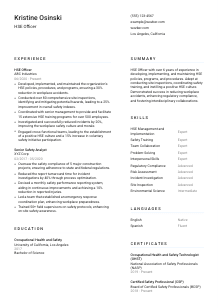
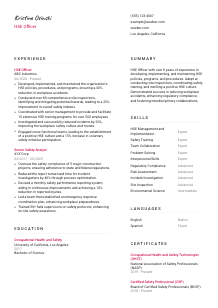
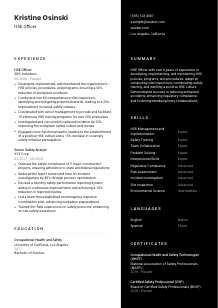
Safeguarding worksites, but your CV feels like it just slipped through the cracks? Check out this HSE Officer CV example, created with Wozber free CV builder. Learn how to match your safety savvy to job demands, ensuring your career path is less accident-prone and hazard-free!
HSE work is reviewed through outcomes that affect people, operations, and liability. Hiring teams want to see how you have prevented incidents, improved reporting discipline, strengthened training participation, and kept sites aligned with safety requirements, not just that you have been around policies and procedures.
A tailored CV makes those results easier to read in the language the role uses, especially when an ATS looks for terms tied to inspections, incident investigation, corrective action, and regulatory compliance. Wozber's free CV builder helps you organise that experience into an ATS-compliant CV so the hiring team can quickly see where your safety programs, field presence, and follow-through match the work.
This section is simple, but it still does real work. For an HSE Officer, clear contact details and an exact job title help the employer connect your application to a safety-focused role that often involves site presence, reporting accountability, and coordination across operations.
Place your full name at the top in a clean, readable format. It should stand out immediately so your application is easy to track across ATS records, interview schedules, and compliance-heavy hiring workflows.
Add "HSE Officer" beneath your name when that is the role you are pursuing. This creates instant alignment and helps distinguish you from adjacent profiles such as Safety Coordinator, EHS Specialist, or Safety Analyst.
List a phone number and email address you check regularly. If you include LinkedIn or a professional website, make sure it reflects your current safety experience, certifications, and project scope.
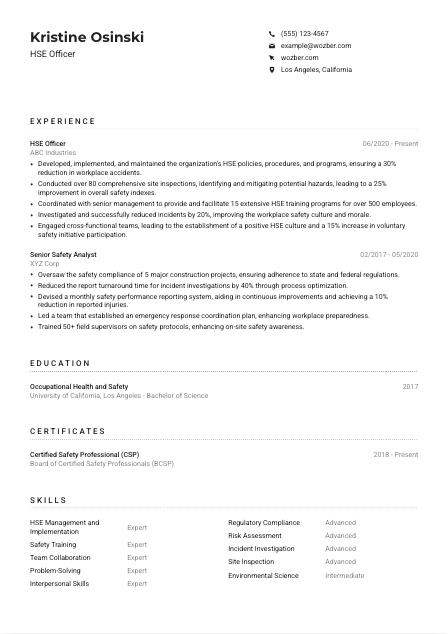
If the posting calls for candidates in a specific area, show that clearly. In the example, listing Los Angeles, California directly supports the employer's stated location requirement without adding unnecessary detail.
A website or LinkedIn profile can add value when it reinforces your HSE background with certifications, industry experience, training activity, or large-scale safety initiatives. Skip it if it is sparse or outdated.
Do not include age, marital status, gender, or other non-job-related details. Keep the focus on professional qualifications, certifications, and readiness for the operating environment.
This section should confirm who you are, how to reach you, and whether you meet practical requirements such as location. For an HSE Officer, that clarity helps the employer move quickly to the parts that show your safety impact.




This is the section where your CV should show how you manage safety in practice. Employers look for more than familiarity with regulations. They want to see inspections completed, incidents investigated, training delivered, trends tracked, and corrective actions carried through in real operating environments.
Read the posting closely and mark the work that appears repeatedly. For an HSE Officer, that usually includes policy implementation, inspections, incident reporting, safety training, trend analysis, and collaboration with managers and site teams. Those themes should shape the bullets you choose.
Use reverse chronological order and give each entry enough structure to be understood quickly. Include your job title, employer, and dates so the reader can follow your progression from analyst or coordinator roles into broader HSE responsibility.
Write bullets that show what changed because of your work. Accident reduction, inspection volume, training reach, audit performance, response time, injury-rate improvement, and participation in safety initiatives are all useful measures in this field. The example does this well by pairing actions with numbers like 80+ inspections, 15 training programs, and a 30% drop in workplace accidents.
Prioritise accomplishments that mirror the role's actual workload. If the posting emphasizes inspections and incident investigation, lead with bullets about hazard identification, root-cause analysis, corrective actions, and safety metrics. If it stresses culture and training, highlight toolbox talks, employee sessions, management coordination, or supervisor coaching.
Include examples of process improvement, reporting discipline, or cross-functional leadership that changed how safety was managed. A monthly performance reporting system, faster investigation turnaround, or stronger emergency preparedness tells the employer you can maintain an HSE program, not simply participate in one.
Your experience section should leave no doubt about the scale of your HSE work. When the bullets connect inspections, investigations, training, compliance, and measurable safety outcomes, your background reads like someone who can own the function from day one.
For HSE roles, education often functions as a baseline qualification. A relevant degree tells the employer you have formal grounding in occupational health, environmental systems, risk control, and the regulatory context behind day-to-day safety decisions.
Check the posting for required or preferred education and make sure your CV reflects it clearly. Here, a bachelor's degree in Occupational Health and Safety, Environmental Science, or a related field is the stated academic benchmark.
List your degree, field of study, school, and graduation year or date range if needed. A simple structure works best because this section is usually scanned quickly for qualification match rather than read for detail.
If you hold multiple degrees, lead with the one most applicable to HSE work. In the example, a Bachelor of Science in Occupational Health and Safety immediately supports the role without extra explanation.
Most experienced HSE professionals do not need to expand this section much. Still, if you are earlier in your career, relevant coursework in industrial hygiene, environmental regulation, hazard control, or emergency management can strengthen your profile.
Honors, research projects, or student leadership are worth adding when they connect to safety practice, compliance, environmental stewardship, or operational improvement. Keep them brief and relevant.
This section does not need to be long. It needs to show that your academic background supports the safety knowledge, compliance awareness, and professional discipline expected in HSE work.
Certifications matter in safety hiring because they show recognized technical knowledge and commitment to professional standards. They are especially useful when the employer names a credential directly or is open to candidates who are in progress toward one.
Pull out required, preferred, or acceptable certifications and mirror that language where it applies to you. In this case, CSP and OHST are the key credentials named, so they deserve clear placement on the CV.
Lead with credentials that strengthen your authority in safety management, regulatory compliance, hazard assessment, or incident prevention. Avoid filling this section with unrelated certificates that do not support the role.
Add the certifying body and the date earned or active period. That gives the employer immediate context on recency and validity. The example lists both the credential and issuer, which makes the section more credible and easier to review.
If you are working toward a named credential, note that accurately. In HSE, current training, renewals, and recognized certifications suggest that your knowledge of standards and best practices is being maintained, not left static.
Well-chosen certifications back up your experience with recognized standards. For an HSE Officer, they can tip the balance by showing that your field judgment is supported by formal professional validation.
The skills section should read like the toolkit you use on the job. For HSE roles, that means a mix of technical safety capabilities, regulatory knowledge, investigation methods, training ability, and the communication skills needed to influence operations and frontline behaviour.
Scan the job description for both direct requirements and implied capabilities. Safety regulations, site inspections, incident reporting, HSE program management, training delivery, problem-solving, and interpersonal communication all point to the kind of skills worth listing here.
Choose skills that are reflected in your experience, certifications, or education. If you list incident investigation, risk assessment, or regulatory compliance, your work history should include examples of investigations completed, hazards mitigated, or standards maintained.
Group your strongest HSE skills rather than trying to cover every ability you have. The sample CV stays close to the role by featuring HSE management, safety training, regulatory compliance, site inspection, and incident investigation alongside collaboration and problem-solving.
A compact, targeted skills section helps the employer see your professional range quickly. For HSE hiring, the best lists connect directly to field execution, compliance oversight, training, and safety improvement.
Communication is part of safety performance. HSE Officers write reports, explain procedures, run training, speak with employees at different levels, and sometimes coordinate after incidents. Language proficiency matters when it affects how clearly you can deliver those responsibilities.
Start with the posting. If a language is specified, include it exactly and make your proficiency level clear. Here, English mastery is required, so it should appear prominently.
List the language the employer asked for before any others. For this HSE role, English should be at the top because it connects directly to training delivery, incident documentation, and communication with management.
Additional languages can be useful in sites with multilingual teams, contractor coordination, or broad employee populations. They are especially valuable when they help you explain safety procedures clearly on the floor or in the field.
Stick to familiar terms such as Native, Fluent, Intermediate, or Basic. Vague wording makes it harder for employers to judge whether you can handle written reports, verbal instruction, or conversation in operational settings.
Only emphasize language capability when it has real workplace value. In many environments, being able to train, investigate, and communicate corrective actions across language lines can improve compliance and participation in safety programs.
This section is most useful when it clarifies how well you can train, document, and coordinate. For an HSE Officer, that can directly affect understanding, compliance, and response quality.
Your summary should give a concise picture of the kind of HSE professional you are. In a few lines, it should establish your experience level, your main areas of ownership, and the type of safety results you have delivered across inspections, training, compliance, and incident reduction.
Before writing, identify the few themes the employer cares about most. In this posting, those include HSE program management, inspections, training, incident investigation, safety culture, and regulatory knowledge. Build your opening around that mix rather than a generic statement about being passionate or hardworking.
Open with your title or specialty and years of experience. Then define the scope of your work, such as developing HSE programs, managing compliance activity, conducting site inspections, or supporting continuous improvement across operations.
Include capabilities that matter in HSE hiring and are backed up by your experience section. The example summary works because it mentions policy development, site inspections, training coordination, safety culture, and measurable reductions in workplace accidents.
Aim for a short paragraph that can be read in seconds. Tight wording is especially important on HSE CVs because hiring managers often move quickly from the summary to your certifications, experience metrics, and compliance-related achievements.
A focused summary gives the reader a fast read on your HSE range and operating level. When it names your experience, safety strengths, and practical results, the rest of the CV lands with more context.
Your CV should now show more than general safety awareness. It should present a clear record of inspections, training, incident response, compliance work, and measurable improvements in workplace safety. Use Wozber's free CV builder to shape that experience into a clean, ATS-friendly CV that reflects the language of the role.
Before applying, review the final version for keyword alignment, certification accuracy, and strong metrics in the experience section. An ATS CV scanner can help you tighten ATS optimisation and spot missing requirements so the employer can quickly judge your readiness to lead HSE programs, investigations, and safety improvement on site.