



Use Wozber and land your dream job
Create CV
No registration required
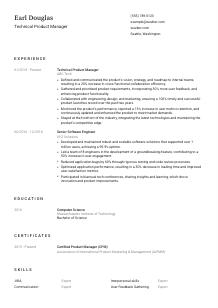
Balancing code and commercial clout. Check out this Technical Product Manager CV example, made with Wozber free CV builder. Learn how to streamline your tech-savvy leadership to meet job-specific milestones, steering your career path toward groundbreaking releases and standing ovations from the product "G.I.T." (Get it there) committee!
Technical Product Managers sit at a busy intersection of product strategy, engineering reality, and customer value. Hiring teams want to see how you turn technical complexity into clear product direction, keep cross-functional work moving, and make roadmap choices that hold up under real delivery constraints. Your CV should make that operating range visible fast.
When the CV mirrors the language of the target role, reviewers can quickly connect your background to roadmap ownership, requirement prioritization, launch execution, and product performance tracking. Wozber's free CV builder helps shape that story into an ATS-compliant CV, so the right terms, tools, and outcomes surface clearly for both screening systems and the people deciding whether you can lead a product through tradeoffs and release pressure.
For a Technical Product Manager, the header should do one practical job right away: confirm who you are, what role you do, and whether any basic screening requirement is already covered. Keep it lean, accurate, and aligned with the position you are targeting.
Put your name at the top in the most readable format on the page. This is a simple section, but it still reflects professional judgment. A clean header helps the hiring team move quickly into your product experience, roadmap ownership, and technical background without distractions.
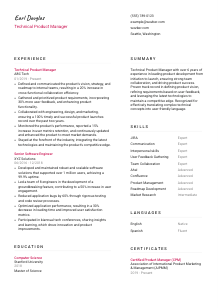
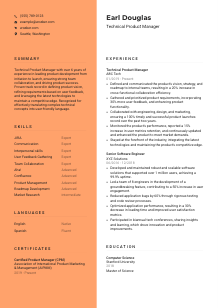
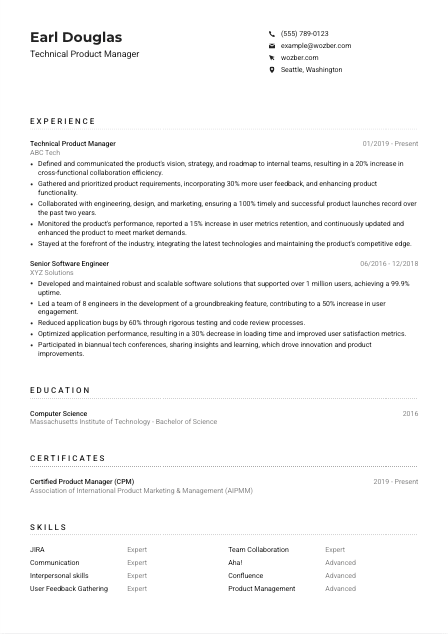
Place "Technical Product Manager" directly under your name when that is the role you are applying for. It immediately frames the rest of the CV around product strategy, cross-functional execution, and technical fluency. In the example CV, that title creates a direct bridge between the candidate's software engineering past and current product leadership.
Include a working phone number and a professional email address, then stop there unless another contact method adds real value. Technical Product Managers are expected to communicate clearly and without noise, and even this section should reflect that standard. Double-check every detail so there is no friction when a recruiter or hiring manager wants to schedule an interview.
If the posting includes a location filter, address it directly in your header. Here, listing "Seattle, Washington" is useful because the role explicitly requires it. Use this kind of detail only when it solves a real screening question, not as filler in every application.
A LinkedIn profile or personal site is worth including if it reinforces your CV with consistent titles, product scope, launches, or technical depth. For TPM roles, that profile can also show thought leadership, shipped products, or a stronger timeline across product and engineering work. Make sure the dates, role names, and achievements match what appears on the CV.
Your personal details should remove basic questions immediately and let the reader focus on the harder part: whether you can set product direction, work credibly with engineering, and deliver measurable results.




This section carries the most weight for a Technical Product Manager because it shows how you operated inside real product cycles. Hiring teams look for evidence of roadmap decisions, requirement tradeoffs, launch execution, and post-release improvement, especially when those actions involved engineering, design, and business stakeholders.
Before rewriting bullets, isolate the work patterns the employer cares about most. In this posting, those include defining product vision, prioritising requirements, partnering across functions, monitoring user metrics, and translating technical ideas into language stakeholders can act on. Those themes should shape which accomplishments you emphasize and which you leave out.
List roles in reverse chronological order with job title, employer, and dates. That format matters even more when your background spans engineering and product, because reviewers need to see how your scope evolved from building systems to leading roadmap decisions. A clear sequence helps them understand your progression into technical product ownership.
Focus each bullet on what changed because of your work. For Technical Product Manager roles, useful bullets often show how you set roadmap direction, improved requirement quality, aligned engineering and design, or influenced launch success. In the example, "20% increase in cross-functional collaboration efficiency" and "100% timely and successful product launches" work because they connect product leadership to business execution.
Use numbers that belong to product work: adoption, retention, launch timing, engagement, delivery speed, defect reduction, or operational reliability. Metrics help separate generic product claims from real ownership. The sample's "15% increase in user metrics retention" is a good model because it ties ongoing product monitoring to a concrete user outcome rather than just saying the product was improved.
Choose bullets that show you can work across technical and commercial contexts, not just that you were busy. Experience with backlog prioritization, user feedback loops, market input, engineering constraints, or tools like JIRA and Confluence should appear before unrelated wins. If you are moving from engineering into product, keep the engineering bullets that prove technical depth, stakeholder leadership, and user-facing impact, such as scaling to 1 million users or improving uptime and performance.
A Technical Product Manager CV works best when the experience section shows decisions, tradeoffs, collaboration, and results in the same line. After reading it, a hiring team should understand the products you influenced and the outcomes you moved.
Technical Product Manager roles often require enough technical grounding to work credibly with engineers, question tradeoffs, and understand platform constraints. Your education section should confirm that foundation quickly, especially when the posting asks for a technical degree.
If the role asks for a Bachelor's degree in Computer Science, Engineering, or a related field, make that easy to find. Put the degree, field, school, and graduation year in a clean structure. In this case, a Computer Science degree directly supports the technical side of product work.
Education should be easy to scan in seconds. List the institution, degree, field of study, and year without extra wording. The point here is clarity, especially for postings that use degree requirements as an early filter.
If you hold a Master's degree in a relevant technical discipline, include it. For Technical Product Managers, advanced study can reinforce credibility in areas like software systems, data-heavy products, or platform decisions. The sample CV does this well by pairing a Bachelor's with a Master's in Computer Science, though a graduate degree is an advantage rather than a universal requirement.
Most experienced Technical Product Managers do not need coursework listed. Add it only if your degree title is broad, your career path is shifting, or the coursework helps connect your background to product and engineering collaboration. Subjects like software architecture, human-computer interaction, data systems, or systems design can be relevant when they clarify your technical base.
Academic honors, thesis work, or standout projects belong here when they still add signal. This is most useful for earlier-career candidates or for roles tied to a specific technical domain. For a seasoned TPM, keep these details only if they support the kind of product area you want to own.
Education matters here because it supports technical credibility, but it should stay compact. Once the degree requirement is covered, let your product experience do the heavier lifting.
Certifications are optional in many Technical Product Manager searches, so only include the ones that sharpen your profile. The best choices reinforce how you manage product work, collaborate with delivery teams, or stay current with product methods and technical change.
Look for credentials tied to product management, Agile delivery, Scrum, or relevant technical domains. Even when a posting does not require certification, a well-chosen one can strengthen your case for roadmap leadership, prioritization discipline, or structured product thinking. The key is relevance to the role's actual workflow.
A short list of credible certifications works better than a long list of marginal ones. For a Technical Product Manager, examples might include AIPMM credentials, Scrum certifications, or domain-specific technical certificates that support the products you manage. The example CV's Certified Product Manager credential fits because it directly reinforces product leadership.
Add issue or renewal dates when the credential is active, recently earned, or periodically maintained. That helps employers understand whether the certification reflects current methods and language. This is especially useful in product environments shaped by changing delivery practices, tooling, and platform ecosystems.
Technical Product Managers are expected to stay current on product discovery methods, delivery models, analytics, and industry trends. If you complete new training in experimentation, AI products, cloud platforms, or Agile planning, update your CV when it genuinely strengthens the roles you are targeting. Ongoing learning is most convincing when it connects to real product work.
Certifications should support your product judgment and technical fluency, not distract from them. If a credential helps explain how you lead product work more effectively, it belongs here.
A Technical Product Manager skills section should read like an operating toolkit, not a generic list of strengths. Include the tools, product practices, and collaboration skills that show how you gather requirements, shape roadmaps, work with engineering, and communicate decisions across stakeholders.
Read for explicit tools and implied capabilities. Here, the clear requirements include JIRA, Aha!, Confluence, communication, leadership, and the ability to translate technical concepts into user-friendly language. Those belong in your skills section only if your experience supports them elsewhere on the page.
Choose skills that reflect how you do the job day to day: roadmap development, backlog prioritization, user research synthesis, stakeholder communication, launch coordination, analytics review, and product management platforms. In the sample CV, the mix of JIRA, roadmap development, user feedback gathering, and team collaboration creates a more believable TPM profile than a list built from vague business buzzwords.
Group skills so a recruiter or hiring manager can read them in seconds. One simple approach is to separate product tools from execution skills and collaboration skills. That makes it easier to see both your platform fluency and your ability to lead work across engineering, design, and marketing.
Every skill listed should feel traceable to experience, launches, metrics, or collaboration patterns elsewhere in the CV. That is what makes the section credible for Technical Product Manager hiring.
Language skills matter in Technical Product Management when they affect stakeholder communication, customer understanding, or collaboration across regions. This section should stay brief, but it can still reinforce one important part of the role: making technical information understandable to different audiences.
If the posting specifies English proficiency, list English first and mark your level clearly. For this position, that requirement is explicit, so it should not be left for the reader to infer. Technical Product Managers spend a large part of the job writing requirements, aligning teams, and explaining tradeoffs, so language fluency has direct operational value.
Additional languages can strengthen your profile when products, users, or teams span multiple markets. They are especially useful if the role touches customer research, regional launches, or collaboration with distributed engineering teams. In the example, Spanish adds breadth, but English remains the priority because it is the stated requirement.
Use clear levels such as Native, Fluent, Professional Working, or Basic. Avoid overstating proficiency, especially in roles where written communication, stakeholder presentations, and requirement clarity are essential. A realistic level is more useful than an inflated one.
Not every Technical Product Manager role needs multiple languages. Include them when they connect to the product's market, support model, or team structure. If your work involves global user feedback, localized launches, or collaboration across regions, those language skills become more relevant.
Only keep this section if it adds something meaningful to the application. For TPMs, language skills matter most when they improve stakeholder alignment, user understanding, or communication across technical and non-technical groups. If that applies to your background, the section earns its place.
For Technical Product Manager applications, this section should confirm required fluency first and then add any broader communication advantage that fits the product environment.
The summary is where you frame your version of Technical Product Management in a few tight lines. Done well, it quickly tells the reader whether you are a roadmap owner, a technically fluent communicator, a launch-focused operator, or some combination of all three.
Read the posting and decide which two or three themes should anchor your opening. In this case, the strongest options are product vision, requirement prioritization, cross-functional leadership, and translating technical complexity for broader audiences. Your summary should reflect the parts you have actually done at a meaningful level.
Lead with your years of experience and the type of work you own. For example, mention technical product management, software products, platform initiatives, or end-to-end product delivery. The sample summary works because it quickly establishes more than 6 years of relevant experience and points to launch leadership and product success.
Use the next sentence to name the kinds of results or capabilities that matter for TPM hiring. That might include defining product vision, prioritising based on user feedback and engineering constraints, improving retention, or partnering across engineering, design, and marketing. If you mention translating technical concepts, make sure the rest of the CV supports it with clear communication and cross-functional accomplishments.
Aim for a summary that can be read in under half a minute. Avoid broad claims about being passionate, dynamic, or results-driven unless they are backed by concrete context. A compact summary with real product language will do more for you than a long paragraph of generic positioning.
A well-written summary gives the hiring team an immediate picture of the products you lead, the teams you work through, and the outcomes you tend to drive. It should set up the deeper proof that follows in your experience section.
A Technical Product Manager CV should make three things easy to see: the product problems you have owned, the cross-functional work you have led, and the measurable outcomes that followed. When those points are clear, the rest of the application becomes much easier to read in context.
Use Wozber's free CV builder to shape that story into an ATS-friendly CV format, then refine it with the ATS CV scanner so the terminology, tools, and priorities from the job description appear naturally where they belong. The finished CV should show that you can move from technical detail to product direction without losing either side of the job.