



Use Wozber and land your dream job
Create CV
No registration required
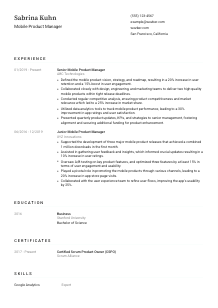
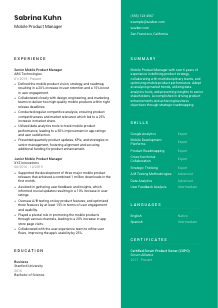
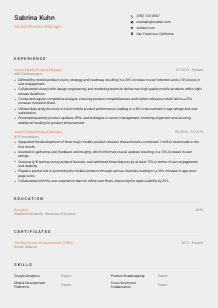
Propelling app launches, but your CV feels stuck at the loading screen? Check out this Mobile Product Manager CV example, created with Wozber free CV builder. Learn how to sync your product roadmap with job criteria, ensuring your career trajectory features zero buffering moments!
Mobile Product Managers sit at the point where user behaviour, business priorities, and release execution meet. Hiring teams want to see how you turn research, app performance data, and cross-functional input into a mobile roadmap that actually moves retention, engagement, ratings, or adoption. Your CV should make that operating range visible fast.
When the CV is tailored well, the first read becomes much more concrete. Wozber's free CV builder helps you align your wording with the job description and present it in an ATS-friendly CV format, so your work on product vision, experimentation, analytics, and stakeholder communication is easier to recognize before anyone gets to the interview stage.
This section is short, but it handles a few practical filters right away. For Mobile Product Manager roles, that usually means a clear job title, reliable contact details, and any stated location requirement.
Use your full name as the main header and make it the most visible text on the page. Keep the formatting clean and readable. This is standard CV structure, but it matters when hiring teams are scanning quickly through product candidates with similar backgrounds in strategy, analytics, and mobile delivery.
Place "Mobile Product Manager" directly under your name if that is the role you are pursuing. Matching the target title helps frame your experience correctly, especially if your past titles vary between product manager, digital product manager, or senior product roles.
Include a phone number and a professional email address you check regularly. Product hiring often moves through recruiter screens, stakeholder interviews, and follow-up discussions on roadmap ownership or KPI reporting, so your contact details need to be accurate and easy to find.
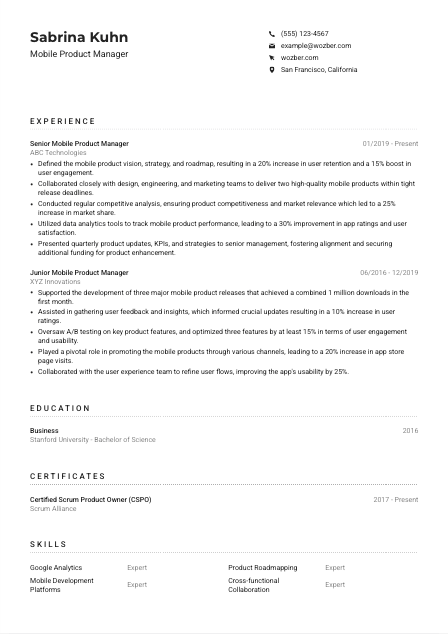
If a job posting names a location requirement, reflect it clearly in your personal details. In the example, listing "San Francisco, California" immediately supports the employer's stated requirement and removes an avoidable question about eligibility or relocation.
Include your LinkedIn profile or personal site if it strengthens your candidacy. For a Mobile Product Manager, that might mean a profile with consistent dates, product launches, experimentation work, or presentations on mobile growth and user experience. Keep it aligned with the CV so your product story stays consistent across both.
This section should confirm that you are reachable, professionally presented, and aligned with any basic setup requirements. Once that is clear, the rest of the CV can focus on roadmap decisions, product outcomes, and how you work with design, engineering, and marketing.




For this role, experience is where hiring teams look for proof of how you run a mobile product. They want to see roadmap ownership, cross-functional delivery, product optimisation, and the business effect of your decisions.
Start by identifying the themes the employer repeats. Here, the priorities are mobile product vision, roadmap definition, collaboration with design and engineering, competitive analysis, analytics, A/B testing, and stakeholder reporting. Those themes should guide which achievements you surface and how you phrase them.
Lead with your most recent work, especially if it shows direct ownership of mobile features, app growth, release planning, or optimisation. Product management careers often progress from support or execution-heavy roles into broader strategy and decision-making, so this structure helps reviewers see that progression quickly.
Each bullet should show what you owned, what you changed, and what improved. Strong Mobile Product Manager bullets often include roadmap decisions, launch delivery, user behaviour analysis, experimentation results, or stakeholder influence. The example does this well by pairing actions such as defining product vision or using analytics tools with outcomes like higher retention, stronger engagement, and improved app ratings.
Metrics carry real weight in mobile product hiring. Use figures tied to retention, engagement, conversion, ratings, downloads, release cadence, adoption, usability, or market share when they are available. Numbers like a 20% increase in user retention or a 30% improvement in app ratings give hiring teams a clearer picture of how your product decisions performed in market.
Keep the section focused on work that proves mobile product management strength. If an achievement does not relate to roadmap strategy, experimentation, analytics, user feedback, launch execution, or cross-functional leadership, it probably does not need to stay. Space is better used on the work that shows how you operate as a product lead.
Your experience section should let a reader follow the link between your decisions and the product results. When your bullets show strategy, execution, and measurable movement in mobile KPIs, your background reads like product management rather than general digital work.
Education is usually a supporting section for experienced Mobile Product Managers, but it still matters when the employer has stated a degree expectation. Keep it straightforward and relevant.
If the posting asks for a bachelor's degree in Business, Marketing, or a related field, make sure your degree is listed in a way that makes that match obvious. In the example, "Bachelor of Science in Business" lines up directly with the requirement and avoids ambiguity.
List your degree, field of study, school, and graduation year or date. Product roles do not need an elaborate education section unless you are early in your career or your academic work strongly supports the role.
Spell out the exact discipline rather than using vague shorthand. For Mobile Product Manager positions, fields such as Business, Marketing, Information Systems, Human-Computer Interaction, or related programs can all be relevant when they connect naturally to product strategy, market analysis, or digital product development.
Coursework is optional. Include it when it adds something your experience section cannot yet show, such as product strategy, consumer behaviour, analytics, UX, or mobile technology. If you already have several years of mobile product experience, this detail is usually less important.
Honors, leadership, or awards can stay if they are concise and genuinely relevant. For example, a capstone in digital product development or a strong business program distinction can add context early in a career. Once your mobile product results are substantial, keep the focus there.
This section only needs to confirm that you meet the academic baseline and, where relevant, show a foundation in business or product thinking. For most experienced candidates, that is enough.
Certifications are useful when they reinforce how you work, especially in agile product environments or specialised areas like experimentation, analytics, or product strategy.
Lead with certifications that strengthen your case for roadmap ownership, backlog prioritization, agile delivery, or customer-focused product decisions. A credential such as Certified Scrum Product Owner fits naturally because it supports the way many mobile teams plan releases and collaborate with engineering.
Choose quality over volume. Hiring teams are more interested in a certificate that supports real product practice than a long list of loosely related courses. If a certification connects to analytics, experimentation, agile delivery, or product leadership, it is worth considering.
Add the date earned or active range so the reader can see how current the credential is. This is especially helpful in mobile product work, where tools, release processes, and user expectations change quickly.
If you are continuing your education, aim it at skills that matter in mobile product management today. That could include A/B testing, product analytics, app monetization, agile frameworks, or customer research. The value comes from showing that your methods are current, not from collecting unrelated badges.
A well-chosen certification can strengthen your CV by showing structured training in the way mobile products are built and improved. Keep the emphasis on credentials that connect directly to product decisions, delivery rhythms, and measurable app outcomes.
The skills section should read like a practical toolkit for running a mobile product. That means balancing product strategy, analytics, experimentation, technical fluency, and cross-functional execution.
Look for both explicit tools and broader operating skills. In this job description, that includes data analytics tools such as Google Analytics or Mixpanel, A/B testing, mobile development knowledge, communication, and collaboration across design, engineering, and marketing. These are the terms worth mirroring when they reflect your actual background.
A Mobile Product Manager CV should show more than soft skills. Include capabilities such as product roadmapping, mobile analytics, user feedback analysis, experimentation, competitive analysis, and familiarity with mobile platforms or frameworks. Then balance them with collaboration, prioritization, and stakeholder communication.
Do not turn this into a master inventory. Choose the skills that support the kind of product work the employer needs. The example keeps that balance well by combining analytics, mobile platform knowledge, roadmapping, A/B testing, and cross-functional collaboration. That mix tells a hiring team you can both shape product direction and work through delivery.
A useful skills section should make it easy to see how you think, measure, and ship. When the right tools and product capabilities appear together, your CV feels aligned with the day-to-day work of mobile product management.
Language requirements matter more in product roles than many candidates realize. Mobile Product Managers spend a large share of their time aligning teams, presenting priorities, and translating user and business needs into decisions.
If the job requires English mastery, list your English proficiency plainly. Do not leave it implied. Product managers are expected to write requirements, present KPIs, discuss tradeoffs, and communicate with senior stakeholders, so language fluency is part of role execution.
Order languages by relevance to the role. English should appear first here because it is explicitly required. Additional languages can follow and may be helpful in global product teams, user research contexts, or multilingual customer markets.
Choose labels that accurately reflect your working ability, such as native, fluent, advanced, or intermediate. Overstating language skill can become obvious quickly in product interviews, especially when the conversation shifts to product strategy, data interpretation, or stakeholder updates.
Extra languages are a plus when they support collaboration across regions, app localization work, or customer insight gathering. In the example, Spanish adds useful range without distracting from the core requirement of strong English communication.
If you work on products with international audiences, stronger language skills can become genuinely useful in research, market expansion, or cross-border collaboration. Mention them when they are real, current, and relevant to the scope of the role.
This section should confirm that you can handle the communication demands of the job, from writing clear product requirements to presenting updates and KPIs. For a Mobile Product Manager, that is operationally important, not just a nice extra.
Your summary should quickly explain what kind of Mobile Product Manager you are. Focus on scope, strengths, and the product outcomes you are known for, not generic personality language.
Start with a direct professional label and a credible years-of-experience marker. A line like "Mobile Product Manager with over 6 years of experience" immediately places you in the right candidate pool and works well when your background already matches the role closely.
Choose two or three strengths that map directly to the posting. For this role, that could be product strategy, market and user analysis, data-driven optimisation, cross-functional delivery, or executive communication. The sample summary works because it ties those strengths to the actual work of defining strategy and improving mobile product performance.
Aim for a short paragraph that reads cleanly in a first pass. Mention the value you deliver, such as driving engagement, refining user experience, improving app performance, or guiding roadmap execution. Save the detailed metrics for the experience section, where they will carry more weight.
A good summary gives the reader a fast, accurate picture of your product scope and where you create results. For this role, it should point clearly toward mobile strategy, analytics-informed decisions, and the ability to move teams toward better product outcomes.
Once each section is aligned, your CV should read like it belongs to someone who can define a mobile roadmap, work effectively with design and engineering, and improve product performance through data and iteration.
Wozber's free CV builder helps you shape that story in an ATS-compliant CV, and its ATS CV scanner can highlight missing requirements, wording gaps, and section-level alignment so your experience matches the role more precisely.
The final check is simple: a hiring team should be able to see your product judgment, mobile domain fluency, and measurable impact without having to infer them.