



Use Wozber and land your dream job
Create CV
No registration required
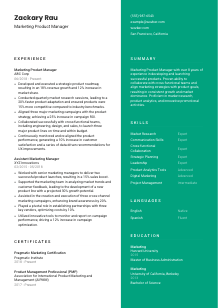
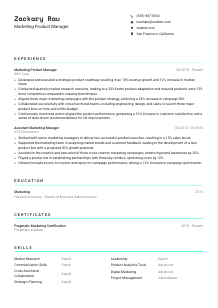
Juggling marketing campaigns, but your CV isn't getting market-fit? Check out this Marketing Product Manager CV example, created with Wozber free CV builder. It shows how to package your strategic product expertise to resonate with job criteria, positioning your career as the top choice in the market!
Marketing Product Managers sit at the point where product direction meets market demand. Hiring teams look for people who can turn research, customer insight, and launch planning into revenue growth, cleaner positioning, and better product adoption. Your CV needs to make that commercial judgment visible quickly, especially through roadmap ownership, launch outcomes, and the way you worked across product, design, engineering, sales, or growth teams.
A targeted CV changes how your background is read in both human review and ATS screening. When the language on the page clearly reflects product roadmap work, market research, campaign alignment, analytics, and launch results, it becomes much easier to separate you from broader marketing or general product candidates. Wozber's free CV builder helps shape that alignment into an ATS-compliant CV, so the first read points to the business outcomes a Marketing Product Manager is expected to deliver.
This section is straightforward, but it still carries screening weight. For a Marketing Product Manager, clean contact details, the right job title, and location clarity help remove friction before anyone gets to your roadmap, launch metrics, or market analysis experience.
Use your full name in a clean, readable format at the top of the CV. Keep the styling simple and professional so the document opens with clarity, not decoration. In a role tied to strategic communication and product positioning, that restraint already works in your favor.
Place the target role directly beneath your name when it reflects the work you do. "Marketing Product Manager" is the clearest choice here because it immediately connects your background to product strategy, go-to-market planning, and cross-functional execution rather than broader marketing management.
List a reliable phone number and a professional email address that a recruiter or hiring manager can use without hesitation. If you include a website or portfolio, make sure it supports your candidacy with relevant work such as launch case studies, positioning work, product messaging, or measurable campaign outcomes.
Some postings include a location requirement, and this one specifically names San Francisco, CA. If you are local, say so. If you are planning a move, note that you are willing to relocate. That small line can prevent your application from being filtered out before your product launch record is even reviewed.
A current LinkedIn profile can reinforce your CV with career progression, endorsements, and additional project context. Keep the titles, dates, and achievements aligned with your CV, especially if you want your product roadmap ownership, launch work, or market research depth to read consistently across both.
This section does not need flair. It needs accuracy, a role-aligned title, and any required location detail so the hiring team can move straight to your marketing product management experience.




For this role, experience carries the most weight because employers want to see how you shaped product direction, supported launches, and improved performance in market. Generic marketing bullets will not do much here. Your experience section needs to show product decisions, cross-functional delivery, and outcomes tied to revenue, adoption, market share, or campaign performance.
Read the job description for the operating themes behind the title. Here, the big ones are roadmap ownership, market research, competitor analysis, cross-functional collaboration, campaign alignment, and performance reporting. Use those themes to choose which achievements deserve space, especially if your background spans both product and marketing roles.
List your positions in reverse chronological order with title, company, and dates. For Marketing Product Manager roles, the title matters, but so does the context around scope. Even before the bullets, a hiring team should be able to follow your progression from supporting launches to owning strategy, positioning, and performance decisions.
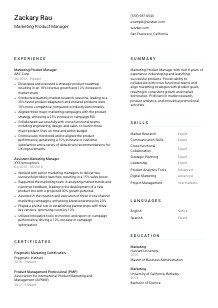
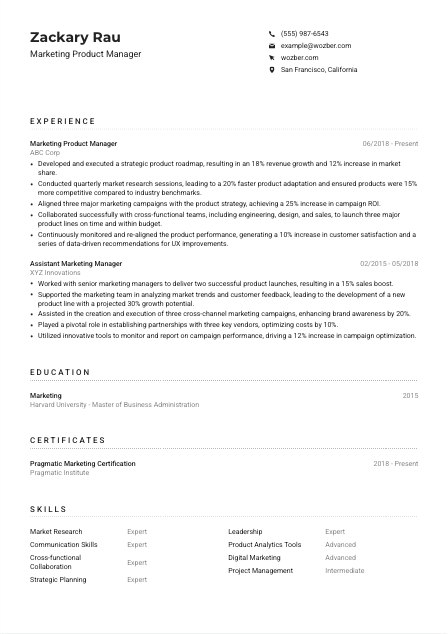
Each bullet should connect an action to an outcome. That usually means showing what you owned, how you influenced the product or go-to-market plan, and what changed because of it. The example CV does this well by tying roadmap execution to 18% revenue growth and a 12% increase in market share, then linking campaign alignment to a 25% increase in ROI. Those are the kinds of results that translate well for this profession.
Numbers matter most when they reflect how the work is actually judged. Prioritise metrics such as revenue growth, market share, launch timing, campaign ROI, customer satisfaction, adoption rate, retention, conversion, or speed of product adaptation. A bullet like "launched three major product lines on time and within budget" works because it combines delivery discipline with commercial relevance.
If earlier roles were more generalist, trim the bullets until the through-line is clear. A Marketing Product Manager CV should foreground market insight, positioning, launch support, stakeholder management, and data-driven iteration. Even support roles can help if they show movement toward product strategy, as in the example's assistant marketing role contributing to product launches, campaign execution, and trend analysis.
By the end of this section, a hiring team should be able to see that you can take a product from research and positioning through launch and performance improvement, with numbers that make that track record concrete.
Education is usually a qualification check first, especially in business-facing product roles. For a Marketing Product Manager, this section should confirm that you meet the degree requirement quickly, while any advanced study adds context around strategic or commercial depth.
If the posting asks for a Bachelor's degree in Marketing, Business, or a related field, make that information easy to find. In this case, a bachelor's in Marketing directly satisfies the baseline requirement, and an MBA strengthens the profile because it supports commercial planning, stakeholder communication, and strategic decision-making.
List the degree, field of study, school, and graduation year. This section does not need long explanations. Hiring teams want to confirm the credential quickly and move back to the experience that shows launch execution, market analysis, and product growth work.
If you have both undergraduate and graduate education, place them in reverse chronological order. An MBA can be especially useful to surface for this type of role because it aligns naturally with pricing, growth strategy, portfolio thinking, and executive communication.
Coursework, capstones, or academic projects are most useful when you are early in your career or when they directly connect to product marketing, analytics, research, or commercialization. If you already have 5+ years of relevant experience, keep this section lean and let your launch history carry more weight.
Honors, leadership roles, or notable projects can stay if they add something specific, such as market research depth, leadership experience, or business strategy work. If they do not support your current candidacy, leave them out and keep the section focused.
Education should confirm your academic foundation fast. Once that box is checked, the CV should return the spotlight to the product, market, and growth outcomes you have delivered.
Certifications are secondary to experience, but they can sharpen your positioning when they reflect recognized product management methods or market-facing strategy frameworks. In a Marketing Product Manager CV, the best certificates support how you research, prioritise, launch, and improve products.
When a job description mentions specific certifications, list them if you have them. Here, Pragmatic Marketing and Product Management Professional credentials are a strong match because they connect directly to market understanding, product strategy, and commercialization practices.
Prioritise certifications tied to product management, product marketing, analytics, research, or go-to-market execution. A shorter, more relevant list is stronger than a broad collection of unrelated courses because it helps the reader stay focused on your strategic product and marketing capabilities.
Certification dates help show that your training is current, particularly for frameworks and tools that evolve with market practice. If the credential is active or recently renewed, that can strengthen your presentation, especially in roles that rely on ongoing market analysis and product iteration.
Do not list certifications as filler. Use them when they genuinely support your experience in roadmap planning, positioning, pricing, analytics, or launch execution. When kept relevant and current, they add another layer of credibility to the profile.
Relevant certificates can help confirm method and specialization. They work best when they clearly support the product strategy and market execution already shown in your work history.
This section should read like the toolkit of someone who can guide a product through research, positioning, launch, and performance review. For Marketing Product Manager roles, the strongest skills lists balance market-facing strengths with the operational abilities needed to work across product, design, engineering, sales, and analytics.
Start with the requirements and responsibilities. This posting points directly to market research, product analytics tools, interpersonal communication, cross-functional collaboration, and strategic planning. Those are not filler keywords. They describe how the role is performed and should be reflected if they match your real background.
Choose skills that appear again in your experience bullets. If you list market research, your work history should show competitor analysis, customer insight gathering, segmentation, or product adaptation decisions. If you list cross-functional collaboration, your experience should show launches delivered with engineering, design, and sales teams.
Avoid padding this section with broad business terms that could apply to almost any manager. A tighter list built around strategic planning, market research, product analytics, digital marketing, communication, and stakeholder management gives a much clearer picture of how you operate. The example CV handles this well by mixing strategic and execution-oriented strengths instead of listing generic buzzwords.
A hiring team should be able to connect this list directly to your experience. When the skills section mirrors your actual tools, methods, and collaboration style, it strengthens both ATS optimisation and the human read.
Language requirements are usually simple, but they still matter when a posting states them directly. For a Marketing Product Manager, language proficiency affects stakeholder communication, market messaging, customer insight work, and the clarity of reporting across teams.
If the job description specifies a language, list it clearly with an honest proficiency level. Here, English is a stated requirement, so it should appear first and be described accurately, whether that is Native or Fluent.
Put the required business language at the top, then add any additional languages that could support regional marketing, customer research, or cross-market communication. This keeps the section practical rather than decorative.
Extra languages can add value in companies with international teams, multilingual customer bases, or regional growth plans. Spanish, for example, can be useful in market-facing work, but it should remain secondary to the required language unless the posting makes multilingual communication a core part of the role.
Choose levels such as Native, Fluent, Professional Working, or Conversational, and avoid overstating what you can do. In a role where positioning, reporting, and stakeholder communication matter, credibility in this section matters too.
Some Marketing Product Manager positions focus on one domestic market, while others support multi-region launches or customer segments across languages. Tailor the section to that scope. Include extra language capability when it strengthens the commercial story, not just because it fills space.
List the required language first, label proficiency honestly, and add other languages only when they strengthen how you can work with customers, partners, or internal teams.
The summary is where you frame your value before the reader gets into the detail. For a Marketing Product Manager, that means stating your level, your blend of product and marketing experience, and the kinds of outcomes you have delivered, without drifting into vague claims.
Use the posting to identify the few ideas that belong in your opening lines. In this case, that includes product roadmap strategy, market research, successful launches, cross-functional collaboration, and performance analysis. Those themes give your summary the right shape.
Open with your title or professional identity, years of experience, and the domain you work in. "Marketing Product Manager with 8+ years of experience" is stronger than a generic leadership statement because it places you immediately in the right lane.
Include two or three strengths tied to results, such as revenue growth, market share gains, launch success, campaign ROI improvement, or customer insight work. The sample summary is strongest where it connects cross-functional collaboration and product goals to consistent growth rather than relying on broad ambition statements.
Aim for a short paragraph that a hiring manager can absorb in seconds. Every phrase should help explain how you guide product strategy, align go-to-market activity, and use data to improve performance. If a sentence does not point toward those outcomes, cut it.
Your summary should quickly establish that you understand both the product and the market side of the job. When it is tailored well, the rest of the CV reads as proof of that claim.
A Marketing Product Manager CV works when every section supports the same story: you can read the market, shape product direction, align launches, and improve commercial performance. That is what hiring teams want to see first, whether they are scanning manually or reviewing an ATS-friendly CV format.
Use these sections to tighten your positioning, then refine the wording with Wozber's free CV builder, ATS CV scanner, and ATS-friendly CV templates so your experience is presented with clear terminology and strong ATS optimisation. The finished CV should make your product strategy and go-to-market impact easy to judge.