



Use Wozber and land your dream job
Create CV
No registration required
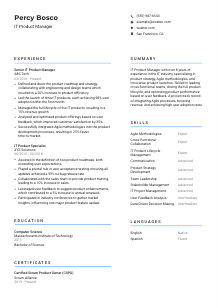
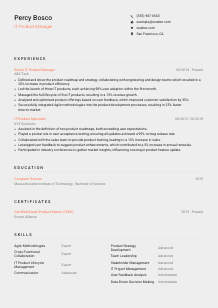
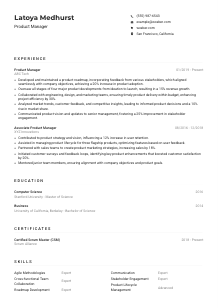
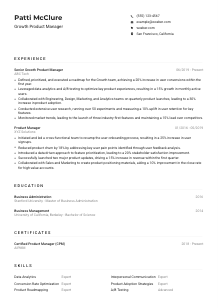
Strategizing tech, but your CV seems to dawdle in beta? Check this IT Product Manager CV example, created with Wozber free CV builder. Learn how to present your product prowess in line with IT job requisites, launching your career trajectory on the fast track to v1.0!
IT Product Manager hiring tends to move quickly once a CV makes one thing clear: you can turn product direction into shipped software. Teams want to see how you have set priorities, worked with engineering and design, run an Agile cadence, and improved a product after launch using customer or performance data. If that chain is vague, even solid backgrounds can look more operational than strategic.
A tailored CV changes that first read by showing where your roadmap ownership, launch history, and cross-functional decision-making line up with the opening. Wozber's free CV builder helps organise that alignment in an ATS-friendly CV format, so the core signals for an IT Product Manager are easy to scan and easy to trust.
For an IT Product Manager, the top of the CV should be clean, direct, and easy to process. This role often sits between technical teams and business stakeholders, so even the contact section should reflect clarity, accuracy, and professional judgment.
Use your full name in a larger font than the rest of the header. Keep it simple and professional. Product managers are expected to reduce friction and create clarity, and that expectation starts with a CV that is immediately easy to scan.
Place "IT Product Manager" directly under your name if that is the role you are pursuing. This helps frame the rest of the CV around roadmap ownership, Agile delivery, and product lifecycle work instead of leaving the reader to infer your direction from mixed titles or adjacent experience.
List a reliable phone number and a professional email address, then check them carefully. Hiring for product roles often moves through several interview stages with recruiters, engineering leaders, and business partners, so missing a call or using an outdated email creates avoidable friction.
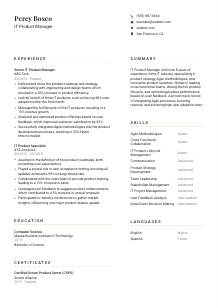
If the opening specifies a location, mirror that clearly in your header. Here, San Francisco, CA is explicitly requested, so showing that match removes a basic screening question right away. If you are planning a move for another IT Product Manager role, state that plainly instead of leaving the employer to guess.
Include LinkedIn or a personal site only if it supports your candidacy with consistent information. For product managers, that might mean a profile that shows product launches, cross-functional leadership, certifications, or talks and writing on product strategy. Make sure the dates, titles, and scope match your CV.
This section should answer the basic practical questions immediately: who you are, what role you target, how to reach you, and whether you meet any stated location requirement. Once that is clear, the hiring team can focus on your product work.




This is the section that carries the most weight for an IT Product Manager. Employers want to understand what products you owned, how you worked with engineering and design, what decisions you drove, and what changed because of your work in adoption, release speed, revenue, retention, or customer satisfaction.
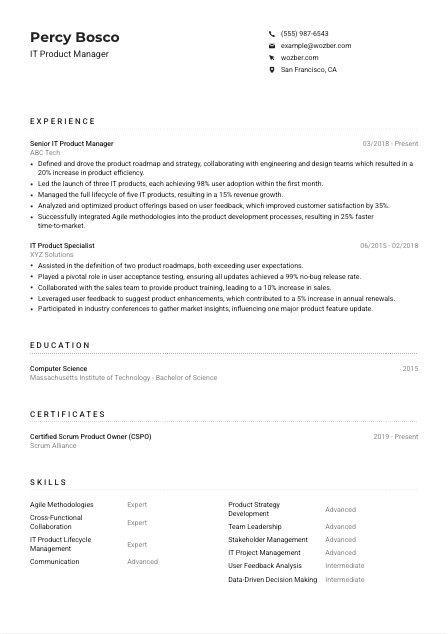
Start by marking the terms that define the job: product roadmap, strategy, Agile development, cross-functional collaboration, launches, lifecycle management, and data-driven optimisation. Those ideas should appear naturally in your experience bullets where they reflect real work. In the sample CV, phrases tied to roadmap ownership, full lifecycle management, and Agile delivery map closely to the opening without sounding copied.
Lead with your most recent roles, especially those with direct product scope in the IT industry. For each entry, include title, company, and dates. That structure helps reviewers quickly confirm progression from supporting product work into ownership, strategy, and leadership responsibilities.
Bullets should show what you drove and what happened next. Strong IT Product Manager bullets often connect a decision or action to a measurable result, such as faster time-to-market, stronger adoption, higher revenue, improved release quality, or better customer satisfaction. The example does this well by tying Agile process changes to 25% faster time-to-market and product optimisation to a 35% improvement in customer satisfaction.
Prioritise work that shows discovery, prioritization, execution, launch, iteration, and end-of-life management. If you have adjacent experience in project coordination, implementation, or sales support, keep only the parts that show product judgment, stakeholder alignment, or market-informed decision-making. This section should read like a product manager who has owned outcomes, not just supported delivery.
Mirror the posting's terminology when it accurately matches your background. If the employer emphasizes Agile methodologies, product roadmap strategy, or customer feedback analysis, use those phrases in context. Pair them with specifics such as sprint planning, release cadence, backlog prioritization, user feedback loops, or launch metrics so the wording reflects actual operating experience.
The most convincing experience sections make the employer picture you in the role already. When your bullets show roadmap choices, cross-functional execution, and measurable product outcomes, your experience reads as product leadership rather than general tech management.
Education matters here because IT Product Managers work close to technical teams and product tradeoffs. You do not need to overstate this section, but you should present the academic background that supports your fluency with software products, technical constraints, and structured problem-solving.
If you have a Bachelor's degree in Computer Science, Information Technology, or a related field, make that easy to spot. This opening specifically asks for that academic foundation, so a degree such as the sample's Bachelor of Science in Computer Science should be presented clearly and without extra filler.
List degree, field of study, school, and graduation year in a straightforward order. Clear formatting helps both human reviewers and ATS parsing. Keep the section easy to verify so attention stays on the relevance of your training rather than on decoding the layout.
When your field of study connects closely to the role, let that connection speak for itself. Computer Science, Information Systems, Software Engineering, and related disciplines all reinforce your ability to work with engineering teams, understand technical tradeoffs, and manage IT products with enough depth to make credible prioritization calls.
Most experienced candidates can keep this section brief, but relevant coursework or capstone work can help if it strengthens your product story. Include it only when it supports areas such as software development, systems design, data analysis, or human-computer interaction, especially if your professional product experience is still growing.
If you have completed additional formal learning in product strategy, Agile delivery, analytics, or technology management, include it when it adds context to your development. For IT Product Managers, continued learning can reinforce how you stay current with product methods and digital delivery practices.
Your education section does not need to do heavy lifting if your experience is strong, but it should confirm the technical grounding that supports product decisions, engineering conversations, and roadmap work.
Certifications carry weight when they reinforce how you actually run product work. For IT Product Managers, Agile and product ownership credentials are especially useful because they speak to backlog decisions, sprint collaboration, and delivery discipline in software environments.
Start with certifications that directly support the responsibilities in the opening. Here, Certified Scrum Product Owner is preferred, so listing CSPO near the top immediately reinforces your familiarity with Agile product ownership. The sample CV uses this well because it supports the job's emphasis on Agile development environments.
Skip long lists of loosely related courses. Focus on credentials tied to product management, Agile delivery, Scrum, analytics, cloud platforms, or relevant IT domains. A short, targeted list tells a clearer story about how you work with development teams and manage releases.
Always show who issued the certification and when you earned it. That context matters for recognized credentials such as CSPO because it helps employers understand both credibility and recency. If a certification requires renewal or continuing education, make that status clear.
Product methods, tooling, and delivery practices evolve quickly. Updating this section with recent certifications or active credentials shows that your approach to Agile planning, product discovery, and release management is current rather than outdated.
A well-chosen certification section adds practical credibility. It should support the way you prioritise work, collaborate with Scrum teams, and lead product delivery in an IT setting.
An IT Product Manager skills section should read like the toolkit behind your execution. Employers look for a balanced mix of product strategy, Agile delivery, stakeholder leadership, and enough technical fluency to work effectively with engineering without turning the section into a random keyword list.
Use the posting to identify the skills that matter most in context. In this case, Agile methodologies, cross-functional collaboration, product strategy, communication, and lifecycle management are central. These are not filler terms. They reflect the daily work of setting priorities, leading tradeoff discussions, and guiding releases.
Order matters. Lead with the capabilities that define your value for the target role, such as Agile methodologies, product strategy development, stakeholder management, and IT product lifecycle management. The sample CV does this effectively by placing Agile and cross-functional collaboration among the strongest entries.
Every skill listed should be supported somewhere else in the CV through experience, certifications, or the summary. Avoid padding the section with generic terms that could belong to any manager. If you include items like data-driven decision-making or user feedback analysis, make sure your experience bullets show how those skills influenced roadmap choices, releases, or product improvements.
This section should sound like the operating toolkit of someone who can set direction, work through technical constraints, and ship improvements with cross-functional teams. If a skill cannot be backed up elsewhere, it does not belong here.
Language ability matters more in product roles than many candidates realize. IT Product Managers spend much of their time aligning engineering, design, leadership, customers, and sometimes regional teams, so communication strength should be visible wherever it is a stated requirement.
When the posting names a language requirement, list it clearly and near the top. This role specifically calls for English fluency, so your CV should show that immediately. In the sample, English is listed as native, which removes any doubt about communication readiness.
Include additional languages when they could support collaboration across markets, customer segments, or distributed teams. For some IT Product Manager roles, a second language can be useful in customer discovery, partner communication, or launch coordination, but it should remain secondary to the core requirement.
Choose clear levels such as Native, Fluent, Advanced, or Intermediate, and be accurate. Product managers spend a lot of time presenting tradeoffs, gathering requirements, and handling stakeholder questions, so overstating language ability can quickly become obvious in interviews.
Additional languages can strengthen your profile, especially in global software businesses, but they should complement rather than distract from product credentials. Keep the emphasis on communication that helps with product discovery, launch planning, or cross-team alignment.
Where relevant, think about languages as part of how you operate, not just a personal detail. If you work with international development teams, customer groups, or regional product launches, your language skills can reinforce your ability to gather feedback accurately and communicate priorities across functions.
For this profession, language skills matter when they support clearer stakeholder communication and smoother product work. Lead with the required proficiency, then add anything else that genuinely strengthens your operating range.
The summary is where you establish your level quickly. For an IT Product Manager, that means giving a concise view of your product scope, years of experience, delivery approach, and the kinds of outcomes you have influenced across the lifecycle.
Start by identifying the few themes that define the target job. Here, those are product strategy, Agile delivery, cross-functional leadership, lifecycle ownership, and performance optimisation. Your summary should centre on those points rather than trying to mention every skill you have.
Your first sentence should state your title or specialization and your years of experience in a way that matches the role. For example, the sample summary leads with more than 8 years in the IT industry and immediately ties that background to product strategy and Agile methodologies, which fits the opening well.
Use one or two lines to highlight the work you are trusted to do and the outcomes you have driven. Strong examples include leading cross-functional teams, launching IT products, improving adoption, accelerating release cycles, or optimising offerings based on feedback and data. Keep this selective and relevant.
Aim for 3 to 5 lines with real substance. Avoid vague claims about being passionate, results-driven, or innovative unless the rest of the sentence explains how that shows up in product work. A compact summary with roadmap, Agile, launch, and optimisation context will land much better.
A good summary gives the hiring team a clear starting point: your level, your product focus, and the business or user outcomes you tend to influence. When that is clear, the rest of the CV has a stronger frame.
An effective IT Product Manager CV shows more than years in tech. It connects roadmap thinking, Agile execution, launch ownership, and post-release improvement in a way that makes your product judgment easy to recognize.
Use Wozber's free CV builder to shape that story into an ATS-compliant CV, refine the language with role-specific terms, and check alignment with the posting through focused ATS optimisation. The final result should make one point clear fast: you know how to lead IT products from strategy through release and iteration.