



Use Wozber and land your dream job
Create CV
No registration required
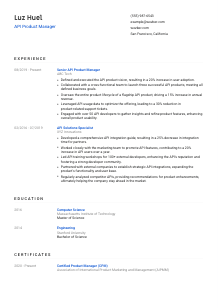
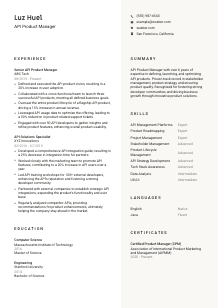
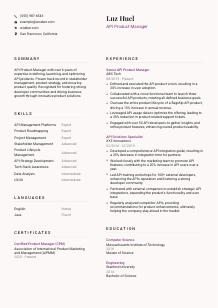
Crafting APIs, but your CV lacks endpoints? Check out this API Product Manager CV example, created with Wozber free CV builder. Learn how to present your API vision in line with job requests, paving a career path where your products stay in high demand, just like the APIs you create!
API Product Managers are expected to connect technical depth with commercial judgment. Hiring teams want to see how you shaped an API roadmap, worked through tradeoffs with engineering, learned from developer adoption patterns, and turned platform capabilities into products that teams and partners actually used.
When that story is tailored well, your CV quickly separates API product work from general SaaS product management. Wozber's free CV builder helps you align your wording with the job description and produce an ATS-compliant CV, so your roadmap ownership, integration knowledge, and developer-facing product decisions are easier to recognize early.
This section is simple, but it still does important work. For an API Product Manager, the header should immediately establish professional identity, reliable contact details, and any practical requirement that could affect candidacy, such as location for a hybrid or onsite team.
Make your name the clearest text in the header using a clean, professional format. API Product Manager CVs often carry technical and strategic detail further down the page, so the top should stay crisp and easy to scan.
Place "API Product Manager" directly under your name when that matches the role you are applying for. This creates immediate alignment and helps position your background around API strategy, integrations, and developer experience rather than broader product work.
List a phone number you answer and a professional email, ideally based on your name. If you also include a website or LinkedIn profile, make sure it reflects the same product scope, launch work, and cross-functional ownership shown in your CV.
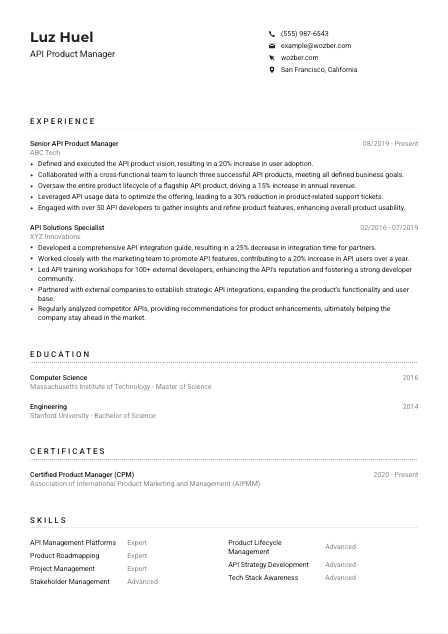
If the job requires a specific location or relocation, make that clear in this section. In the example, San Francisco, California is listed because the posting names that requirement, which removes unnecessary doubt before a hiring team reaches your experience.
A polished LinkedIn profile, portfolio, or personal site can strengthen your application when it shows API product launches, developer documentation work, public speaking, or product writing. Keep the content consistent with your CV so roadmap ownership and technical fluency show up the same way in both places.
Your header should answer the practical questions fast: who you are, how to reach you, what role you target, and whether any location requirement is already covered.




This is where API product management becomes tangible. Hiring teams look past titles and focus on how you guided API products from concept to release, how you worked with engineering and external developers, and what changed because of your decisions.
Read the job description closely and pull out the operating priorities behind it. Here, that includes API product vision, roadmap ownership, lifecycle management, usage analysis, and developer engagement. Then choose past roles and bullets that clearly show those same responsibilities in practice.
List your most recent role first, followed by earlier positions that built your API product background. Titles such as Senior API Product Manager or API Solutions Specialist help, but the stronger signal is how each role expanded your responsibility across launches, integrations, partner enablement, or platform strategy.
Every bullet should show a product decision, a collaboration pattern, or a measurable business result. The example does this well with lines such as defining the API product vision and increasing user adoption by 20 percent, or working with cross-functional teams to launch three API products tied to business goals.
Quantify results with measures that make sense for APIs and platforms: adoption growth, partner integration time, annual revenue impact, support-ticket reduction, release cadence, or developer engagement. A bullet about cutting product-related support tickets by 30 percent says far more than a generic claim about improving quality.
Keep the experience section centered on product strategy, technical collaboration, lifecycle ownership, and developer ecosystem work. If a bullet does not support those themes, rewrite it or remove it. Space is better used on roadmap decisions, market-informed prioritization, and API improvements that changed adoption or usability.
Your experience should make it easy to follow the products you owned, the teams you influenced, and the measurable results of your API decisions.
For API Product Manager roles, education usually supports credibility rather than carrying the application on its own. Still, the degree line matters because many postings ask for a technical or engineering-related background.
Check whether the employer asks for Computer Science, Engineering, or a related field. If you have that background, make it obvious. In this example, degrees in Engineering and Computer Science line up well with the technical expectations around APIs, integrations, and developer ecosystems.
List school, degree, field of study, and graduation year in a consistent order. This section is usually scanned quickly, so simple formatting helps the technical foundation register without competing with your product experience.
If your degree directly supports API product work, do not bury the field of study. A Master of Science in Computer Science or a Bachelor of Science in Engineering reinforces that you can work credibly with engineering teams, integration architecture, and platform constraints.
Relevant coursework, capstone projects, or thesis work can help when you are earlier in your career or moving into API product management from an adjacent role. For someone with 5+ years of experience, these details matter only if they add something specific, such as distributed systems, software architecture, or developer platform design.
Honors, research, or technical leadership can be worth adding when they connect to product thinking or technical fluency. For example, a systems design project, engineering leadership role, or product-focused graduate work can reinforce how you operate with technical teams.
Use education to confirm the technical base behind your product work, especially when the posting asks for a related degree.
Certifications are not always required for API Product Manager roles, but the right one can add useful context. They work best when they reinforce product judgment, platform knowledge, or continued learning in a field that changes quickly.
Some API Product Manager ads mention product or API-related credentials, while others list them as a plus. If the job points to certification, include any relevant match near the top of this section rather than leaving it buried elsewhere.
Choose certifications that strengthen your credibility in product management, APIs, platform strategy, or related technical domains. The Certified Product Manager credential in the example works because it supports the product side of the role without pretending to replace direct API experience.
If a certification is current, renewable, or recently earned, include the date range. That helps show that your training is active and relevant, especially in fast-moving areas like integrations, developer tooling, and product delivery practices.
This section should suggest that you keep building your product toolkit, whether through formal credentials, API-focused learning, or adjacent training in analytics, delivery, or platform management. Keep it concise and relevant to the work you want to do next.
A well-chosen certificate should reinforce your product credibility and technical context, not pad the page with unrelated credentials.
API Product Manager hiring depends on a mix of product judgment, technical fluency, and stakeholder range. Your skills section should reflect that mix clearly, without turning into a long inventory of every tool or buzzword you have touched.
Start with the posting and identify the capabilities behind the wording. In this case, that means API strategy, integrations, developer ecosystems, roadmap ownership, stakeholder management, and product lifecycle execution. Those are more useful than generic labels alone.
List skills that already show up in your work history or summary. If you claim API Management Platforms, Product Roadmapping, or Stakeholder Management, there should be bullets elsewhere that prove you used them to launch products, guide partners, or improve adoption.
The section should show enough technical understanding to support credibility with engineering teams, while still emphasizing product leadership. A mix like API Management Platforms, API Strategy Development, Product Lifecycle Management, Data Analysis, and UX or developer experience awareness usually reads better than a list weighted entirely to one side.
A focused skills section should show that you can lead API products with both technical context and product discipline.
Language ability is usually a secondary section for API Product Managers, but it still matters when the role involves developer communities, external partners, or cross-regional collaboration. Keep it accurate and easy to interpret.
If the posting asks for strong English, list your English proficiency clearly. Product managers spend a large part of the job writing requirements, aligning stakeholders, and explaining technical tradeoffs, so this is more than a formality.
Additional spoken languages can support partner work, global developer outreach, or collaboration across regions. Include them when they are genuinely usable in professional settings, not just casually familiar.
Terms like Native, Fluent, Intermediate, and Basic are enough. They give hiring teams a practical sense of how comfortably you can communicate in meetings, workshops, documentation reviews, or partner discussions.
Extra languages can strengthen your profile when the API product serves international developers or external integration partners. In those cases, this section adds context to your ability to gather feedback and build community across markets.
Do not overstate proficiency, and do not confuse programming languages with spoken ones in this section. If you want to show technical language familiarity or coding exposure, place that in Skills instead.
List only the languages you can genuinely use, and make sure the section supports how you communicate with teams, partners, or developer audiences.
The summary should quickly position you as someone who can own an API product end to end. It needs to connect technical understanding, product direction, and measurable outcomes in a few lines that sound grounded rather than promotional.
Pull the main themes from the job description before writing: API vision, roadmap strategy, lifecycle management, cross-functional delivery, and developer engagement. Your summary should reflect those priorities in compact form.
Open with your title and years of relevant experience. A line like "API Product Manager with over 6 years of experience" works because it immediately sets scope and tells the reader you are not coming from a generalist product background.
Choose highlights that reflect the role's actual demands, such as defining API strategy, improving adoption, translating technical concepts for non-technical teams, or building developer relationships. The example summary handles this well by combining product strategy, stakeholder management, product quality, and community building.
Aim for 3 to 5 lines with precise language. Skip vague claims about passion or innovation unless you attach them to something concrete like API launches, partner ecosystem growth, or measurable product improvement.
After reading your summary, a hiring manager should already understand your API product focus, your level of ownership, and the kind of outcomes you tend to drive.
An API Product Manager CV should make three things easy to spot: how you shape product direction, how you work across technical and business teams, and what changed because of your decisions. When each section supports that story, the CV reads with far more credibility than a generic product management profile.
Use Wozber's free CV builder to tighten structure, improve ATS optimisation, and present your experience in an ATS-friendly CV format that reflects the language of the role. Done well, your CV will make your API roadmap ownership and developer-product thinking clear from the first scan.




