



Use Wozber and land your dream job
Create CV
No registration required
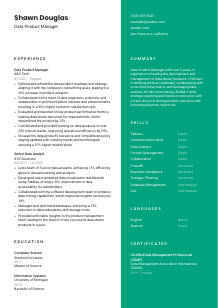
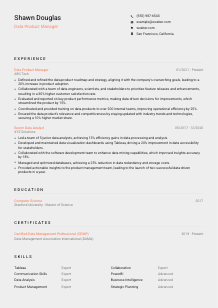
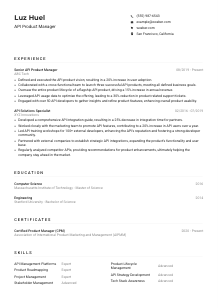
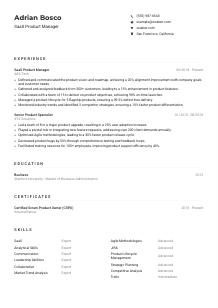
Juggling datasets, but your CV feels unstructured? Check out this Data Product Manager CV example, created with Wozber free CV builder. It shows how to bring together your product prowess and data-driven insights to meet the job criteria, framing your career narrative for success!
Data Product Manager CVs work best when they make one thing easy to understand fast: how you turn data capability into product decisions that matter. Hiring teams want to see someone who can shape roadmap priorities, work credibly with data engineers and analysts, and track whether a data product is actually being adopted, trusted, and improved over time.
The first screen often comes down to whether your CV clearly connects product strategy with analytics execution. Wozber's free CV builder helps you present that connection in an ATS-compliant CV by aligning your language with the job description, keeping technical terms readable, and making it easier for a reviewer to spot your experience with roadmap ownership, product metrics, and cross-functional delivery.
Personal details are simple, but they still shape how smoothly your application moves. For a Data Product Manager, this section should confirm professional identity, contact accuracy, and any logistical requirement that affects hiring, such as location for an on-site or hybrid team.
Your name should sit at the top in a clean, readable format so the CV feels polished from the first line. Keep styling professional and easy to scan, the same way you would present a dashboard or product brief where clarity matters immediately.
Place "Data Product Manager" directly beneath your name when that is the role you are pursuing. Matching the target title helps frame the rest of your background correctly, especially if your past work includes adjacent titles such as Senior Data Analyst, Analytics Product Manager, or BI Lead.
List a current phone number and a professional email address with no casual wording. Small errors here create unnecessary friction, and for a role that depends on precision with metrics, requirements, and stakeholder communication, avoid giving that kind of first signal.
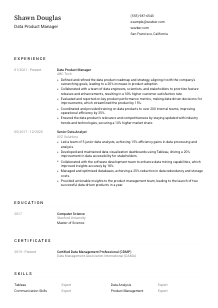
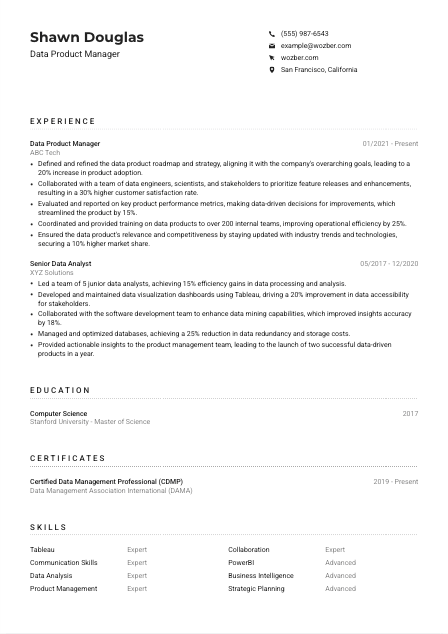
If the posting specifies a location requirement, reflect it clearly in this section. In the example, listing "San Francisco, California" directly addresses the employer's stated need and removes questions about relocation before anyone reaches the experience section.
Include LinkedIn or a personal site only if it strengthens your application with consistent, up-to-date information. For a Data Product Manager, that might mean visible product work, analytics leadership, speaking engagements, or data portfolio context that supports the CV rather than repeating it.
This section should confirm that you are easy to contact, correctly positioned for the target title, and aligned with any practical requirement stated in the posting. In Wozber's ATS-friendly CV template, those basics stay clear and easy to scan from the start.




This is the section hiring teams read most closely for this role. They are looking for decisions, outcomes, and collaboration patterns that show you can guide a data product from strategy through release priorities, performance tracking, and internal adoption.
Before rewriting bullets, identify the operating themes in the role: roadmap ownership, prioritization with technical teams, product performance measurement, stakeholder communication, and internal enablement. Then choose experience that maps to those themes directly instead of listing every analytics task you have handled.
Use reverse chronological order and make sure each role earns its space. A recent Data Product Manager position should naturally lead, while an earlier analytics role can still add value when it shows dashboard development, database work, or insight generation that prepared you for product ownership. The example does this well by following a current product management role with a Senior Data Analyst role that still supports the target story.
Data product work is measured through adoption, satisfaction, efficiency, insight quality, operational improvement, and business impact. Whenever you can, attach numbers to releases, usage, training scale, process improvement, or revenue-related outcomes. "Increased product adoption by 20%" and "improved customer satisfaction by 30%" are strong examples because they show that roadmap and prioritization decisions changed product performance, not just activity volume.
Keep the focus on product strategy, analytics depth, and cross-functional execution. If a bullet does not show prioritization, data decision-making, stakeholder alignment, reporting, visualization, or measurable product improvement, consider removing it. This role sits at the intersection of product and data, so your experience section should stay centered on that intersection.
Use the same terminology employers use when it reflects your real experience. Phrases like "defined and refined the data product roadmap," "prioritised feature releases," "reported on product performance metrics," and "provided training on data products" tell a reviewer quickly that you understand the workflow of the job. The sample CV works because those bullets closely track the responsibilities without sounding copied word for word.
Your experience section should show that you can set direction, work across technical and business teams, and improve a data product with measurable results. Wozber's ATS optimisation tools can help align those bullets with the target role so the connection is visible in both human review and ATS screening.
For Data Product Manager roles, education usually serves as a credibility check on analytical and technical grounding. Reviewers want to see that you can work comfortably with data concepts, systems, and business intelligence, even if your strongest proof still comes from product results and cross-functional delivery.
If the role asks for a bachelor's degree in Computer Science, Information Systems, or a related field, make sure that qualification is easy to spot. List the degree, field, school, and graduation year clearly so the requirement can be confirmed in a quick scan.
Use a consistent structure for each entry and avoid overloading this section with extra detail unless it adds direct value. Hiring teams usually want fast confirmation of academic background here, not a long academic history.
If you hold an advanced degree relevant to data, systems, analytics, or computer science, include it prominently. In the example, the combination of a Master's in Computer Science and a Bachelor's in Information Systems aligns well with a posting that prefers advanced study while requiring a technical foundation.
Most mid-level and senior candidates do not need detailed coursework, but include it if it strengthens a gap or sharpens relevance. Courses or academic projects tied to databases, business intelligence, analytics, machine learning, or product development can be useful if your professional experience is lighter in those areas.
Honors, research, or notable projects can stay if they support the role's analytical or technical demands. For an experienced Data Product Manager, they should be brief and clearly relevant, not a substitute for work achievements.
Education should confirm that you have the technical base expected for a data-focused product role. In an ATS-friendly CV format, that information should be easy to find and clearly aligned with the degree requirements in the posting.
Certificates can add useful depth in a field where tools, governance practices, and analytics methods keep changing. They matter most when they strengthen your credibility in data management, business intelligence, analytics, or product-related decision-making.
Choose credentials that support the work of managing data products, such as data management, analytics, BI, cloud data platforms, or product strategy. The example's CDMP certification is a strong fit because it reinforces data governance and management knowledge that often sits behind successful data products.
A short list of relevant credentials works better than a broad inventory of unrelated courses. Each certification should contribute something meaningful to the profile, whether that is stronger credibility with databases, reporting environments, governance standards, or modern analytics workflows.
If the credential is active, recently earned, or periodically renewed, include the date. That helps show your knowledge is current, which matters in areas such as BI tooling, data architecture practices, and platform ecosystems that evolve quickly.
If you are continuing to develop in product analytics, experimentation, data governance, or visualization, relevant certifications can show that your knowledge is moving with the market. Keep the emphasis practical and tied to the work you want to do next.
Certifications should strengthen your profile, not crowd it. Presented clearly in Wozber's ATS-friendly CV format, they add another layer of credibility around the technical and analytical scope of data product management.
The skills section should show the mix this role actually requires: product judgment, analytical fluency, and collaboration with technical teams. A scattered list weakens that picture. A focused one helps reviewers see how you operate across roadmap, data, and stakeholder needs.
Start with the tools and capabilities the employer names explicitly, then add closely related skills you genuinely use. In this case, that includes data analysis, database management, business intelligence, Tableau or PowerBI, product management, and communication across cross-functional teams.
A Data Product Manager usually needs a blend of product strategy, analytics tooling, and stakeholder execution. Skills such as Tableau, PowerBI, SQL, strategic planning, collaboration, and business intelligence work well together because they show how you translate data into product direction.
Prioritise skills that are likely to influence screening for this role and leave out generic filler. If a skill does not support roadmap work, analytics interpretation, data tooling, product decisions, or team coordination, it probably does not belong in a high-priority position on the list.
This section should quickly show that you can work across product strategy and data execution. With Wozber, you can shape that list into an ATS-compliant CV that reflects the language of the posting without turning the section into a keyword dump.
Language skills are usually a secondary section for Data Product Manager roles, but they still matter when a posting names a required language or when the work involves distributed teams, internal training, or stakeholder communication across regions.
If the posting specifies a language requirement, list it clearly with an honest proficiency level. Here, English is mandatory, so it should appear prominently and leave no doubt about your ability to lead discussions, explain product changes, and report on metrics in that language.
Additional languages can strengthen your profile when the business works across markets or teams. A second language will not replace product credentials, but it can support collaboration, training, and stakeholder communication in broader operating environments.
Terms like Native, Fluent, Advanced, and Intermediate are more useful than vague descriptions. They help recruiters and hiring managers judge how comfortably you can handle meetings, written updates, and cross-functional communication.
Many Data Product Managers spend substantial time translating technical concepts for business users and aligning technical teams around business priorities. If your language skills help in that environment, they are worth including, especially for organizations with international teams or customers.
Be straightforward about what you can actually use in a professional setting. Overstating language ability becomes a problem quickly in stakeholder meetings, training sessions, or executive readouts where clarity matters.
When presented clearly, language skills add context to your communication range without distracting from your product and analytics background. Wozber's free CV builder helps keep this section structured and readable in an ATS-friendly CV format.
A Data Product Manager summary should quickly establish where you sit between product thinking and data execution. This is the place to name your level, your core strengths, and the kind of outcomes you have driven, without repeating the full experience section.
Read the posting closely and identify the few themes that matter most. Here, those are roadmap strategy, collaboration with data teams, product performance measurement, and business intelligence fluency. Your summary should pull those threads together in a few direct lines.
Lead with your title and years of relevant experience so the reviewer can place you quickly. The sample summary does this effectively by stating more than 6 years of experience in data-driven product work, which immediately sets seniority and domain context.
Include the strengths that are most likely to influence screening for this kind of role, such as defining roadmaps, using data analysis to guide decisions, partnering with engineers and scientists, and improving product relevance through metrics and iteration. Keep these claims grounded in the rest of your CV.
Aim for a summary that can be read in a few seconds and still communicate product scope, analytical depth, and business impact. Four to five lines is usually enough. Save finer detail for your experience bullets, where outcomes and tools can be shown more concretely.
A well-written summary helps the reader understand your profile before they reach the detail. With Wozber's free CV builder, you can tailor that opening so it reflects the employer's language and sets up the rest of the CV around roadmap leadership, data fluency, and measurable product results.
A Data Product Manager CV should make three things easy to see: how you set direction, how you work with technical and business teams, and how you measure whether the product is improving. When those points are clear across your summary, experience, skills, and education, the CV reads like someone ready to own a data product rather than someone adjacent to it.
Use Wozber to tailor your content, strengthen ATS optimisation, and present your background in an ATS-friendly CV format that reflects the language of the role. The finished CV should make your roadmap judgment, analytical depth, and delivery track record easy to recognize.