



Use Wozber and land your dream job
Create CV
No registration required
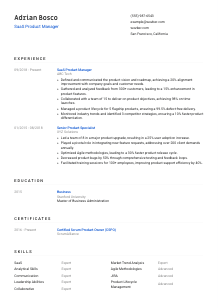
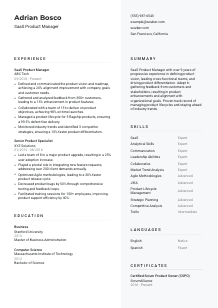
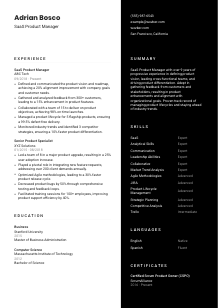
Crafting the roadmap, but your CV seems to show a glitch? Check out this SaaS Product Manager CV example, built with Wozber free CV builder. It shows how to highlight your product prowess to match job expectations, setting your career trajectory in the cloud!
SaaS product management sits at the intersection of customer problems, commercial goals, and delivery reality. Hiring teams look for people who can turn messy feedback, usage data, and market movement into a roadmap that actually ships. Your CV should make that operating range visible, from prioritization and cross-functional leadership to launch quality and measurable product outcomes.
A tailored CV changes how quickly reviewers can place you on the product side of the business rather than in a general project, analyst, or marketing track. Using Wozber's free CV builder with an ATS-friendly CV format helps you mirror the language of the role, surface Agile, roadmap, and product lifecycle work, and show that your decisions have moved adoption, release pace, or product differentiation.
For a SaaS Product Manager, the header should do one thing well: establish a clean professional identity and remove friction before the reader gets to roadmap ownership, delivery results, and cross-functional work. Keep it simple, accurate, and aligned with the role you are targeting.
Use your full name in the most prominent text on the page so the CV feels immediately professional and easy to reference in hiring discussions. Skip nicknames and decorative styling. Product roles already ask the reader to process strategy, metrics, and stakeholder scope, so your header should stay straightforward.
Place the job title directly under your name and keep it close to the wording used in the posting when it reflects your background. Here, "SaaS Product Manager" is the right choice because it aligns with both the function and the product model. This also helps ATS matching without forcing language that does not fit your experience.
List a reliable phone number and a professional email address, then add LinkedIn or a relevant personal site if it strengthens your product profile. For SaaS hiring, a strong profile might show launches, product thinking, portfolio work, or thought leadership around customer discovery, pricing, onboarding, retention, or platform strategy. Double-check every link and digit before you send the CV.
Some SaaS roles care about where product, engineering, and leadership teams work together. This example specifically asks for San Francisco, CA, so listing "San Francisco, California" removes an avoidable question early. If a role is remote or flexible, tailor the location line to that posting rather than copying one format across every application.
If you include a website, make sure it supports your candidacy. A strong link might lead to a product portfolio, launch case studies, product writing, or a polished LinkedIn presence that expands on roadmap ownership and product outcomes. Do not add a link just to fill space. For this role, every item in the header should reinforce product judgment and credibility.
This section does not need personality tricks. It needs accuracy, a relevant title, and any practical detail, like location, that helps a hiring team move straight to your product experience.




This is where SaaS Product Manager CVs usually separate themselves. Hiring teams want to see whether you have actually shaped roadmap decisions, worked through customer feedback, coordinated engineering and design, and delivered product improvements that changed adoption, quality, or business performance.
Mark the responsibilities and requirements that define the role's day-to-day work. In this posting, the recurring themes are product vision, roadmap communication, customer feedback analysis, cross-functional delivery, lifecycle ownership, Agile practice, and market awareness. Those are the threads your experience bullets should follow, because they describe how the company expects product work to happen.
List roles from most recent to oldest and include title, company, and dates in a format that is easy to scan. For product management, progression matters. A timeline that shows movement from product specialist or analyst work into full roadmap ownership helps the reader understand your growth in strategy, stakeholder influence, and delivery accountability.
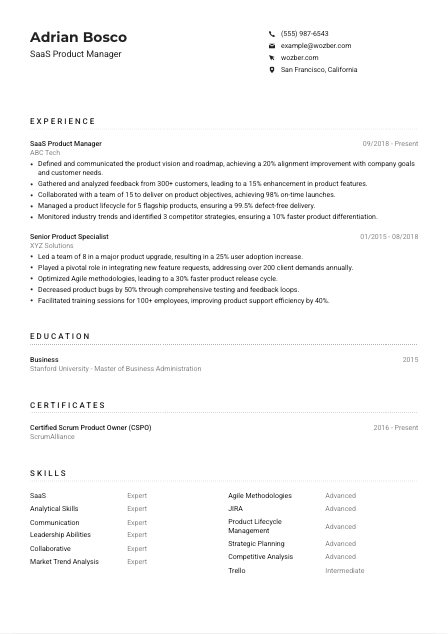
Each bullet should connect an action you owned to a result the business or product felt. The sample CV does this well with lines such as defining the product vision and roadmap and improving alignment by 20%, or gathering feedback from 300+ customers and turning it into a 15% enhancement in product features. That format works because it shows product judgment, collaboration, and outcome in one line.
Use metrics that make sense in SaaS environments: adoption, retention, release speed, launch timing, defect rates, feature usage, customer feedback volume, conversion, or roadmap execution. Numbers help distinguish product management from general coordination. A bullet like "managed 5 flagship products with 99.5% defect-free delivery" says more than a vague claim about overseeing launches.
Prioritise work that shows product strategy, customer insight, Agile execution, and cross-functional leadership. Cut bullets that lean too far into generic operations unless they directly support product outcomes. If you mention training, process optimisation, or support work, tie it back to release efficiency, customer adoption, backlog quality, or another product-relevant result, as the example does with faster release cycles and fewer bugs.
Your experience section should leave no doubt that you can take a SaaS product from idea to launch, make decisions with data, and keep teams aligned while the roadmap moves.
Education matters here because SaaS product roles often sit between technical teams and business priorities. A degree can help establish that you can work comfortably with product strategy, customer problems, and the technical context behind delivery decisions.
Start with the education that speaks most directly to the posting. This role asks for a Bachelor's degree in Business, Computer Science, or a related field, so a Computer Science or Business degree should be easy to find. In the example, the Bachelor of Science in Computer Science answers that requirement directly, while the MBA adds commercial and strategic depth.
Use a simple structure: degree, field, school, and graduation year. That gives recruiters and ATS systems a clean read without making them dig for essentials. Product CVs already carry dense experience details, so the education section works best when it is crisp and standardised.
If you hold a Master's degree, include it when it strengthens your profile. For SaaS Product Managers, graduate study can reinforce strategic planning, market analysis, operations, or technical fluency. It is especially useful when your work spans pricing, go-to-market coordination, platform growth, or executive-facing roadmap communication.
Early-career candidates can use selected coursework, capstones, or product-related projects to show product thinking before they have years of shipped experience. Focus on work tied to software products, customer research, analytics, experimentation, or system design. Once you have several years in product, these details usually become optional unless they are unusually relevant.
Honors, awards, or standout academic projects can add value when they point to analytical rigor or leadership. Keep them brief and relevant. A product strategy competition, software product capstone, or data-driven research project says more for this profession than a long list of unrelated campus activities.
For SaaS product management, education should quietly support the story your experience already tells: you can work across business, user needs, and product delivery without losing the thread.
Certifications carry weight in SaaS product management when they connect to how products are planned, prioritised, and delivered. They are most useful when they reinforce practical frameworks you apply with engineering, design, and stakeholders, especially in Agile environments.
List certifications that map to product delivery, Agile practice, discovery, or prioritization. A credential such as Certified Scrum Product Owner fits this posting because the company explicitly asks for Agile proficiency. Relevant certifications show that you understand the operating model behind backlog management, sprint planning, and iterative delivery.
Add the issue date or validity period so the reader can see whether the certification is current. In product work, where methods and tooling evolve, recency matters. A current Agile or product credential tells hiring teams that your framework knowledge is not stuck in an outdated process model.
If a certification requires renewal, maintain it and show that clearly. That matters most for credentials tied to Scrum, product ownership, or specialised product disciplines. It signals that you stay engaged with the practice, not that you earned a certificate once and left it behind.
Use certifications to show where your product management is growing. Depending on your target roles, that might include product analytics, experimentation, AI product strategy, pricing, growth, or enterprise SaaS. Choose programs that support the kind of roadmap and customer problems you want to own next.
The best certifications on a SaaS Product Manager CV support how you run product work. They should strengthen your case in Agile execution, prioritization, and product leadership, not pad the page.
A SaaS Product Manager skills section should read like the toolkit behind your product decisions. It needs a clear mix of product craft, delivery methods, analytical ability, and collaboration skills that match the way software products are actually built and improved.
Start with the skills the company has already told you matter. Here that includes Agile methodologies, tools such as JIRA or Trello, analytical ability, communication, leadership, and collaboration. Add role-native product skills that connect naturally, such as roadmap planning, product lifecycle management, customer feedback analysis, and market or competitor analysis, if they reflect your real work.
Place the most important product and delivery skills first so the section supports the job target immediately. For this role, SaaS, analytical skills, Agile, product lifecycle management, strategic planning, and cross-functional communication belong near the top. A hiring manager should be able to glance at the list and recognize a product operator, not a general business profile.
Do not overload this section with every platform or soft skill you have ever used. A tighter list is easier to trust and easier for ATS parsing. The sample CV works because it stays close to the role, combining product-domain skills like SaaS and market trend analysis with execution tools like JIRA and Trello. Use proficiency labels only if they are consistent across the section and reflect your actual level.
A well-built skills section should support the claims in your experience section. When someone reads Agile, analytics, roadmap planning, and collaboration here, they should find those same capabilities proven in your bullets above.
Language proficiency matters in product management because the role depends on clear writing, stakeholder communication, and customer context. In SaaS teams, a product manager may write PRDs, lead roadmap discussions, review customer feedback, and align groups with very different priorities.
This posting specifically requires strong English speaking and writing ability, so list English clearly and use an accurate proficiency level. That matters for product documentation, prioritization discussions, launch coordination, and customer-facing communication. If English is your primary working language, say so directly.
Additional languages can strengthen your profile if you work with global customers, distributed teams, or regional markets. They are especially useful in SaaS businesses with international expansion, multilingual support needs, or customer research across markets. Treat them as supporting value, not as filler.
Choose straightforward labels such as Native, Fluent, Intermediate, or Basic. Product roles depend on precise communication, so vague descriptions do not help. Clear labels let the hiring team judge whether you can lead discussions, interpret customer feedback, or collaborate across regions.
If the company sells into specific regions or runs distributed product, engineering, or customer teams, relevant language skills can deserve more emphasis. For example, Spanish on a CV may matter more when the business serves Latin American users or maintains bilingual customer research channels. Tie language visibility to the realities of the role.
Only list languages you can genuinely use at the level stated. Product managers are often pulled into live discussions, customer calls, and written communication, so overclaiming becomes obvious quickly. Accuracy here supports your credibility everywhere else on the CV.
For a SaaS Product Manager, language skills are useful when they expand communication range, strengthen customer understanding, or support global collaboration. List them with the same clarity you bring to product requirements.
The summary should quickly establish your level, product domain, and the kind of outcomes you deliver. For SaaS roles, that usually means linking product strategy with execution, customer insight, and measurable business or product improvements in a few tight lines.
Start by identifying the few themes the role keeps repeating. In this job, those are product vision, roadmap alignment, customer feedback, cross-functional delivery, Agile work, and market awareness. Build your summary around those themes so the opening of the CV immediately places you in the right product lane.
Your first sentence should state your title and level with enough context to frame the rest. A line such as "SaaS Product Manager with over 9 years of progressive experience" works because it establishes seniority before moving into strengths. If your background is narrower, be specific about the scope you do own, such as B2B SaaS, platform products, growth, or enterprise workflows.
Use the next lines to name the work you are strongest in and the results it drives. The sample summary does this by pointing to product vision, cross-functional leadership, feedback gathering, and product differentiation. You can make yours even stronger by adding one business outcome, such as improved adoption, faster release cycles, or better alignment between customer needs and roadmap priorities.
Aim for a compact paragraph that reads like an executive overview, not a list of buzzwords. Avoid generic claims about passion or innovation unless you connect them to shipped products, user insight, or measurable delivery. The summary should set up the evidence that follows in the experience section, not compete with it.
A sharp summary tells the reader what kind of SaaS Product Manager you are before they reach the first bullet point. By the end of it, they should already expect roadmap ownership, data-informed decisions, and product delivery that lands.
A SaaS Product Manager CV works when it makes your product judgment visible in every section. Titles, skills, and education should support the central story, but the real lift comes from experience bullets and a summary that show roadmap ownership, customer insight, Agile execution, and measurable results.
Use Wozber to tighten that story into an ATS-compliant CV with role-matched phrasing, clearer section structure, and stronger alignment between your background and the job description. With the right details in place, your CV should make it easy to see that you can lead a SaaS product from strategy through launch.