



Use Wozber and land your dream job
Create CV
No registration required
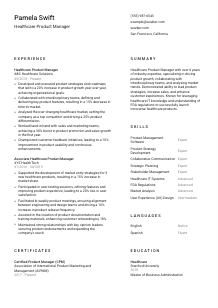
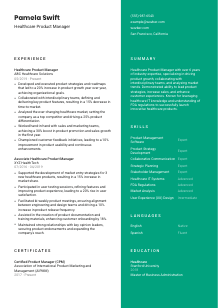
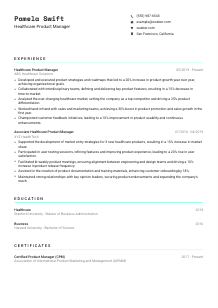
Steering healthcare solutions, but your CV seems off the insurance plan? Recharge your credentials with this Healthcare Product Manager CV example, created with Wozber free CV builder. Learn how to present your medical market insights and strategy savvy in line with employer needs, positioning your career at the forefront of healthcare innovation!
Healthcare product work sits at a demanding intersection. Hiring teams want to see someone who can shape a roadmap, work through clinical and operational realities, and move a product forward without losing sight of compliance, adoption, or business goals. A CV for this field needs to make those decisions visible through product strategy, cross-functional delivery, and results tied to growth, usability, or market position.
Small wording choices change how quickly your background reads as healthcare product management instead of general product work. Using Wozber's free CV builder helps you structure an ATS-compliant CV around the terms that matter here, from roadmaps and customer feedback loops to healthcare IT systems and regulatory context, so the hiring team can quickly see where you've led products in a healthcare environment.
Healthcare product hiring moves quickly past the header, but the basics still need to remove friction. This section should confirm who you are, how to reach you, and whether you meet practical requirements such as location for a role that expects in-person collaboration or regional presence.
Use your full name in a clean, readable format that stands out from the rest of the page. In product roles, clarity matters from the first line. Skip nicknames or decorative styling and make sure your name is the most visible text in the header.
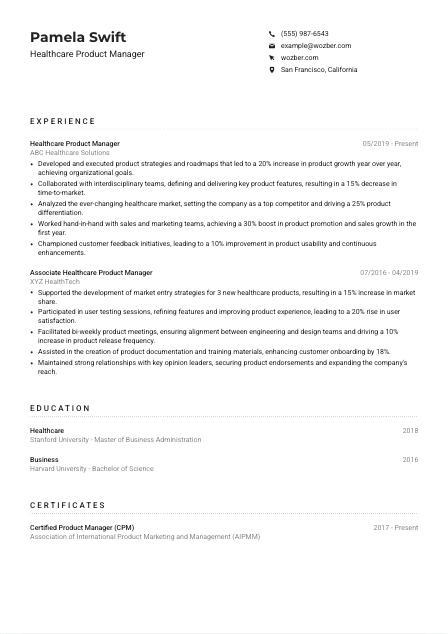
Place "Healthcare Product Manager" directly under your name if that is the role you are pursuing and your experience supports it. Matching the job title helps position you correctly in both ATS screening and human review. The sample CV does this well by using the same title as the opening, which immediately frames the candidate in the right lane.
Add a phone number and professional email address, then double-check them. For a role built on cross-functional coordination with engineering, sales, marketing, and customer stakeholders, being reachable is basic but essential. A simple email format such as firstname.lastname@email.com is usually best.
If the role specifies a city or region, list it clearly. Here, San Francisco, California is part of the stated requirement, so showing that location removes an immediate screening question. Do this when the job asks for it, not as a blanket rule for every application.
A current LinkedIn profile, portfolio, or professional website can reinforce your CV by showing product launches, market-facing work, or thought leadership in digital health. Keep the content aligned with your CV, especially around titles, dates, and major achievements, so your story stays consistent.
Your personal details should answer the practical screening questions in seconds. Once that is handled, the rest of the CV can focus on your product strategy, healthcare knowledge, and delivery record.




This section does the heavy lifting for a Healthcare Product Manager. Hiring teams look for evidence that you have owned roadmap decisions, worked across technical and commercial functions, and improved product performance in a healthcare setting where customer needs, compliance, and market pressures all matter.
Mark the requirements and responsibilities that define the opening, then match them to your own work history. For this role, that includes product strategy, roadmap execution, cross-functional feature delivery, market analysis, customer feedback, healthcare IT familiarity, and FDA-related awareness. Your bullets should mirror those themes where they reflect real experience, so your background reads as directly relevant rather than adjacent.
List your positions from newest to oldest, with company name, title, and dates clearly shown. If you have moved from associate product management into full product ownership, that progression is valuable in itself. The sample CV shows a useful path from Associate Healthcare Product Manager to Healthcare Product Manager, which tells a clear growth story.
Healthcare product management is easier to evaluate when impact is quantified. Use metrics tied to growth, launch speed, adoption, usability, release cadence, market share, or sales support. The example bullets show the right idea with outcomes such as a 20% increase in product growth, a 15% reduction in time-to-market, and a 10% improvement in usability. Those numbers give hiring teams a concrete view of scope and effect.
Focus each bullet on what you drove, who you worked with, and what changed because of your decisions. Strong examples include setting roadmap priorities, coordinating engineering and design on key enhancements, gathering customer feedback to improve workflows, or partnering with sales and marketing on go-to-market plans. That reads much stronger than simply stating you "participated" or "assisted" unless you were genuinely in a supporting role.
Keep the section centered on experience that supports this kind of role. General product work can stay if it shows roadmap ownership, launch execution, or stakeholder management, but healthcare-relevant detail should lead, especially when you have experience with provider workflows, healthtech products, healthcare IT systems, or regulated environments. Every bullet should help explain why you can manage a healthcare product through growth, feedback, and operational complexity.
By the end of your experience section, a hiring manager should be able to point to product outcomes, healthcare context, and cross-functional leadership without guessing. That combination is what makes this CV competitive.
Healthcare Product Manager roles often ask for a degree in business, healthcare, or a related field because the work blends product thinking with industry context. Your education section should make that foundation easy to read and relevant to the opening, especially when the posting lists a degree as a requirement.
List your degree, field of study, school, and graduation date in a simple format. Since this opening asks for a bachelor's degree in Business, Healthcare, or a related field, make sure that information is impossible to miss. Put the degree name and field front and centre.
Use a consistent structure for each entry so reviewers can scan it quickly. Education is usually a verification section, not a storytelling section, so avoid extra detail unless it adds direct value, such as a highly relevant specialization or graduate degree tied to health systems, healthcare management, or product leadership.
If your background spans both sides of the role, make that visible. In the example, a Bachelor of Science in Business paired with an MBA in Healthcare supports the blend of commercial judgment and industry understanding this profession often requires. That combination is useful because it reflects the actual mix of decisions many healthcare product managers handle.
Coursework is most helpful when you are early in your career or when the classes directly support the job, such as health informatics, healthcare operations, regulatory affairs, or product development. If you already have several years of experience, keep coursework selective so the section stays concise.
If you hold a product or healthcare-related certification, mention it in the dedicated certificates section and let your education section stay focused on degrees. Together, these sections can show both formal study and continued specialization, which matters in a field shaped by changing technology, user expectations, and regulation.
This section should confirm that you meet the stated degree requirement and bring relevant academic grounding for healthcare product decisions. Keep it clean, credible, and easy to verify.
Certifications are not always mandatory for Healthcare Product Manager roles, but the right one can reinforce your command of product methods, industry knowledge, or regulated healthcare work. Use this section to show focused professional development, not to list every course you have ever completed.
Include certifications that strengthen your case for healthcare product ownership, product strategy, agile delivery, healthcare compliance awareness, or related specialties. In the sample CV, the Certified Product Manager credential adds weight because it supports the product leadership side of the role, even though the posting does not explicitly require certification.
A short list of relevant credentials is stronger than a long list of loosely related certificates. Choose the ones that connect to roadmap planning, product launch execution, stakeholder management, healthcare systems, or regulated product environments. Relevance matters more than volume.
Name the certifying body and include the date earned or active period where appropriate. This helps reviewers understand both the credibility and recency of the credential. For fields affected by compliance shifts and evolving healthtech practices, current learning carries more weight than stale training.
Healthcare product work changes with reimbursement models, interoperability demands, digital health adoption, and regulatory expectations. If you pursue additional training, choose programs that deepen practical strengths such as healthcare data workflows, clinical user research, SaaS product metrics, or FDA-related product requirements.
The best certifications make your product judgment look sharper and your healthcare context look stronger. If a credential does not support that story, leave it off.
A Healthcare Product Manager needs a mix of product execution, market judgment, stakeholder leadership, and healthcare domain knowledge. Your skills section should capture that mix in language that matches the posting while staying grounded in what you actually use on the job.
Scan the job description for technical, functional, and domain-specific terms, then mirror the ones you genuinely have. Here, that includes product management software, healthcare industry knowledge, healthcare IT systems, FDA regulations, communication, and interpersonal collaboration. This kind of language alignment improves ATS optimisation when it reflects real experience.
List skills that show how you operate across the full product cycle. A Healthcare Product Manager may need roadmap development, market analysis, stakeholder management, product management platforms, customer feedback analysis, and strong communication with engineering, design, sales, and marketing. The sample CV handles this balance well by pairing product strategy and software proficiency with healthcare IT systems and collaborative communication.
Put the skills most central to the target role near the top. If the posting emphasizes healthcare product growth, interdisciplinary delivery, and regulatory understanding, those capabilities should appear before less essential items. This keeps the section aligned with how the role will actually be screened and discussed.
Your skills section should quickly confirm that you can run product work in a healthcare environment, not just manage a generic backlog. Keep the mix practical, specific, and closely tied to the role.
Language skills matter in healthcare product roles because the work depends on clear communication across teams, customers, and sometimes diverse user populations. If a posting names a required language, your CV should show it plainly and use any additional languages to add relevant context rather than filler.
If the role states English fluency, include English with an appropriate proficiency level such as Native or Fluent. This is a direct match to a stated requirement and should be easy for both ATS systems and reviewers to find.
Additional languages can strengthen your profile if they relate to customer research, user communication, regional markets, or cross-border collaboration. In healthcare products, this can be especially useful when products serve diverse patient or provider populations. The sample CV includes Spanish, which can be a meaningful plus depending on the audience and market.
Choose clear labels such as Native, Fluent, Advanced, or Intermediate. Overstating proficiency can become a problem quickly in interviews or stakeholder conversations, especially in roles that rely on nuanced communication and user feedback.
Only emphasize extra languages when they have a plausible connection to the product, customer base, or collaboration environment. If they do, they can support your value in discovery work, feedback collection, onboarding materials, or market expansion. If they do not, keep the section brief.
For a Healthcare Product Manager, language skills can support empathy in user research, smoother coordination with distributed teams, and clearer engagement with varied healthcare stakeholders. Present them as an operational advantage, not a decorative detail.
Meet the stated English requirement first, then use any additional language ability to strengthen the business or user context of your profile.
Your summary should quickly establish the kind of healthcare product manager you are. In a few lines, show your level of experience, the product outcomes you influence, and the healthcare context you understand well enough to work in confidently.
Use the job description to decide what belongs in the opening lines. For this role, that means experience level, healthcare product background, roadmap and growth ownership, cross-functional collaboration, market analysis, and familiarity with healthcare IT and regulatory context. Your summary should pull those threads together in a natural way rather than sounding like a pasted list of keywords.
Start by stating your role identity and years of relevant experience. Something like "Healthcare Product Manager with 6+ years of experience leading digital health products" is direct and useful. The sample summary does this effectively by establishing both tenure and specialization right away.
Follow your opening with specifics that separate you from generalist product candidates. That could be growth-focused roadmap execution, improving usability through customer feedback, or navigating healthcare IT systems and FDA-related constraints. If possible, tie those strengths to outcomes such as adoption gains, launch speed, or product growth.
Aim for about 3 to 5 lines. Every sentence should earn its place by clarifying your product scope, healthcare context, or measurable impact. Avoid broad claims about passion or innovation unless they are backed by results or domain detail.
A hiring manager should finish your summary with a clear picture of your product scope, healthcare fluency, and the results you tend to drive. That sets up the rest of the CV to confirm the claim.
A Healthcare Product Manager CV should make three things easy to see. You can set product direction, work effectively across technical and commercial teams, and deliver results in a healthcare environment shaped by user needs, market pressure, and regulation.
As you revise, keep the language close to the target role and let metrics do as much work as possible. Wozber's free CV builder, ATS-friendly CV templates, and ATS CV scanner can help you tighten phrasing, improve ATS alignment, and organise the content around the requirements that matter most.
When that is done well, your CV gives a clear hiring read on whether you can lead the next healthcare product forward.




