



Use Wozber and land your dream job
Create CV
No registration required
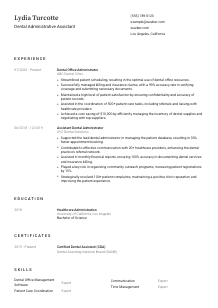
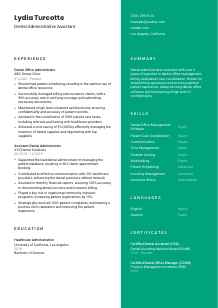
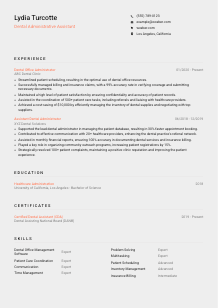
Keeping dental check-ins seamless, but your CV needs a touch-up? Check out this Dental Administrative Assistant CV example, created with Wozber free CV builder. It shows how to align your oral care organisation with job requirements smoothly, paving the way for career smiles as bright as pearly whites!
A Dental Administrative Assistant keeps the clinical day moving. Schedules need to stay full without creating bottlenecks, insurance details need to be correct before claims go out, and patient records need to stay accurate and confidential while the front desk still feels calm and welcoming. Your CV should make that operational reliability visible right away.
Hiring teams often sort quickly between candidates who have general office experience and those who already understand a dental practice workflow. A tailored CV, built in Wozber's free CV builder and refined for ATS optimisation, helps surface the terms, systems, and outcomes that matter here, from scheduling and claims processing to patient communication and record accuracy. That makes it easier to see whether you can step into a busy practice and keep daily operations on track.
Front-office hiring starts with practical details. In a dental practice, that means a clear professional identity, reliable contact information, and any location detail that directly affects availability for the role.
Use your full name at the top in a clean, readable style. Dental office managers move fast between schedules, claims, and patient issues, so your CV header should feel orderly from the first line.
Place "Dental Administrative Assistant" directly under your name when that is the role you are pursuing. Matching the posted title helps both the ATS and the reader connect your background to front-desk coordination, billing support, and patient communication.
List a phone number you answer, a professional email address, and, if relevant, a website or LinkedIn profile that supports your experience in healthcare administration. Accuracy matters here for the same reason it matters in patient records and insurance forms. Small errors create doubt.
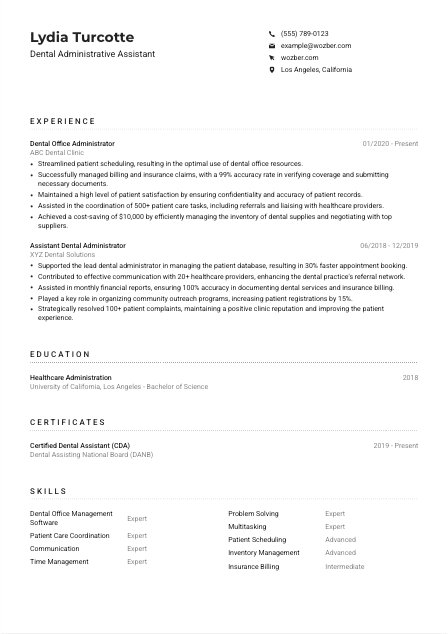
If the employer asks for a local candidate, show your city and state clearly. In the provided example, listing Los Angeles, California directly in the header answers that requirement without taking up extra space elsewhere on the page.
A link is useful when it supports your candidacy with healthcare administration experience, certifications, or a fuller work history. Skip anything casual or generic. For this profession, relevance matters more than digital presence for its own sake.
This section should answer the practical first questions immediately: who you are, what role you do, how to reach you, and whether you meet any location requirement. When those basics are clean, the reader can move straight to your scheduling, billing, and patient coordination experience.




In this field, experience carries the most weight when it shows you can keep appointments, records, claims, and patient communication moving without dropped details. Your bullets should reflect the daily mechanics of a dental office and the results you produced there.
Read the posting for the tasks that define the job, then mirror those responsibilities using your own history. For this role, that includes patient scheduling, reminders, follow-ups, insurance verification, claims submission, records maintenance, referrals, and supply coordination. If you have handled those functions in a dental or medical office, name them directly rather than describing your work in broad administrative terms.
List jobs in reverse chronological order with title, employer, and dates. That straightforward structure works well for ATS parsing and helps the hiring manager quickly trace your progression from support work into broader responsibility, such as moving from assistant administration into full office coordination.
Each bullet should show what you handled and what changed because of your work. The example CV does this well by linking scheduling work to better use of office resources and billing work to a 99% accuracy rate. That kind of phrasing is stronger than simply saying you were responsible for appointments or claims.
Quantify results with measures that fit the job: claim accuracy, patient volume, booking speed, complaint resolution, referral coordination, or supply cost savings. Metrics such as "500+ patient care tasks coordinated" or "$10,000 saved through supply management" give hiring teams a clearer picture of your scope and reliability in a practice setting.
Prioritise experience that supports dental office operations. General office work can stay if it strengthens your case for scheduling, billing, records management, or patient service, but older or unrelated duties should not crowd out the functions most relevant to a dental front desk. Every bullet should help answer whether you can support providers, patients, and office flow from day one.
A hiring manager should be able to scan your experience section and picture you managing the front desk, processing claims accurately, maintaining patient records, and keeping providers' schedules on track. That level of specificity is what moves your CV out of the general admin pile.
Education usually plays a supporting role here, but it still helps frame your understanding of healthcare operations, office systems, and patient-facing work. Present it clearly and keep the focus on relevance.
If the posting does not require a specific degree, list the education that best supports dental administration, healthcare operations, or office management. A degree like Healthcare Administration, as shown in the example, adds context for your billing, coordination, and records experience.
Include degree, field of study, school, and graduation year or date. Clean formatting matters in a role where documentation quality is part of the work, and it keeps the section easy to scan for both recruiters and ATS systems.
If you studied healthcare administration, business administration, medical office support, or a related field, make that visible. Even when experience is the deciding factor, relevant study reinforces that you understand regulated office environments and patient-facing workflows.
Early-career candidates can include selected coursework in topics such as healthcare systems, medical billing, records management, or office administration. If you already have solid dental office experience, those details are usually less important than your actual scheduling and claims work.
Academic honors, leadership roles, or healthcare-related student involvement are worth adding if they support professionalism, organisation, or service orientation. Keep them brief and only include them when they add something the reader cannot already see elsewhere in the CV.
This section should support your candidacy without competing with your work history. When it is relevant and concise, it reinforces that your background fits the administrative side of dental care.
Certifications matter most when they show familiarity with dental settings, office procedures, or regulated patient care environments. If you have them, they can sharpen your profile quickly.
Review the posting for preferred credentials, then place matching or closely related certifications near the top of this section. For this kind of role, credentials such as Certified Dental Assistant or Certified Dental Office Manager directly support your understanding of dental workflows, patient handling, and office operations.
Do not overload this section with unrelated courses or old training. Choose the credentials that strengthen your case for insurance processing, patient coordination, front-desk administration, or dental office management. A short, relevant list reads better than a long mixed one.
Include the year earned and renewal status when applicable. That tells the employer whether the certification is current and whether you maintain professional standards in a healthcare environment where procedures, compliance, and documentation matter.
Dental offices value people who keep up with systems, patient-service expectations, and administrative requirements. If you continue to renew or add relevant credentials, that suggests you stay engaged with the operational side of the profession rather than treating the role as general clerical work.
A well-chosen certification section can quickly separate you from candidates with only generic administrative experience. It tells the reader that you already understand the standards and routines of a dental office.
This section should reflect the tools and capabilities a practice needs every day. Focus on the mix of software fluency, billing knowledge, coordination, and patient communication that keeps the office running smoothly.
Start with the requirements named in the job ad. Here, that includes dental office management software such as Dentrix or Eaglesoft, insurance billing and claims processing, communication, and patient-oriented service. If you have experience with equivalent systems, list them with the exact software names when they match your background.
Your skills section should line up with your work history. If you mention insurance billing, your experience bullets should also show claims work, coverage verification, or payment documentation. If you list patient scheduling, support it with examples of managing calendars, reminders, or booking efficiency.
Prioritise a concise set of skills that reflects how the job is actually performed. For a Dental Administrative Assistant, that often includes scheduling, dental software, records management, patient communication, referral coordination, inventory tracking, time management, and problem solving. The example CV handles this well by balancing software, coordination, and front-office support skills instead of listing generic strengths alone.
This section should leave no doubt that you can manage both the system side and the patient-facing side of the office. When the listed skills match the posting and your experience, the CV reads as practical and credible.
Language ability matters in dental administration because the front desk often handles appointment calls, payment questions, insurance explanations, and patient follow-up. List languages in a way that reflects real workplace use.
If the posting specifically requires strong English communication, list English first and show your actual proficiency level. In a dental office, that covers phone calls, patient forms, claims communication, and coordination with providers or referral partners.
After the primary required language, list additional languages that may help with patient service. In many practices, extra language ability can support smoother intake, clearer explanations, and a better front-desk experience for patients and families.
Choose straightforward terms such as Native, Fluent, Intermediate, or Basic. That gives a realistic picture of what you can handle in patient interaction, administrative communication, and day-to-day office use.
In some markets, bilingual ability is a real operational advantage. The example CV lists Spanish alongside English, which could be useful in a patient-facing Los Angeles practice, but treat that as a tailoring choice based on the employer and community rather than a universal requirement.
Extra languages are most valuable when they improve communication, reduce misunderstandings, and help patients feel comfortable with scheduling, billing, or treatment-related coordination. Present them as a practical service asset, not as a decorative detail.
For this role, language skills matter when they improve communication at the front desk and support a smoother patient experience. Keep the section accurate and tied to actual office interactions.
Your summary should quickly establish that you understand the pace and priorities of a dental office. In a few lines, show your level of experience, your strongest administrative functions, and the kind of results you have delivered.
Start with your title and years of relevant experience in a dental or medical office setting. That immediately answers one of the first screening questions for this role and helps distinguish you from candidates with only general administrative experience.
Mention the work you are strongest in, such as patient scheduling, insurance billing, claims processing, records accuracy, or patient care coordination. Choose two or three functions that match the target role most closely rather than trying to summarise everything at once.
If software proficiency is a stated requirement, mention it when it is a real part of your background. If you have measurable results, work one in naturally. The example summary does this by pairing dental office management expertise with operational improvement and confidentiality, which fits the role well without becoming a list of keywords.
Aim for a short paragraph that sounds grounded in practice operations. Avoid vague phrases about being hardworking or detail-oriented unless they are tied to something concrete, such as claim accuracy, patient service, or front-desk efficiency.
A hiring manager should finish your summary with a clear sense of your setting, your strengths, and your likely contribution to the practice. If those first lines already point to scheduling control, billing accuracy, and dependable patient communication, the rest of the CV has a strong foundation.
A well-tailored Dental Administrative Assistant CV shows more than general office support. It should make your role in scheduling flow, insurance accuracy, patient communication, record management, and supply coordination easy to understand within a few seconds of scanning.
Use Wozber's free CV builder to organise that experience into an ATS-friendly CV format, then refine it with the ATS CV scanner and AI-powered tailoring tools so the language, software terms, and results match the role you want. The finished CV should make it easy for a dental practice to picture you keeping the front office accurate, responsive, and under control.