



Use Wozber and land your dream job
Create CV
No registration required
Juggling office duties, but your CV feels like scattered memos? Organise your career path with this HR Administrative Assistant CV example, created quickly with Wozber free CV builder. Learn how to highlight your organizational knack to match job requirements, presenting a polished profile that's right in step with HR protocols!
HR Administrative Assistants keep the people side of a business running on clean records, timely coordination, and reliable follow-through. Hiring teams look for candidates who can handle employee files, interview scheduling, onboarding logistics, and everyday HR requests without dropping details or creating compliance risk. Your CV needs to show that kind of operational dependability clearly.
When the CV is tailored well, it quickly separates general administrative experience from actual HR support work such as record maintenance, recruiting coordination, and policy-related documentation. Wozber's free CV builder helps you align your wording with the job post and build an ATS-compliant CV that surfaces the HR tasks, tools, and outcomes employers need to see first. That makes it easier for the hiring team to recognize you as someone who can step into the workflow quickly.
This section should answer the practical questions an HR team checks first: who you are, how to reach you, and whether you meet any location or communication requirements stated in the posting. Keep it clean, professional, and aligned with the role's logistics.
Place your full name at the top in a clear, readable format. For an HR Administrative Assistant role, professionalism matters immediately, and a cluttered header can make the document feel less organised than the work itself requires.
Add "HR Administrative Assistant" directly under your name if that is the role you are applying for. Matching the posted title helps frame your background around HR support, employee documentation, onboarding coordination, and recruitment administration from the first line.
List a working phone number and a professional email address, then verify both carefully. HR teams often move quickly when scheduling interviews, and one typo can mean missing a call about an interview slot or next-round paperwork.
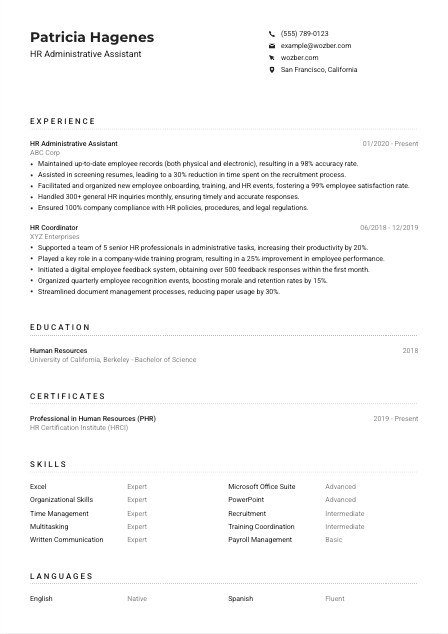
If the employer asks candidates to be based in San Francisco or open to relocation, reflect that in your location line when accurate. In the example CV, listing San Francisco, California immediately removes a practical question and keeps the focus on HR experience rather than logistics.
Add a LinkedIn profile or professional website only if it supports your application with consistent career information. For HR support roles, that usually means a polished profile with matching job titles, dates, and HR-focused responsibilities rather than extra links that add little value.
This section should confirm that you are reachable, professionally presented, and aligned with the job's basic requirements before the reader moves into your HR experience.




For this role, experience is where you prove you can support day-to-day HR operations accurately and at pace. Focus your bullets on the work that keeps an HR department moving: records, recruiting coordination, onboarding, employee support, training logistics, and policy compliance.
Start by identifying the recurring work named in the posting. Here, that includes maintaining employee records, helping with recruitment, coordinating onboarding and training, responding to HR inquiries, and supporting compliance. Those responsibilities should shape which achievements you highlight first and how you describe them.
List each employer, job title, and employment dates in a consistent format. Then use bullet points that emphasize HR administration rather than generic office support. If you have held titles such as HR Coordinator or HR Assistant, frame the bullets around the HR workflows you handled, not just general administrative help.
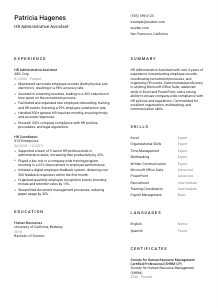
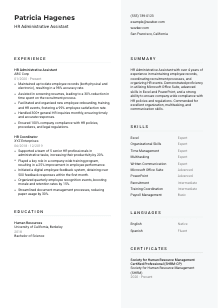
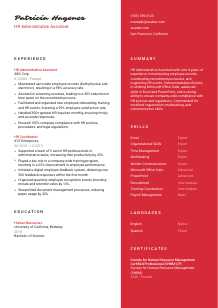
A hiring team already knows an HR Administrative Assistant handles files and schedules. What matters is how well you handled them. The example CV does this well with details such as maintaining employee records at a 98% accuracy rate and reducing recruitment processing time by 30%. That kind of phrasing shows both responsibility and result.
Numbers work especially well in this section when they reflect actual HR volume or performance. Good examples include inquiry volume, onboarding completion rates, document accuracy, training participation, time saved in scheduling, or compliance results. "Handled 300+ HR inquiries monthly" and "ensured 100% compliance" are effective because they show workload and control in terms HR leaders understand.
Every bullet should support your value for HR administration, employee support, or compliance-heavy coordination. Keep the achievements that connect to records management, candidate screening, training support, event coordination, and policy execution. If a past role included unrelated office duties, summarise them briefly and give the space to the HR work that best matches the opening.
Your experience section should leave no doubt that you can handle the administrative backbone of HR, from file accuracy and interview coordination to onboarding support and day-to-day employee communication.
Education matters here because the posting explicitly asks for a bachelor's degree in Human Resources or a related field. Present your academic background clearly so the recruiter can confirm that requirement in seconds.
If you hold a bachelor's degree in Human Resources or a closely related field, make that easy to see. When a job description states the degree requirement directly, there is no reason to bury it beneath less relevant academic details.
Include your degree, field of study, school name, and graduation year or date. HR teams reviewing many applications appreciate simple structure because it speeds up screening and keeps the focus on whether you meet the baseline qualifications.
If your degree is directly tied to HR, spell that out clearly. The sample CV does this effectively with "Bachelor of Science" in "Human Resources," which mirrors the requirement without forcing extra explanation.
Most experienced candidates do not need to list classes, but it can help if you are early in your career or changing fields. Courses in employment law, compensation, organizational behaviour, HR systems, or business communication can reinforce your preparation for records, onboarding, and compliance-related tasks.
Honors, scholarships, leadership roles, or HR-related student involvement can strengthen this section when they add context. Keep them if they support your professional direction and level of responsibility, not simply to fill space.
For this role, your education section should confirm the degree requirement quickly and support the impression that you have a solid foundation in HR practices and workplace administration.
Certifications matter in HR because they signal current knowledge of employment practices, policy frameworks, and professional standards. When the posting mentions PHR, SHRM-CP, or willingness to obtain certification, this section becomes more than a bonus.
Lead with certifications that the employer specifically referenced, such as PHR or SHRM-CP. If you do not have one yet, you can still reflect active pursuit when that is truthful and relevant to the application.
Choose certifications that support HR administration, compliance awareness, people operations, or employment practices. For this kind of role, a short focused list is stronger than unrelated credentials that do not connect to recruiting, onboarding, or employee records.
Show when the certification was earned and whether it is active. That matters in HR because certifications often require continuing education, and employers want to know your knowledge is current rather than outdated.
HR work changes with policy updates, legal requirements, and workplace practices. A certification section can signal that you actively maintain your professional knowledge. In the example, listing both PHR and SHRM-CP immediately reinforces commitment to the field and aligns well with the employer's stated preference.
Relevant credentials support your CV by showing that your administrative experience sits on top of current HR knowledge, not just clerical exposure.
This section should read like the toolkit you use to support an HR department effectively. Balance software proficiency with the coordination and communication skills that keep recruiting, recordkeeping, onboarding, and employee support running smoothly.
Pull the core skills directly from the job description and include the ones you genuinely have. For this opening, that means Microsoft Office Suite, advanced Excel, PowerPoint, organisation, multitasking, time management, and professional communication in English. Using the employer's language helps both ATS matching and human review.
Show a mix of operational and software skills. Pair tools like Excel, PowerPoint, and Microsoft Office Suite with function-specific strengths such as recruitment coordination, training support, document management, and handling employee inquiries. The example CV works well because it combines office software with HR-relevant capabilities instead of listing only generic soft skills.
Trim away skills that do not support the role's daily work. A shorter list built around HR administration, communication, scheduling, reporting, and compliance support is more convincing than a long catalogue of loosely related abilities. If you use ratings, make sure they are realistic and consistent with your experience bullets.
The best skills section supports the rest of the CV. When the tools, coordination strengths, and HR tasks here match your experience, the application reads as credible and ready for the role.
Language proficiency matters in HR because the role involves employee communication, scheduling, onboarding support, and responding to routine questions with clarity and professionalism. Keep this section straightforward and honest.
If the posting requires professional communication in English, list English prominently with an accurate proficiency level. That requirement should be easy to confirm without the reviewer searching through the CV.
Lead with the languages most useful in the role. English should come first here because it is explicitly required. If you also speak another language used in your workforce or community, that can add value in employee-facing HR support.
Extra languages can be a plus in organizations with diverse employee populations, multilingual onboarding materials, or frequent cross-cultural communication. In the example, Spanish adds practical value because HR often serves employees with different communication preferences.
Use clear labels such as Native, Fluent, Advanced, or Conversational, and choose the level you can actually use in a workplace setting. HR conversations often involve policy explanations and sensitive matters, so accuracy here matters.
Some HR administrative jobs are entirely local, while others support broader employee groups or multi-site teams. Tailor this section accordingly. Include extra languages when they strengthen your case for employee support, but do not overstate their relevance if the role does not call for them.
For an HR Administrative Assistant, language skills should reinforce your ability to communicate clearly with employees, candidates, and internal stakeholders in everyday HR interactions.
Your summary should give a fast, credible picture of the HR work you already know how to handle. Focus on years of experience, the kind of HR administration you support, key tools, and one or two outcomes that reflect accuracy, coordination, or compliance.
Start with your professional identity and level of experience in HR administration. Keep the focus on the work this job needs, such as employee records, recruiting support, onboarding coordination, training logistics, and HR inquiries.
Your first line should quickly establish who you are and how long you have worked in related HR support roles. The sample summary does this effectively by naming the title and noting more than 4 years of experience, which immediately sets the level.
Choose details that reflect the posting's priorities. Advanced Excel and PowerPoint skills, record accuracy, compliance support, or recruitment coordination are all stronger than broad statements about being hardworking. Pull one or two of these directly from your experience so the summary feels grounded.
Aim for a short paragraph that can be read in seconds. Three to five lines is usually enough. You want the reader to leave with a clear picture of your HR administrative scope, not a long string of generic claims.
A well-written summary should frame the rest of the CV around the work that matters most here: accurate HR administration, organised support for recruiting and onboarding, and dependable handling of employee-facing tasks.
A tailored HR Administrative Assistant CV should show that you can keep records accurate, support recruiting workflows, coordinate onboarding, and handle routine HR requests with professionalism. When each section reflects those day-to-day responsibilities clearly, the hiring team can quickly see how you would contribute.
Use Wozber to tighten the wording, improve ATS optimisation, and present your experience in an ATS-friendly CV format that matches the role's priorities. The finished CV should make your HR coordination, compliance awareness, and administrative reliability easy to judge.