



Use Wozber and land your dream job
Create CV
No registration required
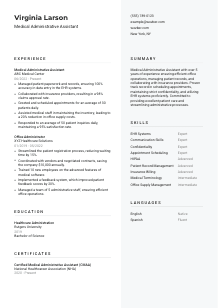
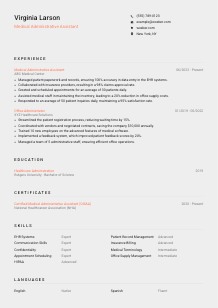
Juggling patient charts but stumped by your CV? Check out this Medical Administrative Assistant CV example, created with Wozber free CV builder. Learn how to blend your health office expertise with job specifics, keeping your career health as robust as patient files!
Front-desk medical administration runs on accuracy under pressure. A Medical Administrative Assistant is often the first person patients meet and the person behind the records, scheduling flow, insurance coordination, and daily office follow-through that keep a practice moving. Your CV needs to show that you can handle patient interaction and administrative detail at the same time, without errors that disrupt care, billing, or compliance.
Screening for this role usually narrows quickly around medical-office experience, EHR use, insurance workflow, and HIPAA-aware communication. Wozber's free CV builder helps you shape that experience into an ATS-compliant CV by aligning your wording with the posting and organising it in a format that makes your patient-facing and back-office work easy to recognize.
Hiring teams for medical office support roles often make early decisions from the top of the page. If your contact details are incomplete, unprofessional, or miss a stated requirement such as location, you risk losing attention before your experience in scheduling, records, or billing is even reviewed.
Use your full name as the clearest text in the header. Keep it simple and professional so the reader can immediately connect your application to the role. In healthcare administration, clean presentation matters because the work itself depends on organised records, accurate entries, and clear communication.
Place "Medical Administrative Assistant" directly under your name when that is the role you are applying for. This helps frame your experience around patient intake, EHR documentation, appointment coordination, and insurance support from the first glance instead of leaving the employer to guess where you fit.
List a phone number you answer reliably and a professional email address, ideally based on your name. Medical offices move quickly when filling support roles, especially when they need coverage for front-desk operations, patient calls, or referral coordination, so easy contact matters.
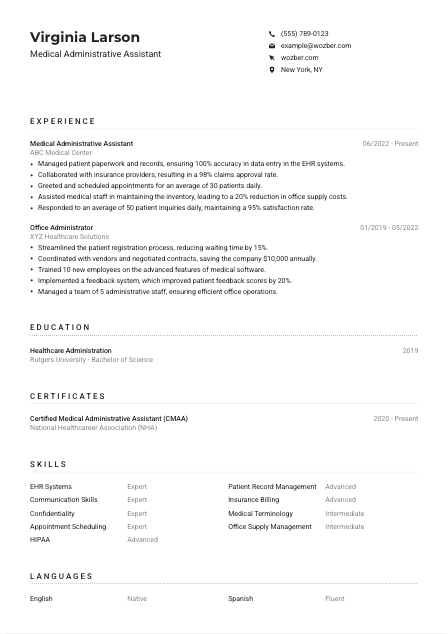
If a position specifies a city or on-site requirement, include that clearly. Here, New York, NY belongs in the header because it answers a stated requirement right away. Use location this way only when it supports the application, not as filler.
A LinkedIn profile or professional website can help if it is current and consistent with your CV. For this profession, that usually means matching job titles, dates, and healthcare administration experience rather than trying to build an elaborate online brand.
Your header should remove basic doubts immediately. The employer should be able to see who you are, the role you are pursuing, how to reach you, and whether you meet practical requirements such as location before they move on to your medical office experience.




For Medical Administrative Assistant hiring, experience carries the most weight when it shows how you handled the daily mechanics of a practice. Patient volume, record accuracy, claims coordination, phone coverage, referrals, and front-desk efficiency all give employers a clearer read than generic office language ever will.
Mark the responsibilities and requirements that shape the actual day-to-day work. In this case, that includes greeting patients, scheduling appointments, managing paperwork and records, coordinating with insurance providers, handling billing support, responding to inquiries, and protecting confidentiality. Those points should directly influence the wording of your bullets.
Start with your most recent position and include your title, employer, and dates. Reverse chronological order works especially well in medical administration because employers want to see your latest exposure to EHR systems, patient communication, office procedures, and healthcare-specific workflows.
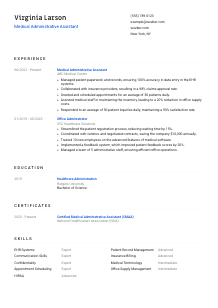
Do not stop at describing duties. Show what you handled and how well you handled it. A bullet like "Managed patient paperwork and records, ensuring 100% accuracy in data entry in the EHR systems" works because it ties a core responsibility to a measurable standard. The sample CV does this well across records, scheduling, inquiries, and insurance coordination.
Metrics make administrative work easier to evaluate. Include figures tied to patient flow, claims approval, response volume, waiting time, scheduling load, supply savings, or satisfaction scores when you have them. The example's 98% claims approval rate and average of 30 patients scheduled daily are strong because they sound native to the work rather than forced.
Prioritise bullets that show medical-office relevance over general administrative activity. EHR data entry, insurance follow-up, HIPAA-conscious record handling, patient registration, referral coordination, and phone triage tell a stronger story than broad statements about being organised or helping the team. If a previous role was outside a clinic, pull forward the parts that still connect to regulated office support and service accuracy.
Your experience section should show that you can keep a medical office running smoothly while handling patient-facing communication and sensitive records with care. When your bullets reflect actual workflow and measurable results, the role becomes much easier to picture you in.
Education usually plays a supporting role in Medical Administrative Assistant hiring, but it still helps shape your profile. A degree or coursework connected to healthcare administration, medical office systems, business support, or patient services can strengthen the CV, especially when paired with hands-on clinic experience.
List the education that best supports your administrative and healthcare background. Even when a posting focuses more on experience than academics, a degree in Healthcare Administration or a related area adds useful context for records management, medical terminology exposure, and healthcare office operations.
Include the institution, degree, field of study, and graduation year or date. Hiring teams reviewing many applications need to find qualifications quickly, and a straightforward structure prevents this section from distracting from your experience.
If your field of study connects to the role, name it clearly instead of leaving only the degree title. In the example, a Bachelor of Science in Healthcare Administration helps reinforce familiarity with the healthcare setting and complements the candidate's medical office record.
Do not overload this section with every class you took. Include targeted details only if they support the role, such as coursework in medical terminology, health information management, billing systems, or patient administration. If you hold a CMAA, place it in the certification section rather than trying to fold it into education.
Honors, leadership, or relevant extracurricular work can help if you are earlier in your career or changing into healthcare administration. Keep the focus on items that suggest reliability, service orientation, and organised execution rather than unrelated campus activities.
This section should reinforce your background, not compete with your experience. When the degree, field, and any relevant training clearly support medical office work, it adds useful depth without slowing the reader down.
Certifications matter most when they support the actual workflow of the job. For Medical Administrative Assistant roles, that usually means credentials tied to medical office procedures, patient records, billing basics, compliance awareness, or recognized administrative standards in healthcare settings.
Check whether the employer names a certification directly. Here, Certified Medical Administrative Assistant, or CMAA, is listed as a plus, so it deserves clear placement if you have it. That immediately tells the employer you bring training relevant to front-desk procedures, documentation, and healthcare office support.
List certificates that actually help for this type of work. One healthcare-specific credential carries more weight than a long list of unrelated courses. Prioritise certifications connected to medical administration, HIPAA, billing, records, or patient service workflow.
Add the issue date and, if applicable, the active period. This is especially useful for credentials that are current or renewed. In the sample CV, showing the CMAA date range helps confirm that the certification is active and recent enough to matter.
Medical administration changes with software updates, payer processes, compliance expectations, and office systems. Continued training in EHR platforms, insurance procedures, or privacy practices can make your CV stronger over time, especially if you are moving toward more responsibility.
A relevant certificate should support the story already told by your experience and skills. For this profession, the best ones show that you understand how a medical office runs and can step into regulated administrative work with less ramp-up time.
The skills section works best when it mirrors how the job is actually done. For Medical Administrative Assistant roles, employers are looking for a mix of software fluency, patient-facing communication, record accuracy, insurance coordination, and confidentiality practices rather than a generic office skills list.
Read the description closely and note both stated and implied requirements. In this role, that includes EHR proficiency, medical software use, medical terminology, insurance processes, communication with patients and staff, and HIPAA-conscious handling of records. These are the terms that should shape your list.
Only include skills that show up elsewhere in the CV. If you list EHR systems, insurance billing, appointment scheduling, or patient record management, your experience bullets should back them up with real workflow or results. The sample CV connects these skills to record accuracy, claims approval, and patient volume, which makes the section more credible.
Resist the urge to include every tool or trait you have. Prioritise the skills a medical office needs to trust you with patient intake, scheduling, referrals, claims support, and confidential records. A shorter list of well-matched capabilities is more effective than a broad inventory of general admin terms.
When this section is tailored well, the employer can quickly see that you understand the systems, terminology, and patient-service demands behind the title. That is far more useful than a generic summary of office strengths.
Language ability can add real value in healthcare support roles because communication affects scheduling accuracy, patient comfort, intake clarity, and follow-up. For a Medical Administrative Assistant, language skills matter most when they improve day-to-day interaction with patients, caregivers, and staff.
If the posting requires English, list it clearly and use an honest proficiency level. Since this role specifically requires English, it should appear first so the employer can confirm that you can manage calls, patient questions, paperwork, and coordination without ambiguity.
Include other languages that could help in patient-facing settings, especially in diverse communities or busy outpatient practices. A second language can be useful for appointment scheduling, basic intake support, and helping patients feel understood, even when it is not a formal requirement.
Only list languages you could use in a professional setting at the level stated. In this field, overstating fluency can create real communication problems with patients, forms, or instructions, so precision matters.
Terms like "Native," "Fluent," "Intermediate," and "Basic" are easy to understand and scan quickly. They also set realistic expectations for how you can support the office in person, on the phone, or through written communication.
Not every Medical Administrative Assistant job will place the same value on multilingual ability. If the practice serves a broad local community, a second language may be a real advantage. In the sample CV, Spanish adds helpful context because it complements a patient-facing administrative profile.
This section is most effective when it supports the real communication demands of the job. Lead with required English proficiency, then add other languages that would genuinely help you serve patients and support office flow.
Your summary should quickly establish what kind of medical administrative support you provide and where you create value. Focus on the parts of your background that matter most in this profession: patient interaction, records accuracy, scheduling, insurance coordination, software fluency, and dependable handling of confidential information.
Before writing, note the few priorities that show up repeatedly. Here, the employer wants someone with medical office experience, EHR proficiency, insurance process knowledge, strong communication, and careful confidentiality practices. Those themes should guide the summary rather than a generic statement about being hardworking.
Start by naming yourself as a Medical Administrative Assistant or healthcare administrative professional and include your years of relevant experience. That gives immediate context and helps the employer place you in relation to the role's requirement for at least 2 years in a medical office or similar setting.
Choose two to four qualifications that map directly to the position. EHR systems, patient scheduling, insurance coordination, medical terminology, and HIPAA-conscious record handling are all stronger summary material than broad claims about organisation. The sample summary works because it stays close to the actual workflow of the role.
Aim for a compact paragraph of three to five lines. Include your experience level, your key medical-office strengths, and one clear indication of results or reliability. A concise summary is easier to scan and gives the rest of the CV a clear professional frame.
By the end of these lines, the reader should already understand your level of medical administrative experience, the systems and workflows you know, and why you can be trusted with patient-facing coordination and confidential records.
A tailored Medical Administrative Assistant CV should make four things easy to see: your medical office experience, your comfort with EHR and insurance workflows, your patient-facing communication, and your ability to handle records with accuracy and confidentiality. When those points are clear across the page, the application reads as grounded and job-ready.
Use Wozber's free CV builder, ATS-friendly CV templates, and ATS CV scanner to sharpen that alignment, surface missing requirements, and present your background in an ATS-friendly CV format. The final result should make it easy for a hiring team to picture you keeping the front desk, patient flow, and administrative operations on track from day one.